North Texas will see wind chills of -15 this weekend. Can that cause frostbite?

Wind chills over the weekend in North Texas could reach as low as -15 degrees, which would be “life-threatening” for people and animals, the National Weather Service Fort Worth said.
A strong Arctic cold front will arrive on Friday, Jan. 23, bringing chances for wintry mix over the afternoon and evening hours. Temperatures are expected to be below freezing from late Friday to mid-Tuesday, Jan. 27.
The coldest wind chills will be Saturday night/Sunday morning, which could result in hypothermia if precautions are not taken, according to the NWS Fort Worth.
What exactly are wind chills? Can they cause hypothermia or frostbite? How is wind chill calculated? Here’s what to know.
What does wind chill mean?
Wind chill temperatures are how cold people and animals feel when outside.
It’s based on the rate of heat loss from exposed skin caused by wind and cold, according to the NWS. Essentially, as wind increases, it draws heat from the body and drives down skin temperatures and internal body temperatures.
Those factors are why wind chill only applies to people and animals and not inanimate objects.
The only impact wind chill has on something like cars or pipes is that it cools the object more quickly to the current air temperatures, according to the NWS. An inanimate object will not cool below the actual air temperature.
In this NWS example, if the temperatures outside is -5 degrees and the wind chill is -31, the inanimate object will not drop lower than -5 degrees.
Can wind chill cause frostbite or hypothermia?
Wind chill can help accelerate both.
Frostbite occurs when frigid air makes contact to exposed skin, which leads nerves and blood vessels just below the top layer of skin to freeze. The injury can lead to loss of feeling and color to the areas it affects such as ears, nose, chin, fingers and toes, according to the Centers for Disease Control and Prevention.
Hypothermia happens when body temperature drops below 95 degrees. Symptoms are fatigue, confusion, disorientation, excessive shivering and loss of coordination. In the later stages, skin will turn blue, pupils will dilate, and pulse and breathing slow.
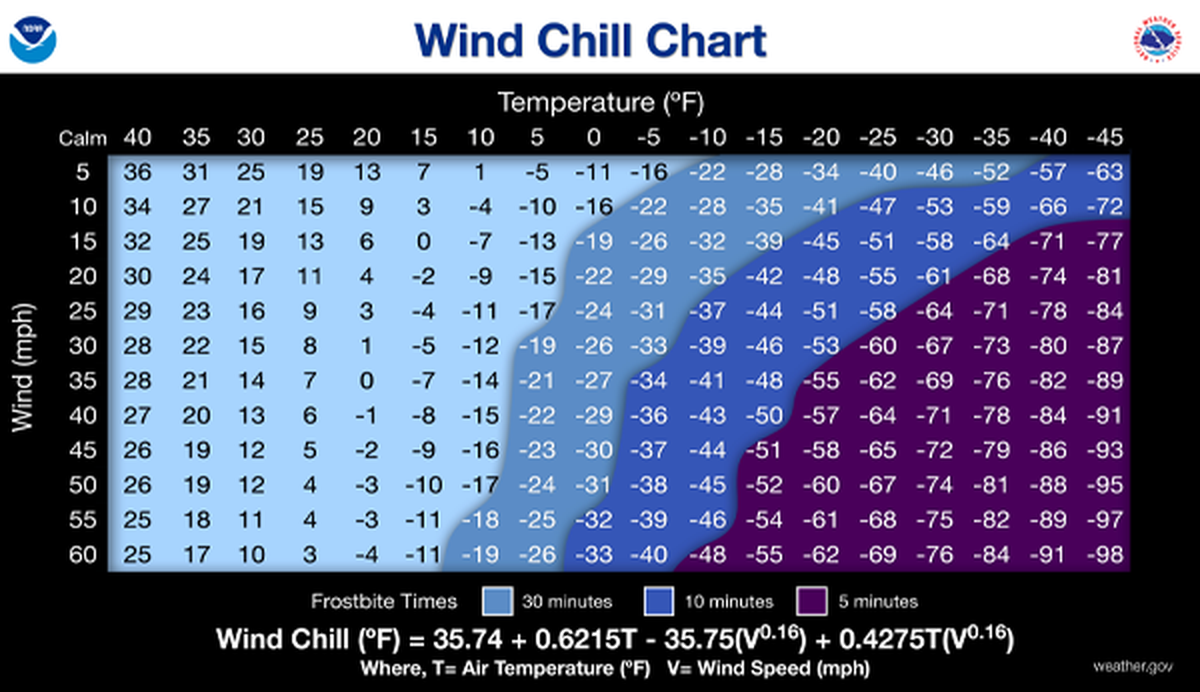
The NWS has a wind chill chart that represents when frostbite can occur by incorporating air temperature and wind speeds.
For example, a temperature of zero degrees and 15 mph wind speed will produce a -19 degree wind chill, which can cause frostbite in 30 minutes. See the full chart below to see how long it would take to develop frostbite.
How is wind chill calculated?
The NWS calculates wind chill temperatures with the following formula: Wind chill (ºF) = 35.74 + 0.6215T - 35.75(V^0.16) + 0.4275T(V^0.16).
For those looking for an easier way to calculate wind chill, the NWS has a free online calculator. By entering in the temperatures and wind speed, the calculator will convert the data to wind chill temperatures.
The calculator only works for temperatures at or below 50 degrees and wind speeds above 3 mph, according to the NWS.
This story was originally published January 21, 2026 at 3:37 PM.