North Texans head to Austin as congressional redistricting push continues
Tyler McVety of Euless didn’t get a chance to address lawmakers in Austin before heading back home to North Texas Friday night around 8 p.m., but had a message ready.
The words were inspired by a state office building inscribed with passage from the first Texas constitution. The building reads: “All political power is inherent in the people and all free governments are founded on their authority and instituted for their benefit.”
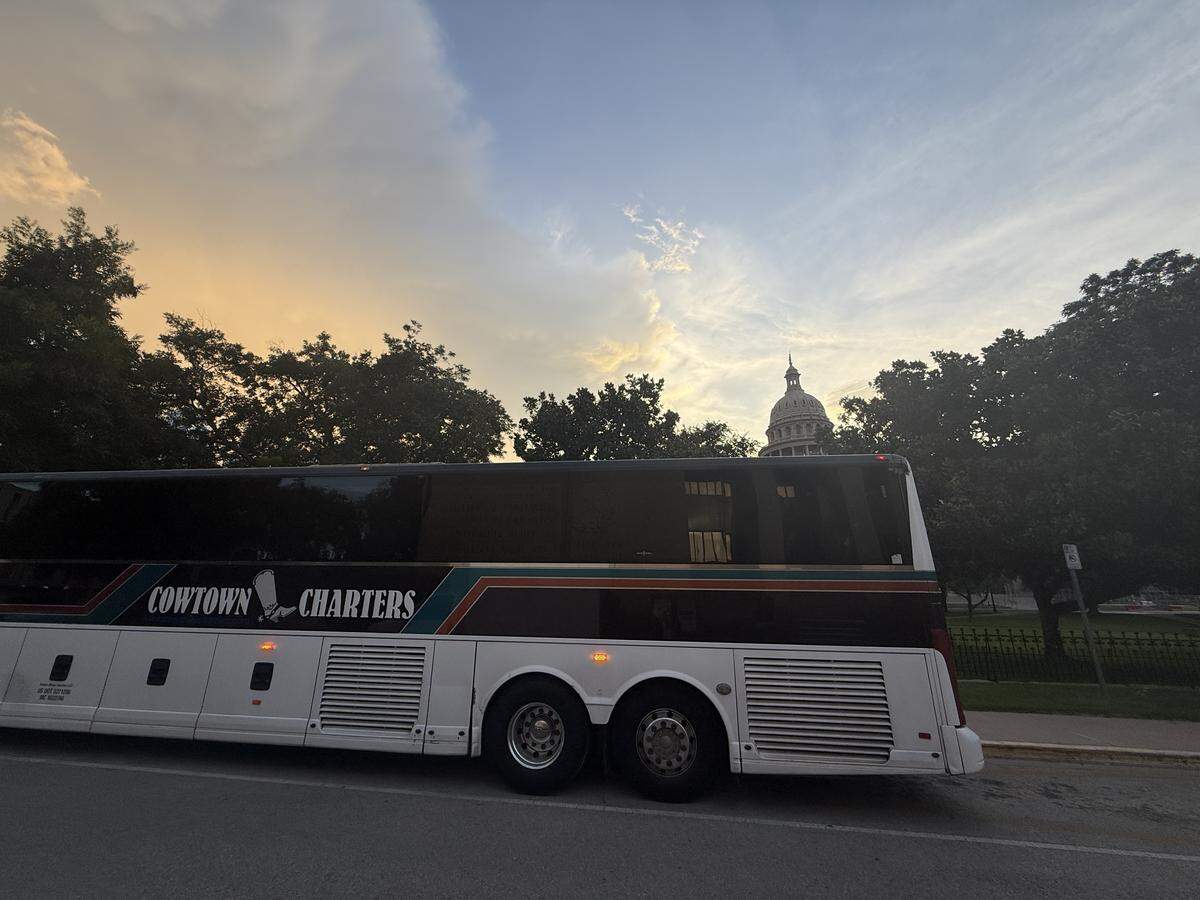
McVety, arriving at the Capitol on a charter bus from Arlington for a House committee hearing on mid-decade congressional redistricting, was struck by the words.
“We saw it just as we came out of the bus, so I actually ended up rewriting my entire speech basically because of that,” said McVety, who was among the North Texans in Austin on Friday, Aug. 1, prepared to share their thoughts on a proposed congressional map.
The meeting, which lasted past 1 a.m. Saturday will be the only House-led public hearing on the redrawn congressional boundaries released on June 30. The committee voted 12-6 to advance the map to the full House in a Saturday morning vote.
The map, filed by Rep. Todd Hunter, a Corpus Christi Republican, is designed to position Republicans to pick up five congressional seats sought by President Donald Trump.
“We’re Texas, and we don’t bend to the will of anybody else, and Trump comes along and he says, ‘Give me five more seats,’ and we say, ‘You’ve got it boss,’ and we work to give him five more seats, and we end up with this racially gerrymandered map,” McVety said.
The hearing drew people from across the state, including members of congress such as Rep. Marc Veasey, a Fort Worth Democrat, and Rep. Jasmine Crockett, a Dallas Democrat. Some said they support the redistricting push, but most opposed the effort.
Veasey and Crockett testified that the map at the center of the hearing would disenfranchise Texans.
“The only way that you get here is by making sure that you trample upon the rights and the liberties and the voices of minorities,” said Crockett, whose district includes part of Tarrant County.
The mid-decade redistricting — which is unusual but not unheard of in Texas — has moved fast, as lawmakers meet for up to 30 days on redistricting and other issues such as flood relief and THC laws placed on a special session agenda called by Gov. Greg Abbott. The session began July 21.
Lawmakers were in Austin on July 24, Houston on July 26 and Arlington on July 28, taking general redistricting testimony, as specific maps had not been proposed at that time.
The proposal could be on the House floor by early next week for debate, said committee chair, Rep. Cody Vasut, an Angleton Republican.
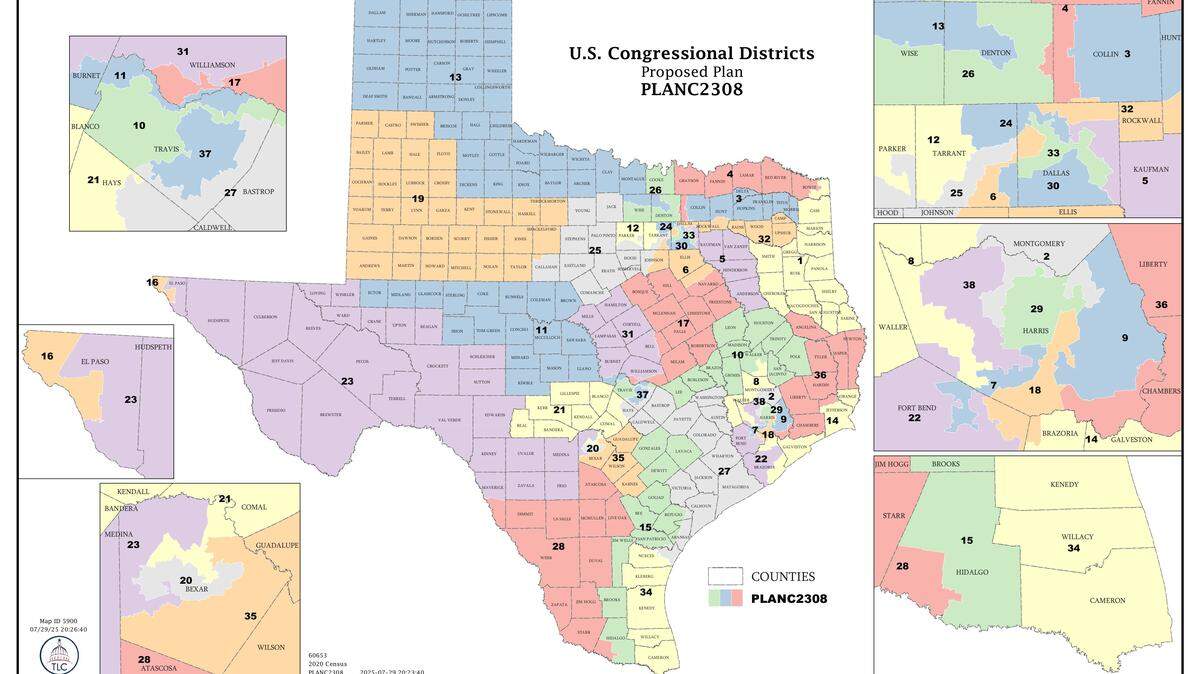
Proposed congressional map laid out for lawmakers, public
A Department of Justice letter highlighting four congressional districts preceded the special session. In it, the federal department said three Houston-area congressional districts and Congressional District 33 in North Texas are “unconstitutional ‘coalition districts.’”
Texas Attorney General Ken Paxton in a response letter to the DOJ argued the congressional districts in question were not drawn in a way that’s race-based. But Paxton said he does support a special session on redistricting, citing “recent changes to the legal and political landscape.”
Hunter outlined the changes to the congressional districts as he laid out the bill at the hearing’s start, not shying away from the fact that it was drawn with partisanship in mind, which he said is lawful.
Thirty-seven of Texas’ 38 congressional districts are changed to some degree, but the primary changes are focused on five districts for partisan purposes, Hunter said: CD-9, CD-28, CD-32, CD-34 and CD-35.
“Each of these newly drawn districts now trend Republican,” Hunter said, noting that political leanings do not guarantee political success, but allows Republicans the opportunity to compete.
The proposed plan has eight congressional districts where Hispanic residents make up the majority of citizens of voting age, compared to seven currently. There are two districts where Black residents make up the majority of citizens of voting age, whereas there are none currently, he said.
The map proposes 24 districts where white residents make up the majority of eligible voters, up from 22 currently, according to an analysis by The Texas Tribune.
“Whether you agree or disagree with the plan, I want you to know how it is based,” Hunter said. “I think it’s a good plan for Texas, and I urge its adoption.”
Tarrant County congressional members on redistricting
Congressional District 33, held by Veasey, currently spans portions of Tarrant and Dallas counties, but would fall entirely within Dallas County if the proposed map is adopted.
What was the Tarrant County portion of the district would be largely divided between Congressional District 12, represented by Fort Worth Republican Rep. Craig Goldman, and Congressional District 25, represented by Willow Park Republican Roger Williams.
Congressional District 33 was drawn by a court to ensure “communities of colors — Black and brown Texans — could finally have a voice in Congress,” Veasey told the panel of lawmakers. Trump and Republicans want to “erase” the district because it empowers people they’d rather ignore, Veasey said.
“For the Black communities and brown communities in Fort Worth, their representation and their ability to have influence in elections are gone,” Veasey said. “It’s done.”
The map pulls Congressional District 30 further into west Tarrant County and removes Dallas Lovefield Airport and downtown Dallas from the district, Crockett said.
Veasey and Crockett would no longer live within the districts they currently represent, though district residency isn’t a requirement to run for Congress. Asked about his political future in an interview, Veasey said his main focus is fighting the proposed congressional map.
.JPG "IMG_3617 (1).JPG")
Goldman and Williams declined to comment. A spokesperson for Rep. Jake Ellzey, a Waxahachie Republican, also did not return an interview request emailed on Friday.
Rep. Beth Van Duyne in a Wednesday interview with the Star-Telegram said she hadn’t yet looked at the particulars, but understands that her district’s new lines are similar to the current ones. Van Duyne said she’d run for whatever district she’s drawn into and is comfortable with the changes to her district in the proposed map.
North Texans are looking for the same things, she said.
“At the end of the day, they’re going to look at how the economy is affecting them,” Van Duyne said. “Whether or not they’ve got money in their wallets. They’re looking at wages, and they’re looking at the cost of living. And I think that as long as that’s what our focus is on, I think the midterm should be positive for Republicans.”
North Texans testify in Austin
Despite a 2:30 a.m. wakeup and 5:15 a.m. departure time ahead of what was sure to be a long day, the trip was important for Emeri Callaway, with the Tarrant County Young Democrats.
Callaway and McVety, who traveled to Austin from Euless, were among those on a bus sponsored by Veasey offering a ride to the committee hearing.
“For me, this is too important of a moment to stay silent and not do anything and everything within our own collective and individual powers to use our voices to stand up to the mid-decade redistricting scheme that Donald Trump and Texas Republicans are attempting to force upon Texans,” Callaway said in a written comment, adding that Texans from across the state journeyed to the Capitol to “fight for their right to fair representation.”
Also joining them, but leaving before the committee hearing ended to travel back to North Texas, was Lon Burnam, who was a Fort Worth-are state lawmaker when legislators redistricted mid-decade in 2003. He was also at the Arlington hearing, but the time allocated for public testimony lapsed before he got the chance to speak.
Burnam was among those who broke quorum to try and halt redistricting in 2003. More than two decades later, he’s encouraging Democrats to break quorum to try and thwart the current redistricting proposal.
Precious Olayinka, who lives in Congressional District 26, also urged lawmakers to vote against the proposed map. The map “silences and disenfranchises people of color in Texas,” she said.
“This kind of gerrymandering is highly racist and manipulative,” she said. “This could limit voter turnout and destroy bipartisanship in Texas.”
Others from North Texas said they supported the redistricting plan, including Denton Mayor Gerard Hudspeth.
Hudspeth said the plan creates more compact districts, keeps communities together and increases the number of minority majority districts. More Black and Hispanic Texans are supporting Republican candidates, he said.
“It has been my personal experience that the citizens in my area vote Republican and want representatives who reflect Republican values,” said Hudspeth, who is Denton’s first Black mayor.
Chair of Denton County GOP Melinda Preston also testified in favor of the proposal. Texas’ population has grown a lot over the past decade, and “redistricting is how we keep up with that change,” Preston said.
“When districts are drawn fairly and thoughtfully, everyone benefits. So let’s approach redistricting the way we approach most things here in Texas, with common sense, with honesty and with a long term view,” Preston said.
Melinda Akowski of Tarrant County said the map is a fair and accurate representation of Texas’ current growing population and voter trends. Akowski pushed back on the idea that the proposed map is racist.
“That word is too often used to generate fear and division,” she said.
Public testimony was capped at 10 hours.
The bus from Arlington left around 8:30 p.m. but Callaway stuck around later, catching a different ride home, in hopes of talking before the clock ran out.
It was nearly 11 p.m. when that time came. Public testimony closed soon after at about 11:30 p.m., with some not having the chance to speak, though they could submit written testimony for consideration.
“‘I’ve been waiting 13 hours here in the Capitol to testify, and the fact that we are here at all is a slap in the face to all Texans,” Callaway said.
This story was originally published August 1, 2025 at 10:04 PM.