
Is Texas taking Tarrant County’s redistricting playbook statewide?
U.S. Rep. Marc Veasey stood before reporters in Tarrant County and called a redistricting proposal racial gerrymandering — “plain and simple.”
“We’re not going to be silenced,” said Veasey, a Democrat from Fort Worth. “We’re not going to be erased, and we’re not going to let them drag us back into Jim Crow politics.”
The remark was made at a May 27 news conference, as Tarrant County commissioners considered new maps for its five-member commissioners court, but the words could easily be confused with comments on a more recent effort by state lawmakers to redraw Texas’ congressional districts.
Just two months ago, commissioners were poised to vote on one of seven proposed precinct maps, each diluting the power of one of the court’s two Democratic members, Commissioner Alisa Simmons of Arlington. She and her Democratic colleague, Commissioner Roderick Miles Jr. of Fort Worth, both represent southern Tarrant County precincts which have a higher population of Black and Hispanic voters.
Now, Texas lawmakers are weighing mid-decade congressional redistricting during a special legislative session called by Gov. Greg Abbott.
A map under consideration by House lawmakers would put Republicans on a path to gain five additional congressional seats.
The effort backed by President Donald Trump has been largely opposed by those who’ve testified before state lawmakers and has sparked outcry from Democratic elected officials who say the effort is a Republican power play that will disenfranchise voters. To try and block or stall the map, most Democrats have busted quorum, leaving the Capitol to halt work on the bill.
The redistricting efforts locally and in Austin are also drawing parallels. Some opponents say Tarrant County is the proving ground for the back-to-back map reconfigurations.
In May, Veasey was speaking out as the seats of local Democrats were targeted, but this time, it’s the congressional district he represents that could be at risk.
The Tarrant-Texas redistricting parallel
Tarrant County’s mid-decade redistricting was a two-month-long process that began in April with commissioners voting along party lines to hire the Public Interest Legal Foundation. The firm was tapped over the county’s in-house attorneys.
Supporters of the plan said redistricting was needed to account for Tarrant County’s increased population in the years since the prior maps were crafted in 2011.
In 2021, the county considered a redistricting with updated 2020 census data, but an attorney who aided in the process said the map was ideally balanced in 2011 and even more so in 2021.
The court heard from hundreds of residents, mayors and political organizations who opposed the plan, though dozens of pro-redistricting residents and north Tarrant mayors also spoke up. Those opposed, many of whom were minority voters, were concerned they would be overtly drawn out of their chosen representative’s district.
Near the end of the process, the Republicans on commissioners court began speaking up about their belief that the county should continue being run by a red-majority and that the redistricting would ensure that.
On June 3, the court selected one of the seven slightly varied, Republican-favoring maps primarily drawn by the president of the National Republican Redistricting Trust, Adam Kincaid. Kincaid was also consulted on Texas’ current congressional map that’s been tied up in court since taking effect four years ago.
The new county precinct map, which went into effect immediately, is likely to lead to Simmons’s seat flipping toward the Republicans in the 2026 election.
The process in Austin has also been swift and is geared at helping Republicans win more seats.
The Texas House began taking testimony on redistricting on July 24, and held field hearings in Houston and Arlington. A specific map wasn’t out for those meetings, but proposed districts were out by the morning of July 30.
Testimony was taken that Friday, and by Aug. 4 the map was set for a House floor debate.
But House Democrats have a stall tactic not available to Tarrant County commissioners: A quorum break. There are 150 members of the House, but 100 must be present for business to convene. With at least 51 Democrats outside of the Capitol, many in Chicago, Boston or Albany, redistricting work has been put on pause.
The special session ends Aug. 19, which means Democrats will have to stay away for a while longer to block the map, though Abbott could call subsequent special sessions. Meanwhile, the map continues to move through the Senate. It needs to advance out of both chambers to make it to Abbott’s desk.
In Tarrant County, Simmons stalled the final vote by demanding answers from the map drawer and law firm.
Ultimately, the tactic changed nothing.
Texas redistricting follows the ‘same playbook’
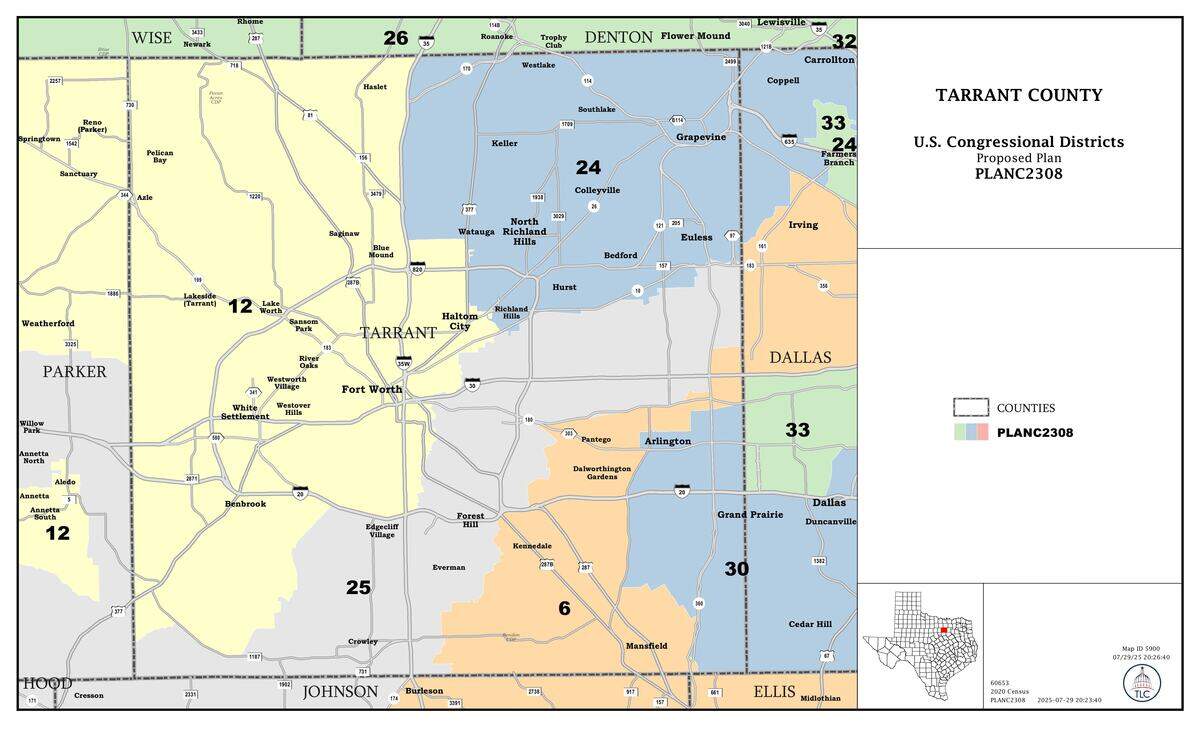
The map before Texas lawmakers would, among other changes across the state, cut the Tarrant County portion out of Congressional District 33, which currently spans both Tarrant and Dallas counties. The district would still lean Democratic, according to presidential data from the Texas Legislative Council.
The map adds two districts where white residents make up the majority of eligible voters, according to The Texas Tribune.
The proposed plan includes eight congressional districts where Hispanic residents make up the majority of citizens of voting age, up from seven, Hunter said at the Aug. 1 hearing. It creates two districts where Black residents make up the majority of citizens of voting age. Currently there are zero, he said.

During a press conference before a July 28 hearing on congressional redistricting, Simmons referenced the local push that changed the lines of the precinct she represents. The state’s select committee on congressional redistricting was in town to take general testimony on the idea of redrawing the federal lines.
Simmons drew specific parallels between the latest effort and the county-level reconfiguration, noting the mid-decade timeline, a lack of information on who’s drawing the maps and a lack of data to guide the boundaries.
Redistricting is typically done every 10 years, aligning with the U.S. Census, though Texas has engaged in mid-decade redistricting before. That means the latest census data available to lawmakers is from 2020, the same figures used to draw the current congressional map that is in effect and being litigated in federal court.
Some speakers at the July 28 committee hearing in Arlington raised concerns about the outdated data, just as they did a few months ago for the Tarrant redrawing.
“I urge this committee to leave our current districts intact until 2031 redistricting cycle, when we have updated census data available,” said Khanay Turner, the executive director of the Barbara Jordan Leadership Institute. “Or, at the very least, until the current map that we’re dealing with right now has exhausted all of its legal challenges since it’s in court.”
Simmons said in a July 10 social media post that Republicans are using the “same playbook” for congressional redistricting. When comparing the two maps, opponents say both aim to decrease Democratic representation and would strengthen the votes of white constituents.
“Tarrant County was the test run, and it was a racial gerrymander, plain and simple,” Simmons said. “Now Republicans want to do it statewide—to protect Trump, gut federal services, break grant promises, and crack and pack minority districts. Same playbook. Same voter suppression. We see it. We’re ready.”
What’s different in Tarrant, Texas redistricting efforts?
Though both governing bodies heard out its constituents regarding redistricting, Tarrant County residents were given a chance to speak out only after the first five of seven proposed maps had been announced. The final two maps, one of which was chosen, were quietly added to the menu days before the commissioners picked a new map.
The map that state legislators have before them now was submitted after the Senate and House redistricting committees held public hearings. The Texans who spoke during those committee hearings had no map to refer to in their remarks.
Once the map was submitted, a singular hearing time was scheduled in the House on the proposed new districts. The hearing drew Texans from across the state but additional field hearings aren’t being held. Most who spoke opposed the proposal. A Senate committee has also held hearings on the specific map, which is expected to soon be debated before the full chamber.
The state hearings had stricter rules as to quorum and time allotted to testimonies. At the House hearings, testimony time was halted at five hours. In Tarrant County hearings, each person was heard out, but the event was elective for commissioners.
Some of the rules about redistricting on the two governmental levels differ as well. In Texas counties, the elected officials get to decide which map fits their precincts the best. Conversely, congressional representatives do not decide the boundaries of congressional districts, a responsibility that instead falls to the Texas Legislature.
Federal law says the districts must be as equal as possible in population size.
Republicans receive ‘no immediate consequences’ for redraw
Tarrant County Democratic Party Chair Allison Campolo said she hoped she was being pessimistic thinking that a state redistricting was coming after the county redrew.
The county redistricting taught Republicans that “there’s no immediate consequences for cheating voters out of fair representation,” Campolo said.
Tarrant County Judge Tim O’Hare did not respond to a request for comment, but in a June 22 radio interview said he loves the idea of redrawing Texas’ congressional map to boost the number of Republicans in Washington.
“All of these maps are political, they always have been,” O’Hare said on The Mark Davis Show. “They’re drawn by the people in charge, and if we have an opportunity to make sure President Trump, in his last two years in the White House, has a stronger Republican majority in the House or even keeps the Republican majority in the House, we absolutely ought to do it. So I applaud the Governor for putting that on the special session.”
Tarrant GOP Chair Bo French has also supported the state’s redistricting effort.
“It is time for Republicans to do what democrats have always done,” French said in a post on X. “Use your power. The difference is democrats use it to cheat. Here we can use it legally and win for generations. There is nothing stopping you except the weak ones in your midst.”
As far as the Democrats go, Campolo said they have learned that constituents care deeply about the issue. Campolo is impressed at the sheer volume of people showing up at the hearings in unfavorable places held at inconvenient times and staying for hours.
The redistricting across both Tarrant County and the state will have a significant impact on the midterm election turnout, Campolo said.
“It is immediately and repeatedly evident that this has crossed a line that people cannot forgive and will not write off,” Campolo said in a text.
Whether Tarrant’s redistricting helps Democrats or hurts them in the midterms remains to be seen. The same goes for the proposed map in Texas if it ultimately moves forward. Litigation is already underway over the county’s boundaries and would likely be filed over the new congressional map if approved.
Then there’s the cascading effects. Other states are already considering mid-decade congressional redistricting, and Democrats have warned of a trickle-down effect to local governmental bodies.
“If this map goes through, if it passes, it will then be an opportunity for injustice to move to the county level,” said U.S. Rep. Al Green, a Houston Democrat, during a recent news conference. “Might move to various commissioners courts, or to the city council level, or to the school board or to the state reps or the state senates, and not just in Texas but around the country. Injustice anywhere is a threat to justice everywhere.”
This story was originally published August 8, 2025 at 2:58 PM.