Texas bill that opponents fear puts TRE rail at risk gains momentum
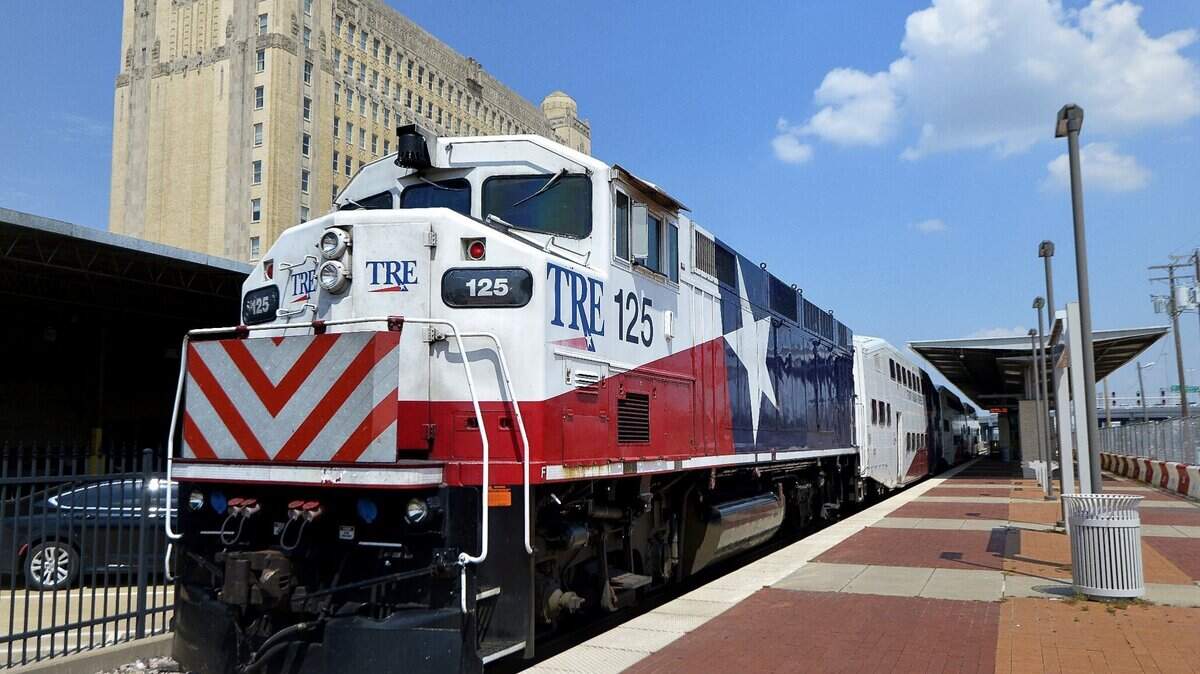
Legislation that jeopardizes a rail linking Dallas and Fort Worth, according to opponents, could soon be heard by the full Texas House.
House Bill 3187 advanced from the House Transportation committee on a 9-2 vote on May 6, the latest movement on the proposal by Rep. Matt Shaheen, a Plano Republican, as the Texas legislative session enters its final stretch.
The legislation is opposed by Dallas Area Rapid Transit and Trinity Metro, who together own and operate the Trinity Railway Express line. Both warn that the legislation puts the operation of the line at risk. The rail between Dallas and Fort Worth is used by thousands each year, including by concert-goers and sports fans attending events at the American Airlines Center — home of the Dallas Mavericks and the Dallas Stars.
If HB 3187 passes, a city could take up to 25% of its sales and use tax that funds DART and use it for a general mobility program to fund things like sidewalk construction and maintenance, hiking and biking trails, drainage improvements, and street lights and traffic control improvements.
“House Bill 3187 Kills Dart,” DART spokesperson Jeamy Molina said Tuesday. “There’s no illusions behind this. It will destroy DART.”
As for the Trinity Railway Express: “We would have to look at services across the entire service area, but that’s place where we would work closely with Trinity Metro to decide how deep the cuts are in that area,” Molina said.
“Those could be as far as not being able to run the service, very, very limited service — all things we would have to work out once we knew the exact impacts,” Molina said.
DART warns that if the legislation passes as first filed it would lead to thousands of DART-related jobs lost, reduces DART’s economic impact by nearly $1 billion and a 30% service reduction across DART’s service area.
DART gets 75% of its revenue from a 1% sales tax on the 13 cities in its service area: Addison, Carrollton, Cockrell Hill, Dallas, Farmers Branch, Garland, Glenn Heights, Highland Park, Irving, Richardson, Rowlett, Plano and University Park, Molina previously told the Star-Telegram.
The original version caps that revenue at 0.75% rather than the current 1%, but that part of the bill was removed in a committee substitute.
The state website that tracks bills says the bill passed as substituted, but Molina in an interview and a representative from Trinity Metro in a statement said the bill passed as originally filed.
Shaheen’s office later confirmed it was the committee substitute that advanced.
Even amended, DART’s budget would be cut by 25% and the same kinds of service reductions and cuts would happen, Molina said in a text.
“Without DART’s investment, Trinity Metro would not be able to continue the current level of operation for TRE,” Trinity Metro’s Chief Strategy Officer Anette Landeros said in a statement. “We remain concerned for our Tarrant County residents who regularly use TRE as their preferred way to seamlessly commute to Dallas for work, sports events and concerts. Because we are in the business of connecting people to life, we worry about the impact this would have on connectivity in our booming Metroplex.”
The Fort Worth side of the Metroplex is growing rapidly and with that comes a need for more transit services, said Trinity Metro President and CEO Rich Andreski in an April 24 interview, after opposing the bill in a committee hearing.
Trinity Metro is concerned about how the bill could impact the Tarrant County transit agency’s business long term, Andreski said, but the transit agency’s immediate worry is what the bill could mean for the Trinity Railway Express line.
“With a potential reduction in revenue available to DART, DART will have to make hard choices, and, there’s only so many places to cut and achieve those budget reductions,”Andreski said. “And one of them is very likely going to be TRE.”
The TRE is a 50-50 joint venture with DART, Andreski said.
“If DART were to step back, Trinity Metro could not go it alone,” he said.
Public transportation officials and some city leaders were at odds in Austin on April 24, as lawmakers considered the legislation in a public hearing.
The hearing began after 10 p.m. and lasted past midnight as transportation officials, city officials and North Texans who use DART’s public transportation options weighed in on the bill.
While some cities in DART’s service area praised the transit agency, others said they weren’t getting enough of a benefit for the money being spent.
Shaheen told lawmakers that DART’s financial structure has changed little in more than four decades and needs an overhaul. The legislation will not be a “financial disaster” for DART, Shaheen said, pointing to changes between the originally filed bill and the committee substitute.
The bill could be scheduled for a debate on the House floor. If it advances there, it would head to the Senate.
The Texas legislative session ends June 2.
This story was originally published May 6, 2025 at 2:40 PM.