Texas bill could jeopardize Trinity Railway Express, the rail linking Dallas-Fort Worth
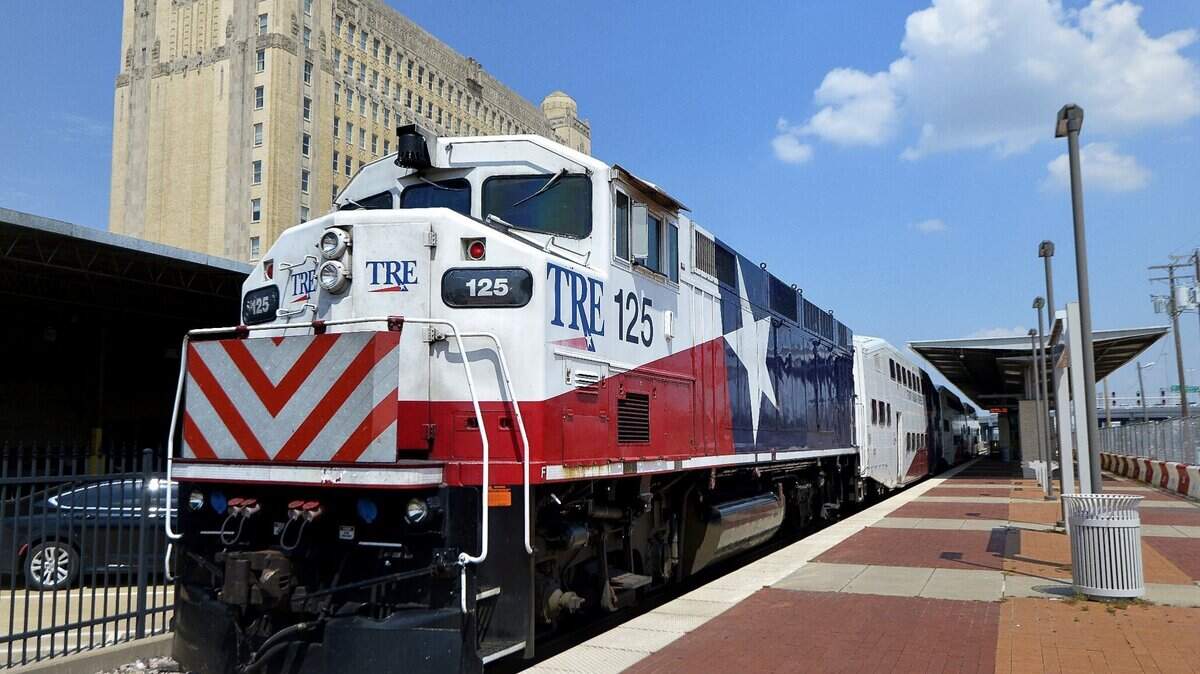
A rail linking Dallas and Fort Worth that is frequented by sports fans and concertgoers from Tarrant County could be at risk if a bill pending before Texas lawmakers is passed into law, Dallas Area Rapid Transit warns.
The Trinity Railway Express line is used by thousands each years and has stops between the two cities. Among them, the American Airlines Center, which hosts the Dallas Mavericks, Dallas Stars and musicians like Katy Perry and Dua Lipa.
Dallas Area Rapid Transit cautions that a bill set to go before a House committee on April 24 would lead to service reductions, including for the Dallas to Fort Worth line.
House Bill 3187 requires cities that fund DART to set aside up to 25% of the sales and use tax that would otherwise go to the agency for a general mobility program. The dollars could be used to fund things like sidewalk construction and maintenance, hiking and biking trails, drainage improvements, and street lights and traffic control improvements.
The bill, authored by Rep. Matt Shaheen, a Plano Republican, as written could also lead to an additional 25% drop in the overall sales and use tax revenue that funds DART, though that provision will be removed from the bill, Shaheen said in an interview after this article’s initial publication.
Jeamy Molina, a DART spokesperson, on April 22 said that if passed DART would be looking at job losses and a 30% service reductions across its service area, which spans Addison, Carrollton, Cockrell Hill, Dallas, Farmers Branch, Garland, Glenn Heights, Highland Park, Irving, Richardson, Rowlett, Plano and University Park.
The public transportation options include light rail, bus routes and paratransit services, as well as the Trinity Railway Express commuter rail. The rail linking Dallas and Fort Worth is owned and operated by both DART and Trinity Metro.
DART receives 75% of its revenue from a 1% sales tax on the 13 cities, Molina said. The other 25% of revenue comes from things like fare revenue and grants.
For the Trinity Railway Express, the “best case scenario” were the bill to pass is a reduction in frequency, perhaps to once a day, Molina said.
The worst case? The line would stop entirely, Molina said.
“Because we work with Trinity Metro, we would have to work very closely with them on how we move forward and make any decisions, but we would be reducing services across the entire service area, so that doesn’t limit us not looking at TRE and finding out how we would have to cut services there,” Molina said.
Trinity Metro CEO Rich Andreski will testify before the House Transportation committee when the bill is heard on April 24, said Anette Landeros, the chief strategy officer for Trinity Metro, in a statement. Andreski will emphasize the importance of regional connectivity, Landeros said.
“We recognize DART’s concerns about sustaining its portion of operational costs and, under current funding levels, Trinity Metro would not be able to assume full responsibility while maintaining existing service,” Landeros said. “However, we remain committed to Tarrant County residents who rely on TRE and look forward to working with state leaders to ensure a strong, connected transit network for our communities.
Tomorrow, we will focus on communicating the critical role TRE plays in the daily lives of Tarrant County residents, underscoring how regional transit investment directly impacts their ability to commute, work, and enjoy entertainment options like sporting events, concerts, and other cultural attractions.”
In fiscal year 2025, the TRE has had 656,518 rides, Molina said. There were about 1.3 million in fiscal year 2024. DART’s fiscal year starts in September.
“DART is an essential part of making sure that the North Texas region thrives,” Molina said. “Cutting our funding would have so many people lose access to being able to get to work, to get to school, to get to their doctor’s appointments.”
The proposal comes after Plano and other North Texas cities have passed resolutions supporting a cut in their contributions to DART, according to KERA.
Shaheen said DART has fought transparency and refused to work with its member cities to “correct an egregious imbalance” of payments being made by some of the cities. Cities want a legislative fix, he said.
“If they would sit down with these cities and agree on a new funding system, there would be no reduction in revenue,” Shaheen said. “But I’m forced to file legislation to fix this problem.”
Molina on April 23 disputed that DART hadn’t been responsive to cities or financially transparent. DART released an Ernst & Young study in 2024 sharing financial information, according to KERA.
Andrew Fortune, the director of policy and government affairs for the city of Plano, which supports the bill, said there may be a committee substitute to the legislation that would offer clarity on a part of the proposal that DART says would cut its revenue by 25% by reducing a maximum 1% sales tax DART collects to 0.75%. Shaheen said that portion of the bill will be removed.
He and Molina did not have a copy of a committee substitute as of early Wednesday afternoon. Changes to bills are often presented by bill authors during committee hearings.
“The intent is for DART to continue levying the full one cent sales tax and continue to collect the full one cent sales tax,” Fortune said.
Instead the goal is to lean into the 25% mobility program, which Fortune described as a “rebate program.”
In fiscal year 2023, Plano received less than 50 cents on the dollar in returns from taxpayers funding of DART, Fortune said, pointing to an Ernst & Young study.
Plano is committed to transit and DART, he said.
“The goal of the bill and the hope of the bill is that this will provide flexibility for Plano and other communities in DART to provide solutions for transit services,” Fortune said.
The bill was initially set for a hearing on April 17 in the House Transportation Committee, but the hearing was rescheduled to April 24.
An identical Senate version of the legislation by Sen. Angela Paxton, R-McKinney, Sen. Brent Hagenbuch, R-Denton, and Sen. Tan Parker, R-Flower Mound, has not been scheduled for a committee haring. Rep. Morgan Meyer, R-University Park, Rep. Jared Patterson, R-Frisco, and Rep. Terry Canales, D-Edinburg, are also listed as authors on the House bill.
Molina said DART’s board has passed a resolution to return 5% of DART’s revenue to seven of its 13 donor cities, including Plano.
“Everything that they are asking for, we can do without having to go to the Legislature,” Molina said.
This story was originally published April 23, 2025 at 4:19 PM.