‘It sends chills down my spine.’ Why some North TX Republicans are against school vouchers
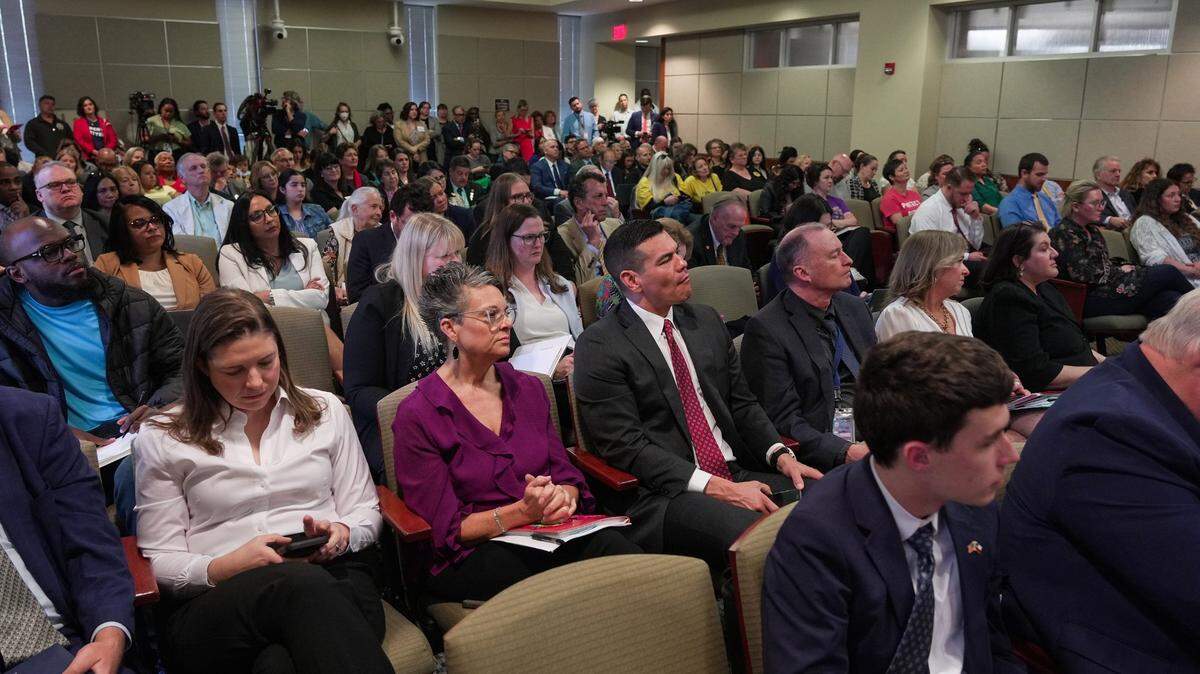
Hollie Plemons took her seat before a panel of lawmakers in Austin to make her conservative case against school vouchers.
“This is going against everything that a Texas Republican is,” said Plemons, a mother of three and Tarrant County GOP precinct chair from Fort Worth who has been outspoken in her opposition.
She was one of hundreds in a marathon hearing on March 11 to testify before the House Public Education committee as they considered House Bill 3, the House’s version of an education savings accounts program, a voucher-of-sort that supporters say would give parents more choice in their child’s education. A similar proposal passed in the Texas Senate on Feb. 5. The details are different, but both would let parents use state dollars for their child’s private or home schooled education.
The issue has historically been a tension point for Texas Republicans, facing opposition from some within the party, particularly among rural House members who have feared for their local public schools.
As the legislation is debated there are also Republicans — like Plemons — whose opposition stems from what they see as a breach of traditional Republican principles opposing government subsidies and supporting small government. This is despite support for vouchers from many in the Republican Party’s upper-most ranks.
“In a way, for these conservatives, vouchers are big government,” said University of Houston political science professor Brandon Rottinghaus. “Vouchers are basically setting the table for winners and losers. That’s something that many conservatives, fiscal conservatives, are adamantly against.”
Plemons said she’s been attacked by Republican groups and called a Democrat, communist and Marxist for her stance.
“I’m none of those, but the bill is,” she said.
The March 11 hearing where Plemons spoke went through the night and into dawn, finishing after 6 a.m. the next day. She has lent her voice to other voucher hearings in recent years, as the issue is debated among lawmakers.
When Plemons wrapped up her latest testimony, Rep. Gina Hinojosa, an Austin Democrat, acknowledged that their views do not typically align. Here, they do, she said.
“I giggle a little bit because I’ve had so many Republicans come up to me today and say, ‘I don’t agree with you on a lot of things, but I agree with everything you’re saying about this bill,” Hinojosa said.
‘What is school choice?’
Gov. Greg Abbott has made “school choice” a top priority — one that he’s invested significant time and political capital in. After a bill didn’t make it to his desk in 2023 , despite multiple special sessions, Abbott targeted Republicans who opposed his plan in the 2024 primaries.
With the ballots tallied, Abbott declared victory, announcing there’s enough support in the House for the policy to pass. House Bill 3 has 76 Republican members who’ve signed on as authors. It needs 75 votes to pass.
Among the Tarrant County co-authors are House Reps. David Lowe, Nate Schatzline, Tony Tinderholt, David Cook, John McQueeney, Giovanni Capriglione. Rep. Charlie Geren, R-Fort Worth, has opposed vouchers in the past and is not a bill author. Tarrant County Republican Sens. Phil King, Tan Parker, Brian Birdwell and Kelly Hancock are authors on the Senate bill.
The savings accounts could be used for education related costs like tuition, books, school supplies and transportation, among other expenses.
Rep. Brad Buckley, a Salado Republican who authored the bill and chairs the Public Education Committee, said students would generally receive a little over $10,000 per year in the House’s version of the proposal. Home schooled students could receive up to $2,000 each year and students with a disability could receive up to $30,000 each year.
Any Texas child can apply for the funds, but if there’s more interest than money available, priority will be based on disabilities and income level.
In the Senate version, students would get $10,000 for private school tuition each year. A student with disabilities would receive $11,500 to attend private school. Home schooled students could receive at least $2,000. In the event of more education savings account requests than funding allows for, that bill allocates up to 80% of the education savings accounts to members of low income households or children with disabilities.
Dallas County GOP Chair Allen West mulled the idea of “school choice” in a recent post on the local party’s website. The former Texas GOP chair ran against Abbott for governor in 2021, challenging him from the right.
“I do not think we have a very clear understanding of what ‘school choice’ means,” the post reads. “When I hear people use language such as ‘universal school choice,’ well, it sends chills down my spine because of the word ‘universal,’ which was also used to describe Obamacare as “universal healthcare.”
West addresses the Senate’s proposal, saying it goes against a party platform item that calls for funding that follows a child with “no strings attached” and opposes “regulations on homeschooling or the curriculum of private or religious schools.”
“Instead of issuing a voucher, why not enable Flexible Education Savings Accounts that are tax credits, not vouchers?” West said in the post.
The local split over vouchers
The divide bleeds into the state’s most local party representatives: Precinct chairs, like Plemons.
The precinct chairs who make up the Tarrant County Republican Party’s executive committee rejected a resolution March 8 “urging the equal treatment of parents in education funding.”
A chorus of support was followed by a louder chord of opposition as Tarrant County GOP Chairman Bo French called for a vote. French did not return requests for comment on the resolution and his position on the pending legislation.
Among those on the losing side of the vote was Caleb Backholm, a precinct chair who lives in Fort Worth and is a member of the Tarrant County GOP’s resolution committee. He said he’s been to all types of schools: public school, home school, private school and international school in Mexico.
“I’ve been exposed to lots of different schoolings, and the thrust of the issue for me is I think that Texas — I think every state, but I think that Texas — should make it just as easy for parents to send their kids to private schools as it is to send their kid to public school,” Backholm said in an interview.
The resolution stated: “The Tarrant County Republican Party calls on the Texas legislature to pass legislation that will fund all Texas families equally, and in which the same tax dollar amount allotted to a child enrolled in a public school shall also be allotted to a child enrolled in a private school, and that no new requirements or restrictions, including curriculum requirements, shall be added to any private school receiving these tax dollars. The consent of the parents is sufficient oversight.”
The resolution critiques the Senate bill, saying it neglects most students and mandates certain curriculum, though the bill’s text says the state and organizations that administer the education savings accounts may not limit educational methods and curriculum.
Backholm favors the idea of education savings accounts and generally supports the bills making their way through the Legislature. Parents being able to pick the school that best matches their child is a “huge deal in life” but many students aren’t getting that option because of a lack of funds, said Backholm, whose youngest of three kids recently graduated from high school.
“Essentially we have a voucher system for every public school in the state,” he said. “The parent enrolls the student, the student’s information is sent into the state and then the state sends the money to the school. That’s essentially what a voucher is — we don’t call it that but for all intents and purposes that’s what it is, and that’s how it would ideally work for private schools as well, and with the home schools, only they wouldn’t get as much money in the home school.”
The resolution was too generic, said Tamma Gunn, a precinct chair and resolutions committee member, who voted against the resolution
“We didn’t want to pass anything that made it sound like we were supporting HB 3 or SB 2,” she said.
For Plemons, there are numerous issues with the proposals before lawmakers. In an interview with the Star-Telegram, Plemons said the legislation is not fiscally conservative and that education vendors are the “big winners.”
“Everybody has the right to choose,” Plemons said. “What they’re talking about is money. They want to stick their hand in my pocket and say that, that equals a choice for them, and it doesn’t.”
She told lawmakers the bill grows the government, creates a subsidy and goes against Republican Party principles. Plemons is no stranger to pushing back against the government: she sued the Fort Worth school district over mask mandates and scrutinizes other district policies.
Backholm offers a contrasting view: Texas is already subsidizing the vast majority of students’ education in public schools because it’s something the state is required to do, he said.
“I’m just calling for equal treatment for everybody,” Backholm said. “Saying that we are going to subsidize or pay for everybody equally is not subsidy and it certainly isn’t socialism or anything like that. It just equal treatment.”
Plemons also testified to lawmakers that she doesn’t think Republican voters would support the bill if they knew undocumented students were eligible for the funds or that the dollars could be used for LGBTQ focused schools or Islamic schools.
One of her children is in a Christian private school and the other attends a charter school.
“I don’t want the government involved there,” Plemons said in an interview. “I don’t want the government idea of Christianity to come seeping into my school and changing it. I want it to stay pure the way that it is when I toured that school.
“So I think that any time you’re allowing the government into a religious space, you’re just asking for trouble. The points that I make about the Muslim schools and the LGBTQ schools is, if we’re talking about Republicans as a whole, what are they not going to want? That. Right there, that. So it’s a very blanket statement, but yes it covers all religions, including my own.”
Plemons said she would never support an ESA or a voucher, but like West she would favor a tax exemption on school property taxes for those whose kids are not enrolled in public schools.
“If you don’t want your money going to fund your public school and you’re not using your public school you’re using something else, why should you as a current parent of a K-12 child have to pay for other people’s kids whenever you’re not using that system?” Plemons said.
Asked what’s behind the divide between Republicans, Gunn pointed to the term “school choice,” which is regularly used to describe the education savings account program.
“Many people don’t understand how many choices we already have, and so when you put the title on there, they believe that’s giving them more liberty to choose the education for their children,” she said. “And it is — I mean, if it were sincerely that, it would. But there are many things in this particular bill that are not school choice. They will actually begin to limit our choices in the long run.”
This story was originally published March 14, 2025 at 1:38 PM.