Who will be Texas House speaker? Here’s where the race stands after Election Day
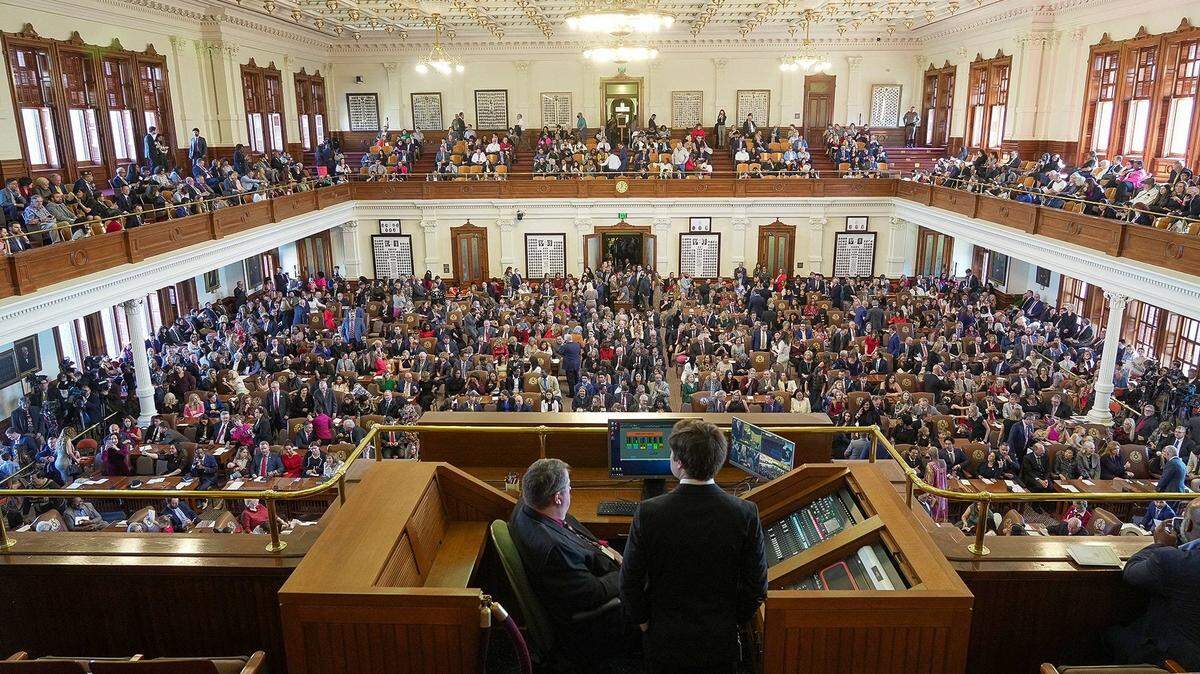
With Election Day in the past, the race for Texas House speaker is heating up as the Republican incumbent tries to hold onto the leadership role and a North Texas Republican tries to win it.
Speaker Dade Phelan of Beaumont and Rep. David Cook of Mansfield are running for the post, as is Rep. Ana-María Rodríguez Ramos, a Richardson Democrat.
On Nov. 12, Rep. John Bryant, a Dallas Democrat, also filed paperwork with the Texas Ethics Commission declaring himself as a candidate. Bryant did not immediately return a call seeking comment.
The next Texas legislative session doesn’t start until Jan. 14, but with a key GOP caucus meeting ahead, the two Republicans are working to win the support of their House colleagues.
The process of picking a speaker is a bit of a political inside-baseball game of numbers. It can be confusing and convoluted. But it’s also one of the House’s first jobs when members head back to Austin, and an important one at that: The House Speaker’s responsibilities include presiding over the chamber’s day-to-day operations as they debate possible new laws.
So what can Texans expect for the speaker race? Let’s start with the basics.
What is a House Speaker?
Essentially, the House speaker is the leader of the Texas House — the presiding officer, if being formal.
A speaker is picked from the members of the Legislature and is generally a member of the party that makes up a majority of the House’s 150 members. When members elected during the Nov. 5 election are sworn in, the House will be composed of 88 Republicans and 62 Democrats. Republicans picked up two seats in the general election.
The speaker’s duties include overseeing floor debates, recognizing lawmakers who want to speak and ruling on procedural questions with the help of the House parliamentarian. House rules, which are voted on at the start of each session, also task the speaker with selecting committee leaders and members, referring bills to committees and directing interim studies when lawmakers are not in session.
In Texas, the Legislature meets for 140 days every two years. The Texas governor can call members back for special sessions, as well. Take 2023, when lawmakers were in consecutive special sessions for around six months after the regular session ended in late May.
The speaker can vote on bills before the full House, but doesn’t have to and often doesn’t.
How is the Texas House speaker picked?
A candidate must declare their intention to run with the Texas Ethics Commission beforehand and needs 76 votes to win, simple majority.
It seems straight forward, but there are several steps before the legislative session even starts that can add some wrinkles.
On Dec. 7, the House GOP Caucus will meet to name its endorsed candidate for House Speaker. To win the endorsement, a candidate needs the support of two-thirds of caucus members. (The threshold could be lowered to three-fifths if a single candidate doesn’t get two thirds support after two rounds of voting.)
Republican caucus bylaws say that “not only are we supposed to come together and caucus and choose a nominee amongst ourselves, but we’re all honor bound to go support that person on the House floor,” said House Republican Caucus Chair Tom Oliverson, a Cypress Republican.
“So, that’s the rules,” he said. “We’ll see, right? But that is what the bylaws say.”
Democrats have a 16-member working group that “represents the diverse interests of our caucus,” said House Democratic Caucus Chair Trey Martinez Fischer, a San Antonio Democrat.
“We meet and talk on a regular basis to evaluate this process, and we take direction from the members of the committee and the members that are in the Democratic caucus to see that we’re making good decisions,” Martinez Fischer said.
By the time the race has arrived for a House floor vote, the Speaker is generally elected by an overwhelming majority of all members.
Most recently, Phelan won in 2023 on a 145-3 vote against Rep. Tony Tinderholt, an Arlington Republican. Three Republicans voted against Phelan: Tinderholt, Rep. Nate Schatzline, a Fort Worth Republican, and former Rep. Bryan Slaton, a Royse City Republican.
Who is running for speaker of the Texas House of Representatives?
What’s the state of the race so far?
This is where things get a bit complex.
Much of the debate around who should be speaker is done out of the public eye, but social media posts and public statements offer some insight into the state of the race.
Phelan has been criticized by some members of his own party for his leadership, particularly his appointment of Democrats as committee chairs — a long held practice in the House that opponents say dilutes Republican power — and the impeachment trial of Attorney General Ken Paxton. The House voted 121-23 in May 2023 to send impeachment articles to the Senate. Paxton was acquitted in a Senate trial. All three candidates actively in the race voted for impeachment.
Phelan appointed eight Democrats as committee chairs in 2023 compared to 13 in 2021, according to The Texas Standard. He stood by Democrats holding the leadership roles in a March interview with Spectrum News 1.
“Texas is doing the right thing,” he said in the interview. ”We’re unique because we have a bipartisan relationship here in the Texas Legislature. This is nothing new. I didn’t start this. This has been going on for decades and decades and decades. It keeps us from being like Washington, D.C., where everything shuts down. We don’t want the chaos that is in Washington, D.C. We want to get things done for the folks here in Texas.”
Phelan survived a primary runoff against a challenger from the right who had the support of several Republican leaders, including President-elect Donald Trump. When legislative sessions wrapped in late 2023, he touted measures that were passed by the Legislature like border security and border wall funding, property tax relief, efforts to bolster school safety, broadband expansion, restricting DEI initiatives at public colleges, and legislation that bans gender affirming care for transgender children.
When announcing his speaker bid, Cook said that leadership should better reflect the will of the majority party, including a “a shift to a Republican committee chair model.”
Rodríguez Ramos entered the race in September.
“I’m in the race because our constituents need to know that when they put us in power, we’ll stand up against the Big-Government Republicans and fight for our ability to afford rent and buy a home, for our reproductive freedoms, our neighborhood public schools, and our ability to live without the fear of gun violence,” she said in a statement.
Multiple House Republicans originally filed to run against Phelan for speaker, including Oliverson, the House GOP Chair. He and the other Republican members who were running have since endorsed Cook.
Which brings us to Sept. 20, the day they coalesced around Cook.
A group of Republicans met behind closed doors and reportedly held a series of votes, eventually choosing Cook as their pick for speaker. Cook later shared a list of 48 Republicans who support his bid — just over half the caucus, but not two-thirds or three-fifths.
The list is made up of current members and incoming members, all but one of whom have since won their November general elections. Two are are unnamed.
The list includes a note stating the list only includes members who participated in the Sept. 20 vote, and that “several others have expressed commitment to reform, but chose to wait until after the November elections.” Cook did not immediately respond to a Nov. 8 text seeking an updated list.
“Our goal remains clear: To reform the Texas House so that it truly reflects the will of the people,” Cook said at the time. “I will work tirelessly to solidify the support needed within our caucus and, after that, to unite the House in order to effectively lead as speaker. This is not just about one person; it’s about a movement that will reshape Texas for the better.”
The race ramps up post Election Day
After Tuesday’s election, Cook sent a note to Republican House members and members-elect: “We cannot continue to govern effectively without the Republican majority electing our speaker.”
In the note, Cook referenced former House Speaker Joe Straus, who in 2009 took office with the help of a group of Republican members who worked with Democrats to propel him to the post.
Since then, a division that has turned to a “civil war” has been festering in the party, he said, laying out three paths:
▪ Support him — the “reform candidate who has already earned the trust and firm support of over half the Caucus.”
▪ Speculate that a new candidate could emerge.
▪ (What Cook described as the “worst option”) Reelect Phelan with “the backing of a handful of Republicans and a majority of Democrats.”
Cook was not available for an interview Nov. 8, but in a text he said “the makeup of the House is far more conservative in 2025, but whether or not 2025 will be a more conservative session will largely depend on the Members’ selection of House leadership on Day 1.”
Phelan pushed back on Cook’s letter in a statement shared the Star-Telegram Friday. The office has not released a list of Republican members supporting him.
Cook doesn’t have the votes to win the speakership, Phelan said.
“Rep. Cook does not have the necessary support to become the caucus nominee, let alone the Speaker of the House,” Phelan said.
The meeting in which some members pledged to support Cook was unsanctioned, exclusionary, circumvented the caucus’ official process and has “greatly fractured the caucus in the exact manner Rep. Cook is now criticizing,” Phelan said in the statement.
“As I stated on the day this exclusive, unsanctioned meeting occurred, I have the votes to become Speaker of the House and look forward to leading another banner session that reflects the will of our state and its lawmakers,” he said.
Oliverson said he’s committed to making sure the caucus meeting on Dec. 7 is fair and transparent, and that members have a chance to express their preferences and choices. He pointed out that post Election Day, the Republican caucus grew by two while the Democratic caucus shrunk by two.
“So the Delta now in terms of Republicans you would need to basically cross over and do a deal with the Democrats, to sort of take us back to what we had under Joe Straus, that number just went up by two of Republicans that you need to make it work,” he said.
Rice University political science professor Mark Jones sees the election outcome as being a silver lining for Phelan as he bids for speaker. Several moderate Republicans who support him survived the general election, Jones said.
And then there’s the question of how Democrats will vote. Martinez Fischer, the House Democratic Caucus chair, declined to say in an interview.
“I’ve been in the Legislature 11 terms,” he said. “I was just elected to my 12th a couple of nights ago, and one thing I’ve always learned is that conversation is always an internal conversation, and a member-to-member conversation. So I’ll leave it there.”
But, overall, Republicans are divided, Martinez Fischer said.
“I think that the elephant in the room, literally, is that the Republican caucus is divided, and they are pitted against each other,” he said. “And so long as that remains, they will not have the effectiveness of an operating majority.”
And a divided Republican caucus can’t win without the support of Democrats, Rodríguez Ramos said.
“If Democrats rubber-stamp a Republican speaker, the public will continue to see no difference between the two parties,” she said. “Their caucus is divided; no Republican has a path to the speakership without winning over us Democrats, and there is no Republican in the race for speaker who is committed to protecting the values Texans truly care about.”
This story was originally published November 11, 2024 at 3:31 PM.