A blue Texas? Democrats look to Colin Allred as he runs against Ted Cruz for U.S. Senate
A blue Texas?
That’s long been the question in a state that hasn’t elected a Democrat statewide in three decades.
“If you’re betting in Las Vegas, you probably don’t bet for it, but the things don’t always play exactly to the odds,” said Matt Angle, the founder and director of the Lone Star Project, an organization aimed at electing Democrats in Texas.
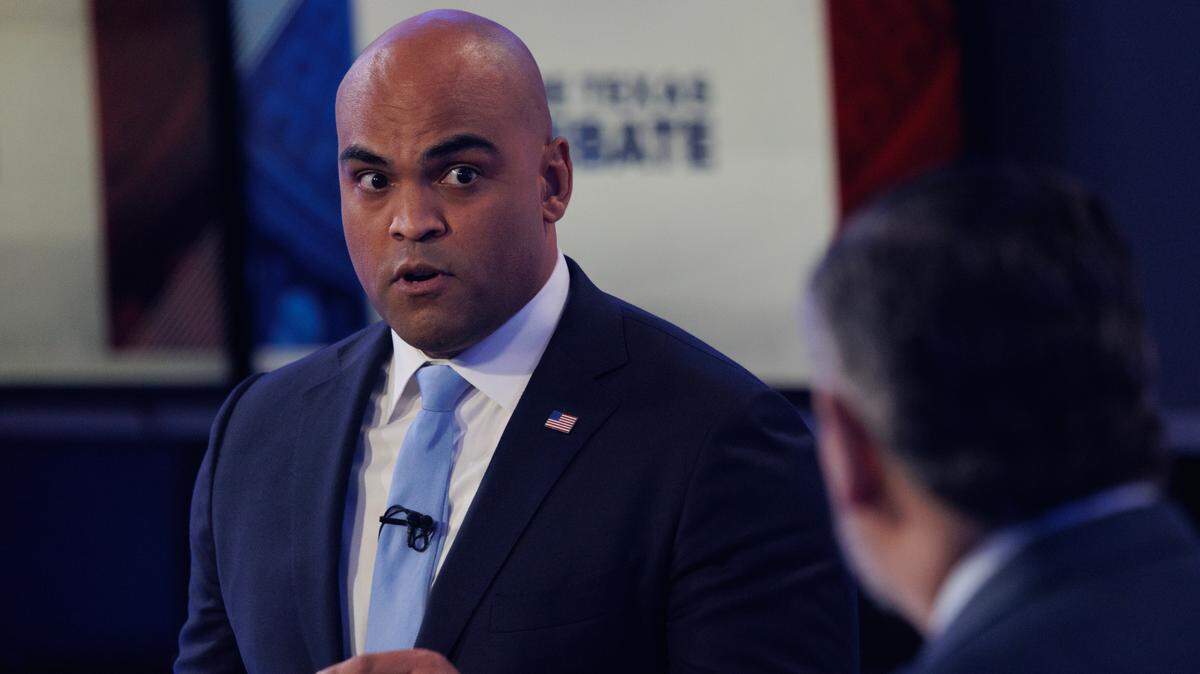
He and other Democrats across the state and country are hoping to beat those odds on Nov. 5, with a high-profile Senate race on the ticket: Ted Cruz vs. Colin Allred.
“Ted Cruz is unpopular, unlikeable, and continually puts his own interests ahead of what is best for Texas,” said Amanda Sherman-Baity, a spokesperson for the Democratic Senatorial Campaign Committee, in a written statement. “Meanwhile, Colin Allred has proven he can take on and win tough fights. In November, Texans are going to fire Cruz and elect a Senator who will put the people of Texas over petty self-serving politics.”
The candidates are in a tight race as Cruz seeks his third term in office. Cruz’s campaign is confident he can win, but the race is getting national attention as Democrats try to keep their narrow hold on the Senate.
The contest is playing out in a presidential year, with Vice President Kamala Harris, a Democrat, and former President Donald Trump at the top of the ticket, and in a changing state that has gained 2.15 million registered voters since the 2018 general election.
“We’ve understood as Democrats in Texas that coming back in this state is a long-haul process, and we’re still in that, but I think the trends are very positive,” said Rep. Joaquin Castro, a San Antonio Democrat.
Tarrant County Democratic Chair Crystal Gayden is feeling confident that Texas will flip. Ever since Harris was announced as the Democratic nominee, energy at the top of the ticket has funneled down the ballot, she said.
“I think our chances flow all the way down to the bottom of the ticket,” she said.
That includes the U.S. Senate race, which Gayden believes Allred has a “strong chance” of winning.
Democrats make gains as Texas gains people
Margins have been narrowing in recent elections as Democrats make gains in Texas.
Take the presidential ticket: Trump won by 5.58 points in 2020 compared to 8.99 points in 2016 versus Democrat Hillary Clinton. Republican Mitt Romney beat Barack Obama by 15.79 points in 2012.
Or the Senate: Cruz won by 2.56 points in 2018, a fraction of his 16-point lead when he was on the ballot for the first time as a U.S. Senate candidate in 2012.
In 2018, Cruz generally prevailed in the more rural parts of the state, while O’Rourke led in the state’s urban cores and along much of the Texas-Mexico border. (South Texas has been competitive in recent years, a trend that continues this election cycle, according to The Texas Tribune.) Margins were also tighter in suburban areas that are seeing much of the state’s growth. David Wasserman, senior editor and elections analyst for the Cook Political Report based in Arlington, Virginia, notes that Republicans are “fairly maxed out” in their ability to win more of the rural vote.
But since then, Texas has gained millions of new, untested voters, about which there are a lot unknowns when it comes to their voting behavior.
“It’s fascinating because the stereotype of many of Texas’ suburbs is that voters from the coasts have infiltrated Texas,” Wasserman said. “The reality of those voters’ leanings could be more complex, because there are also retirees who have been drawn to Texas who appreciate the state’s conservatism and vote Republican.”
The Cook Political Report recently upped its competitiveness rating for the Senate election, moving it from “likely Republican” to “lean Republican.”
Recent polls have had Cruz roughly 4 points ahead of Allred, according to 538.
On the presidential side, the margins are generally wider. Polls put Trump ahead of Harris by 6.5 points on average, as of Wed. Oct. 16, according to the polling website 538.
“It’s hard to judge the presidential campaign because there’s not a presidential campaign in Texas,” said Angle, with The Lone Star Project. “Neither the Trump campaign nor the Harris campaign are really competing in Texas. Trump’s assuming that he wins it and Kamala Harris is assuming that she doesn’t.”
Still, Angle thinks the race will be closer than some anticipate. Harris will do at least as well as Biden did in 2020, and maybe a little bit better.
“We’re four years further in people really being appalled by the anti-democratic direction that the Republican Party has taken under Trump’s leadership, and the fact that Trump himself is clearly diminished and clearly does not articulate any type of vision that a rational person would embrace,” Angle said.

But Democrats winning Texas would be an uphill feat, he said.
“Make no mistake, anybody looking with a clear eye at Texas knows that it’s a long reach for Democrats,” Angle said. “It’s still a steep hill to climb. It can be climbed, but nobody should think that it’s even ground or that it’s a toss up race. That’s not where we are. We have to overcome a clear Republican advantage in the state.”
What does it take to flip Texas blue?
Winning Texas will take more than boosting turnout, Angle said.
“There’s a lot of Democrats, particularly people who don’t live in Texas who like to talk about Texas, who like to take the rising electorate approach or say that Texas is not a red state, it’s an non-voting state,” Angle said. “And those are good little phrases to cheer up Democrats, but they’re not practical strategies to win.”
For Democrats to win statewide, they need to be enthusiastic and united around a candidate and build a coalition goes beyond those who identify as Democrats — “people who don’t get up every day and think of themselves as Democrats or Republicans, but they default to Republican in Texas because that’s either who they think they’re going to win or who they hear from.”
It also means winning over a “narrower group of fair-minded Republicans who are appalled,” Angle said.
“Colin Allred seems to understand that,” Angle said.
.JPG "1015 Cruz Allred Debate ST 11 (1).JPG")
Allred and Cruz have touted bipartisanship and labeled their opponent as extreme. Both have also announced endorsements from officials in the opposite party. For Allred, that includes former Tarrant County Judge Glen Whitley, a Republican who addressed reporters as a surrogate for the Allred campaign following the Oct. 15 Senate debate.
“I don’t believe that Texas is going to flip to a Democratic or a blue or even a purple,” Whitley said. “But I do think that this is a very important race, and I believe that Colin Allred is the right person at the right time, and someone who cares very much about the people of Texas and not just about the party.”
Asked to clarify if he thinks Allred can win Texas, Whitley said: “I think Colin Allred can win this race in Texas, but I don’t see all of Texas going blue anytime soon.”
Cruz spokesperson Sam Cooper weighed in on the race’s close margins after the debate. Speaking to reporters, he touted Cruz’s bipartisanship and pushed back against the idea that Cruz is re-branding amid a close contest. When something’s bad for Texas, Cruz will fight against it; and when it’s good for the state, he’ll work to get it passed, Cooper said.
Aside from Trump, Cruz is the top target for Democrats across the country, Cooper said.
“The national Democrats don’t like Ted Cruz because he fights every single day for what people of Texas believe in,” he said. “So we feel good about where the race is.”
Hispanic support
A big question this cycle is whether Democrats will be able to retain Hispanic support in cities, along the border and in South Texas, said Wasserman with the Cook Political Report.
Wasserman said that for a Democrat to win the Senate seat in Texas, it will take a “resurgence in Democratic support among Hispanic voters.” He also predicted Allred would likely need to win Collin and Denton counties to win statewide.
“We’re unlikely to see Allred hit Beto O’Rourke’s numbers in the Rio Grande Valley or El Paso, so that means that Democrats would need to win even more votes in Austin, Dallas, San Antonio and Houston, particularly in fast-growing, white-collar suburbs,” Wasserman said.
To win Collin and Denton counties, it would take “an extraordinary performance among suburban professionals, particularly women,” Wasserman said. He would also need to win over some Republicans, Wasserman said.
“The target groups for him are Republicans who have no problem voting for (Sen.) John Cornyn, but are lukewarm on Ted Cruz and Donald Trump,” Wasserman said.
The national Democratic Party has made investments in Texas this election cycle.
“Texas is a young and diverse state, and Democrats are continuing to close the gap each cycle,” DNC spokesperson Maddy Mundy said in a statement. “On November 5th, Texas Republicans have to run with Donald Trump and Ted Cruz at the top of their ticket, on a Draconian abortion ban that is spiking maternal and infant mortality in the state. It’s not a matter of if Texas will flip, but when. The DNC is committed to helping our partners on the ground continue to close the gap.”
Some of spending includes:
- A six-figure investment for Latino voter outreach through Latino media outlets;
- $70,000 to help Allred’s campaign in South Texas and the Rio Grande Valley;
- $140,000 for organizing staff and infrastructure;
$150,000 in the Texas Democratic Party through the DNC’s State Party Partnership program.
The DSCC also announced a multi-million dollar investment in television ads for the Senate race, as they try to keep their slim majority in Washington.
“This is the one thing I’ve learned from campaigns over the years: Close elections, margin of error elections are won on the ground,” said DNC Chair Jaime Harrison in an interview with Fox 4 Dallas-Fort Worth earlier in October. Harrison spent time in the Metroplex working to get out the vote and phone-banking with Allred.
In the interview, he called the Texas Senate race “probably the hottest” in the U.S.
“Probably the most competitive Senate race that we see in the country,” said Harrison, who has also traveled to Houston and Austin this year. “Colin Allred has really built a great operation that has Ted Cruz worried.”
But ultimately, the DNC’s job is to win races, Angle said.
“They make cold-blooded decisions nationally, and at the end of the day, Texas becomes an aspirational state rather than a targeted state,” he said.
Angle mentioned Harrison’s recent visit to North Texas. Him visiting the state is helpful, but isn’t real investment in the state, Angle said. Real infrastructure follows winning races, he said.
“That’s why the best way to boost infrastructure would be if Colin were to break through and win,” Angle said.
So will Texas swing?
That question will be answered Nov. 5.
This story was originally published October 17, 2024 at 10:25 AM.