
Why has the price tag for Fort Worth’s future city hall more than doubled in two years?
It was supposed to cost $100 million.
When the city bought the Pier 1 tower for $70 million in February 2021, members of the then-Fort Worth City Council heralded the purchase, saying it would be cheaper to buy and pay to renovate an existing building than starting from scratch.
The City Council will vote Tuesday whether to borrow $50 million to cover added costs to the project.
The city has workers in at least seven buildings downtown, and has been considering building a new city hall since 2004.
Former Mayor Mike Moncrief and city staff explored purchasing and renovating the historic U.S. Post Office building at 251 W. Lancaster Ave., but renovation costs slowed the process and the postal service backed out of the deal in 2014.
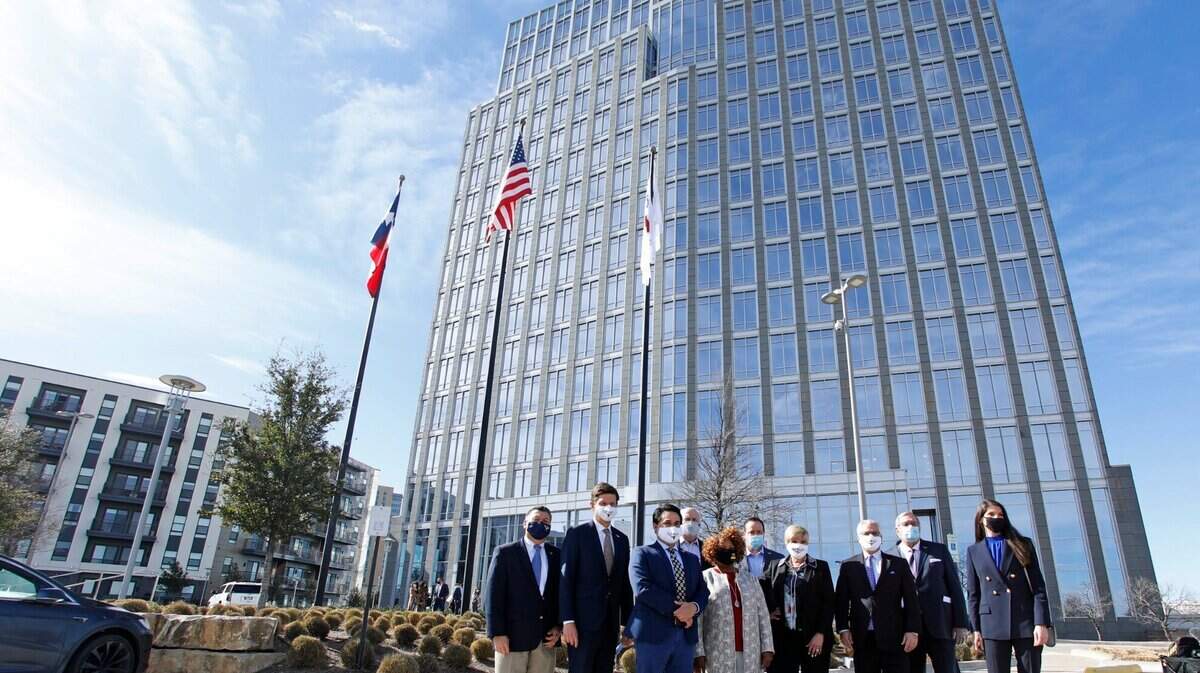
Instead of spending up to $200 million on a new building, the city purchased the landmark skyscraper for $70 million in 2021, with plans to move in by this spring.
The total cost has grown to $230 million.
The city points to inflation, unforeseen maintenance issues, and a broadening of the project’s scope as the main drivers of the cost increases.
Representatives for the city argued the new building will streamline city services, and wind up saving money in the long run.
The muscular tower with the iconic rooftop lights sits on 15 acres at the edge of downtown with views of Sundance Square, the West Seventh Street and what will be Panther Island.
Flaws in the building
Discovering hidden costs are not unusual after the purchase of a building, said Andrew Matheny, a researcher for commercial real estate firm Transwestern.
Some of Transwestern’s commercial office clients have seen 20% to 30% increases to their original build-out costs.
The city needs to spend roughly $12 million to replace the tower’s elevator, update the lighting system, as well as fix other maintenance bugs that weren’t discovered until after the purchase.
The elevators have about five more years before they need to be replaced, and it’s easier to do that before everyone moves in, said property management department head Steve Cooke in an email exchange.
An architect, engineers, plumbers, electricians and other experts did a walk through of the building before the purchase, Cooke said.
They identified issues with the lighting, technology, and the roof. Cooke said those problems were factored into the city’s cost estimates.
However, larger problems with the tower’s lighting controls weren’t known until after the city bought the building.
“If we wanted to move as is, we could have done that,” Cooke said. “If we had done that, we would have a building that is literally half as efficient in its use than we plan to make it.”
Inflation and scope
Inflation and supply chain issues have raised the costs for a lot of city projects, said assistant city manager William Johnson.
Bids to fix city streets are coming in 40% to 60% higher compared to before the pandemic, Johnson said.
The city also increased the scope of the project by consolidating more employees into the new city hall building, and increase from 900 to 1,600.
That’s a major increase, said Richard Palmer, a senior construction science lecturer at Texas A&M University. He compared the added personnel to adding extra square footage to a house after initially planning a much smaller build.
However, Johnson said this consolidation is a boon to the city’s finances. He referenced nine city-owned lots and buildings the city plans to sell for an estimated $19.4 million, in addition to the Central Library, which sold in December for $18 million.
The city also leases several buildings in downtown Fort Worth, which it won’t have to pay for after consolidating departments into the new building.nThat could save the city roughly $1 million a year, former city council member Cary Moon said during a November 2021 city council work session.
The city didn’t have a good sense of the final use plan for the new city hall when it bought the Pier 1 tower in 2021, said city spokesperson Valerie Colapret in response to a series of emailed questions from the Star-Telegram. The city hired Houston-based consulting company Athenian Group to help flesh out its plans.
The federal floodway
The city will have to pay an extra $8 million to make sure the new council chamber and a parking garage addition don’t impact a federal floodway. The floodway was built by the U.S. Army Corps of Engineers in the 1950s to protect Fort Worth from Trinity River flooding.
The documentation about the floodway wasn’t very clear, Johnson said.
“Once we got clarity ... it is what it is,” he said.
Other potential benefits
Having the city of Fort Worth occupy the old Pier 1 tower could be a boon to the downtown commercial office market, said Matheny, of Transwestern.
With the city taking the Pier 1 tower’s unused office space off the market, occupancy rates could drop. That would make the downtown office market look much more attractive for developers, he said.
How is the city paying for this?
The city funded the initial $100 million purchase and renovation with tax notes, a form of public debt that doesn’t require voter approval.
The City Council also approved using $8.5 million in funding from a Texas Public Education grant and $6.4 million in American Rescue Plan Act funding for technology and security updates.
The city does not anticipate expanding the scope, so it shouldn’t need any more than the $230 million, Johnson said.
Pier 1 built the tower for $90 million in 2004. Chesapeake Energy, riding high from the Barnett Shale boom in the 2000s, bought the building for $104 million in 2008. Six years later it was sold to Houston-based Hines. A California investment group purchased the building in 2018.
This story was originally published February 14, 2023 at 6:00 AM.
.jpg)