
Fort Worth approves City Council map that it calls an imperfect compromise
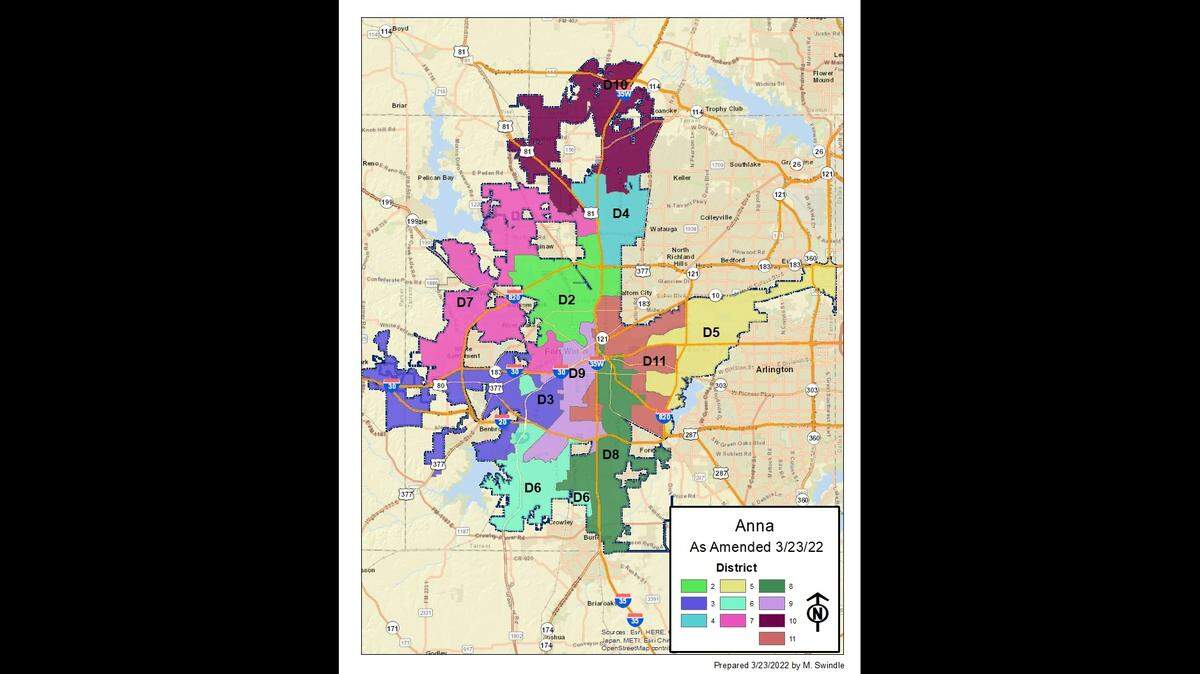
The Fort Worth City Council unanimously approved a redistricting map Tuesday, calling it an imperfect compromise between competing neighborhood interests.
None said it was a perfect map, but all said it achieves the goal of keeping together communities of interest while expanding opportunities for Hispanic representation on council.
The map sets the boundaries for May 2023 city council elections barring any changes from potential legal challenges. The new map has two new districts after they were added in a 2016 charter election.
“While we’re all proud of what we did on this dais, no one is doing jumping jacks because we all had to make some really tough decisions,” said District 9 council member Elizabeth Beck.
Several council members commended Beck for her willingness to move neighborhoods that have historically been in district 9 into the new district 11 in order to create a second opportunity district for Hispanic residents.
These are districts where the voting age population of a minority community is large enough to give that community the opportunity to elect a representative from their group.
Worth Heights, parts of Rosemont and parts of Hemphill Heights were connected with communities in east Fort Worth to create a district with 58.8% Hispanic voting age population.
“The sacrifice is giving up neighborhoods that I love to represent,” Beck said. She mentioned her mother grew up in Worth Heights and grandmother had a store in the south side.
“But we haven’t talked about the gain and the opportunity with this new district,” Beck said.
Several residents objected to the map, saying it puts too much of an emphasis on the racial makeup of future city councils rather than guaranteeing equitable representation for all residents.
“Generations of my family have said you look at the character of a person and not the skin color, and I’d like you to reconsider that in these maps,” said Ridglea Hills resident Jennifer Crossland.
Crossland was particularly concerned about Como being taken out of District 3 to be joined via the Chisholm Trail Parkway to District 6.
However, despite his wishes to keep the neighborhood, District 3 council member Michael Crain said this is what Como wanted.
“You called me an adopted son of Como, and as an adopted son I know there is no better voice to represent Como than an actual son or daughter from Lake Como,” Crain said. He fought through emotions while promising to continue advocating for Como at city hall.
District 2 council member Carlos Flores also pushed back against accusations of racial gerrymandering. He said the map unites communities of interest that have cultural ties and similar socioeconomic backgrounds.
Others worried about the map’s political implications.
Wedgewood resident Carlos Turcios said it seemed like conservative voting precincts in his neighborhood were moved out of District 6 to favor council member Jared Williams.
Turcios is also a guest columnist for the Star-Telegram.
Beck said the process is inherently political, but said it’s more about addressing the needs of neighborhoods rather than the wants of individual council members.
She said the council tried to honor the requests of individual neighborhoods to the best of its ability throughout the redistricting process.
Several council members heralded the openness and transparency of the redistricting process. District 4 council member Cary Moon compared Fort Worth’s process to those drawing state and federal redistricting maps. He said Fort Worth held its negotiations and map drawing sessions in public forums.
Moon also noted it was important for the council to finish its redistricting process by June so the city has time to respond to expected litigation and potential candidates have time to meet residency requirements to run for office.
Candidates must continuously reside in their district for six months before they file to run for office, according to the Fort Worth city charter.
The deadline to establish residency for the May 6, 2023, election is Aug. 17, 2022.
Mayor Mattie Parker called redistricting a full contact sport and thanked residents who participated throughout the process for their input and advocacy.
“It’s OK to disagree, but it’s also OK to do so in a civilized manner to try to reach a consensus that’s the best for all people,” Parker said.
This story was originally published March 29, 2022 at 4:47 PM.
.jpg)