We investigated how often top Fort Worth, county leaders travel. Here’s what we found
READ MORE
Travel on the taxpayer’s dime
The Star-Telegram reviewed thousands of expense records for top government leaders in Fort Worth, Tarrant County, the school district and Tarrant Regional Water District, from business travel to club memberships.
Expand All
We investigated how often top Fort Worth, county leaders travel. Here’s what we found

Your tax dollars give these top local leaders access to members-only Fort Worth Club
What are the travel expense rules for public employees in Tarrant County? It depends

When government leaders travel on your dime, every dollar deserves careful scrutiny
Look up salaries for Fort Worth and Tarrant County government employees
The Tarrant Regional Water District’s now-general manager spent at least 20% of his weekdays on business-related travel in 2019, a Star-Telegram investigation found.
Dan Buhman, who was the district’s deputy general manager at the time, said that year’s travel was during a time of “transition.” Buhman stepped up from second-in-command to the district’s top role in summer 2021.
Buhman’s taxpayer-funded business travel, which stretched over a total of 52 weekdays and two weekend days in 2019, was more extensive than that of other top public officials in Fort Worth City Hall, the Tarrant County government and the school district.
The Star-Telegram reviewed more than 5,000 pages of expense reimbursements and credit card charges that span three years — from July 2018 through July 2021 — for 14 top officials in local government positions. The newspaper’s analysis focused on 2019, the last calendar year before the coronavirus pandemic disrupted travel.
Some officials had few expenses and traveled infrequently. Other deputy- or assistant-level managers logged at most a total of 13 days traveling, compared with Buhman’s total of 54 days. One exception is a county official who is the liaison to the legislature in Austin.
Buhman’s travel also surpassed that of the most senior local government executives. Buhman’s boss at the time, former water district general manager Jim Oliver, recorded 12 trips in 2019 over a total of 32 weekdays and one weekend day, records show.
In the same year, Fort Worth ISD Superintendent Kent Scribner recorded 15 out-of-town trips involving a total of 25 weekdays plus 14 weekend days, for a total of 39 days.
Tarrant County Administrator G.K. Maenius took 11 trips involving a total of 13 weekdays and two weekend days. Fort Worth City Manager David Cooke made at least eight out-of-town trips involving a total of 20 weekdays and five weekend days, records show.
Buhman’s travel included out-of-state trips, such as to a National Waterways conference in Memphis, Tennessee; a National Water Resources Association conference in Portland, Oregon; and a Gartner IT Symposium/Xpo in Orlando, Florida. His 2019 trips cost the district’s taxpayers a total of $22,025, according to a Star-Telegram analysis of records provided by the district.
“There was a lot of training going on for me to understand all these different organizations,” Buhman said. “There was more travel at that time, because we were trying to get a scope of everything that was going on.”
He added that his travel in general is necessary to make connections with heavy hitters in his field, including the U.S. Army Corps of Engineers, which is now spearheading the flood control portion of the long-promised Panther Island redevelopment project along the Trinity River.
“I would say my travel is based on that idea — what’s going to give us that influence? What’s going to give me the training I need?” Buhman said. “But … I need to be here in the office, I need to keep my expenditures to a reasonable level, and we’re really focused on that.”
A controversial backdrop
All public agencies are responsible for managing taxpayers’ dollars in an appropriate way, something that local governmental leaders underlined.
Cooke, the Fort Worth city manager, said it’s a balance between providing enough training and networking opportunities, and expending money in a way that taxpayers will understand and approve. The city manager said he has a simple test for what is or isn’t a responsible expenditure.
“You can spend on anything you’re willing to read about in the newspaper,” Cooke said.
[More: Tarrant Regional Water District uses tax dollars for Fort Worth Club membership]
While all public entities are subject to scrutiny, the Tarrant Regional Water District has been in the public eye more than most in recent months.
Over the summer, the district’s board of directors announced that it was working to undo a planned $300,000 payment to Oliver, the now-retired general manager who at the time was in his final week in the role. According to the board, former board president Jack Stevens had used a loophole in the district’s policies to give Oliver hundreds of thousands of dollars worth of paid time off, which Oliver was then eligible to cash out as he retired. The publicly elected board revoked that action, effectively barring Oliver from taking that money, but the former general manager then threatened legal action. The district eventually settled with Oliver, who was set to receive more than $150,000.
The Star-Telegram also reported over the summer that Stevens, the former board president, had made a similar arrangement with Panther Island executive J.D. Granger. When the board revoked that $60,000 arrangement, Granger did not threaten legal action and did not receive a settlement.
Since that controversy first broke, members of the public who have attended the water district’s meetings have demanded change and transparency.
While many residents are more familiar with the structure and function of the local city and county governments, the water district is also a governmental agency, subject to the same transparency and open meetings laws as the city or county. It is funded through local taxes and water sales.
The water district provides raw water to more than 30 wholesale customers in North Texas, including the cities of Arlington and Fort Worth. It also manages a floodway system with lakes and levees.
Under added public pressure, Buhman, as the new general manager, has repeatedly emphasized his commitment to setting a fresh tone in his agency. That will involve a review of all district policies, including for spending and travel, he said.
“We’re very keen on the fact that we’re stewards of the public money, we’re stewards of the ecosystem, we’re stewards of our infrastructure,” Buhman said.
Public spending is “not to entertain ourselves,” he said. “We use this money to make our employees better so we serve the public better, to do things that are necessary for the business so that we can serve the public better.”

What the records reveal
The Star-Telegram’s analysis of the public records shows that Buhman’s 2019 trips were mostly within Texas.
Records show 12 of his 20 trips were within the state, including day-long meetings in the Austin area. The remaining eight trips were out of state.
In total, Buhman flew to his destination in 10 of his 20 trips, including all of the out-of-state travels.
When asked about Buhman’s travel, water district board president Leah King initially said that “52 days ... feels like a lot.” After reviewing the records compiled by the Star-Telegram, King said her opinion depends on the type of travel Buhman was taking.
“If it’s not relevant to the day-to-day operations of the organization, or the opportunity to improve the operations of the organization, I would have concerns,” King said. “If it’s directly related to the work that we do and to the work that we’re responsible for, then ... that would be the expectation, that he would go to either advance knowledge (or) advance, perhaps, advocacy.”
King added that being out of the office for business travel does not necessarily mean the stoppage of regular work, such as replying to emails.
Buhman’s biggest travel expense in 2019 was a six-day business trip to Orlando for the annual Gartner IT Symposium/Xpo, where he stayed in the conference hotel — the Disney Dolphin Resort — before taking a few additional personal days. The business portion of that trip totaled $2,487, with more than half of the cost stemming from the hotel, which totaled about $1,600.
The symposium describes itself as “the world’s most important gathering” of chief information officers and IT executives. The theme for the 2019 event was to “help CIOs understand how to shape and lead the digital society through powerful discussions, influential connections and strategic insights.”
Buhman said he was given free admission to the symposium because he was the manager of an employee who had a paid registration. The cost to attend this year’s symposium is $4,975 for a public-sector employee.
In an interview, Buhman acknowledged that work travel doesn’t just cost taxpayers money for transportation, meals and event fees.
“It’s staff time, which is an expense. In the end, that’s an expense to the public,” he said.
Other top officials
Public records show how much other top officials traveled, too.
Scribner, the Fort Worth superintendent, made fewer trips than Buhman, though his total expenses covered by taxpayers were slightly higher.
Records show he made 15 trips in 2019, spending a total of 25 weekdays, plus an additional 14 weekend days, either partially or entirely out of the office on business trips.
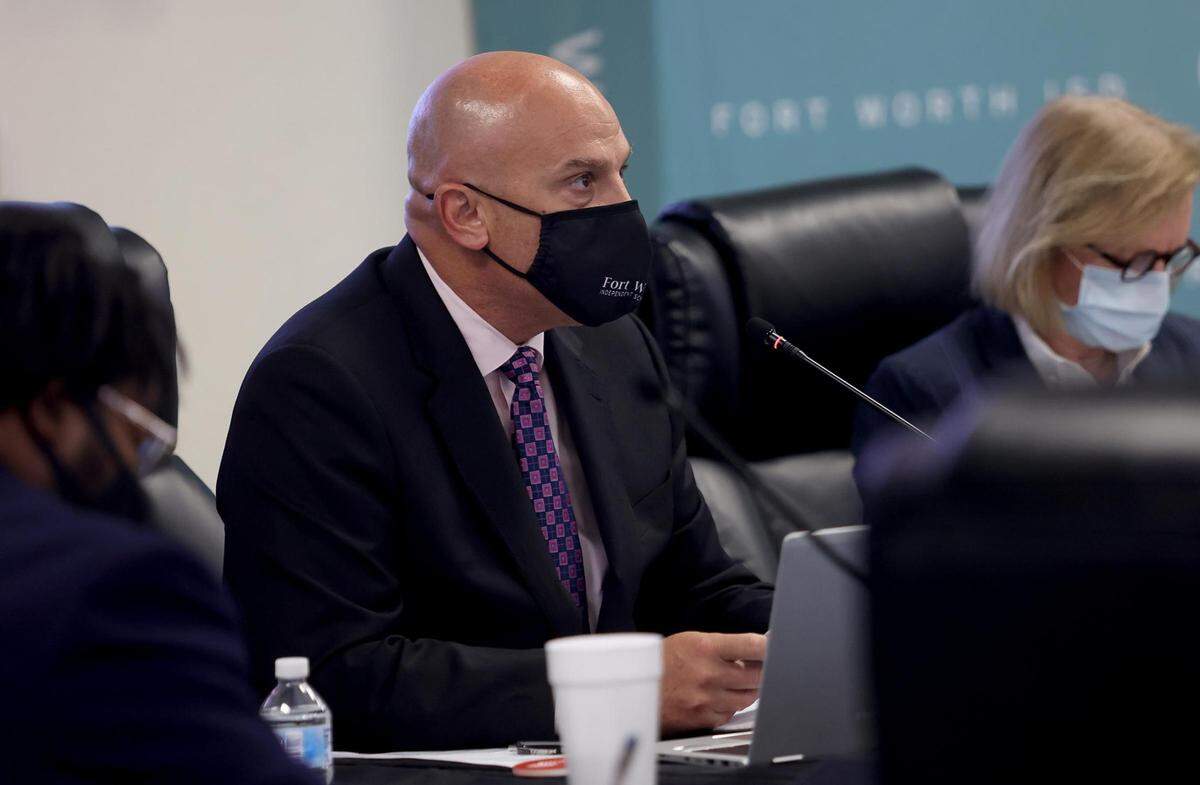
Those 2019 trips, according to school district records, cost a total of $23,448, about $1,400 more than Buhman’s travel expenses from that year.
Scribner’s most expensive trip was in July 2019, when he and several school board members traveled to Boston for a professional development program at the Harvard School of Business. That trip totaled $3,653 for Scribner, according to documents; the largest portion of that bill was the tuition, which included lodging, at more than $2,800 per person.
A spokesperson for the school district repeatedly declined to make Scribner and other staff available for interviews for this story.
Oliver, the water district’s former general manager, logged at least 12 out-of-town trips in 2019, costing a total of $16,258. He spent 32 weekdays, plus one additional weekend day, partially or entirely out of the office on business.
In addition to Oliver’s 12 trips, records show two conference registrations that do not appear to be attached to other expenses, making it unclear whether Oliver went on those trips.

Oliver told the Star-Telegram in a text message that he did not wish to comment but added, “throughout my tenure at TRWD, and until the day I left, TRWD was regarded, by people in the business, as one of the best run water agencies in the state & the country.”
Cooke, the city manager, logged nine out-of-town trips in 2019. Maenius, the county administrator, logged 11 trips in 2019; nine were single-day. Records also show two additional trips with documented registrations or down payments but no other expenses.
Besides Buhman, one other official stood out for number of days spent out of the office in 2019.
Russell Schaffner, an assistant county administrator, spent 100 days in Austin in 2019, records show. He works as the county’s legislative liaison and spends the majority of the Texas legislative session in the capital.
Schaffner is “responsible for monitoring the activities of the legislature, the committees of the legislature and state agencies,” Maenius said. “He’s got to be down there because something may pop up that needs to be resolved within an hour or two and you just can’t get that whenever you’re not down there.”
The county owns a condo in Austin, where Schaffner stays. His out-of-town expenses mostly fall within his per diem of $50 per full day, plus transportation costs such as fuel. The county purchased the 485-square foot condo in 1998, according to Travis County property records. It paid $55,500, county records show.
Other top officials whose 2019 travel records were reviewed by the Star-Telegram were:
The Fort Worth school district assistant superintendent, Karen Molinar, who traveled four times over a total of 13 days.
A Tarrant County assistant county administrator, Lisa McMillan, at the time the county’s economic development coordinator, who took three trips over a total of nine days.
A Tarrant County assistant county administrator, Jay Singleton, who traveled twice over a total of five or six days.
A Fort Worth deputy city manager, Jesus Chapa, who took four trips over a total of 13 days. Chapa’s records also include a “lost receipt” form filled out for an unspecified flight in 2019.
A Fort Worth assistant city manager, Dana Burghdoff, who took two trips over a total of six days.
A Fort Worth assistant city manager, Fernando Costa, who took two trips over a total of eight days.
A Fort Worth assistant city manager, Valerie Washington, who took four trips over a total of 12 days.
This story was originally published March 6, 2022 at 5:05 AM.