These Texas counties are getting new congressional districts in proposed map
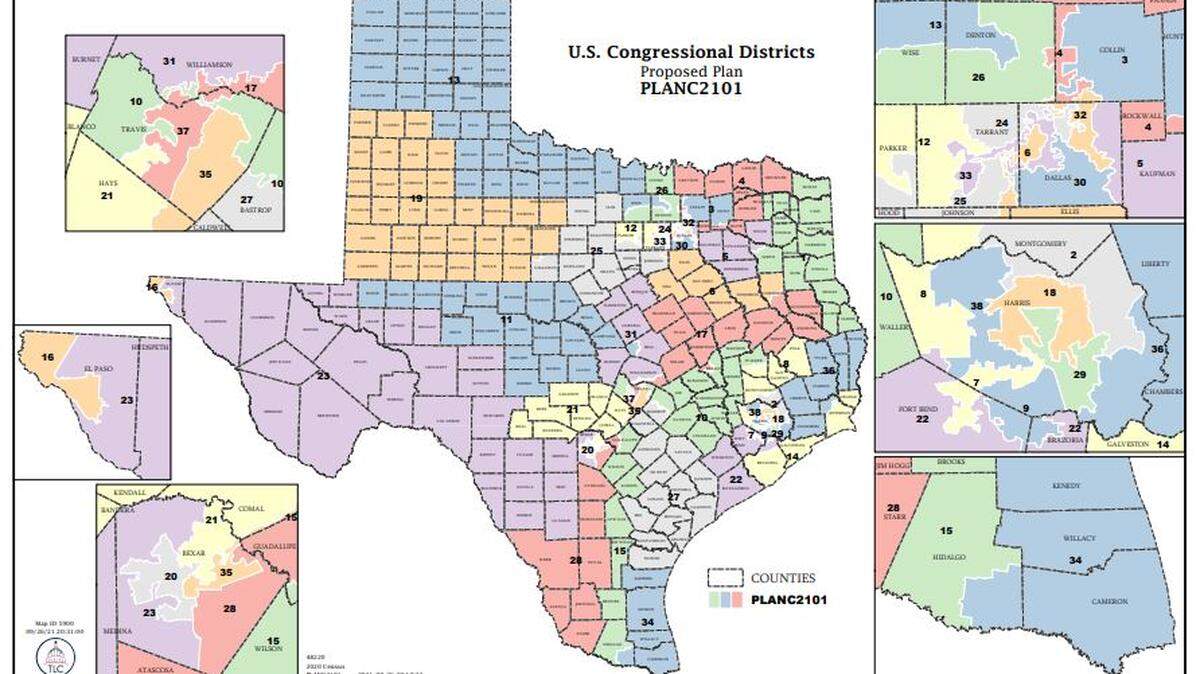
Texas’ two new congressional districts are going to Travis and Harris counties in an early proposal for the federal boundaries.
Lawmakers are in Austin for a special session to draw the state’s new legislative, congressional and State Board of Education districts. The Texas Senate on Monday released drafts of the congressional maps, filed by Sen. Joan Huffman, a Houston Republican.
The map is likely to change as it makes its way through the Legislature, but the initial version has Congressional District 37 in central Travis County and a small part of south Williamson County. Congressional District 38 sits primarily in central-east Harris County. Experts have previously said North Texas is in the running for one of the state’s new congressional district. Texas gained more seats than any other state.
While Tarrant County didn’t gain one of the two new districts, it would get an additional congressional representative in the proposal. The county has six congressional districts. In the proposed map, it would have seven, with 2% of the county’s southeastern edge falling into Congressional District 30, represented by Rep. Eddie Bernice Johnson, a Dallas Democrat.
Other districts would be altered, including Rep. Michael Burgess’ Congressional District 26, which as drawn now includes most of Denton County and about 8% of north central Tarrant County. Under the proposed map, his district would include less than 1% of the the county.
Tarrant County’s largest congressional district would be Congressional District 12, held by Rep. Kay Granger, a Fort Worth Republican. Rep. Marc Veasey, a Fort Worth Democrat, would see Congressional District 33 carved up in Dallas County, with Congressional District 6 held by Republican Rep. Jake Ellzey representing much the area. Ellzey’s district currently doesn’t fall in Dallas County.
Redistricting is done every 10 years after the latest census count. Census figures released in August showed Tarrant County gaining roughly 301,600 new residents, the fifth most of all U.S. counties. Harris County gained the most new residents and Bexar County, home to San Antonio, gained the sixth most. Travis County gained the ninth most.
Tarrant gains Democrat representation
The proposed map has Tarrant County represented by two Democrats in Congress (Veasey and Johnson) and five Republicans (Ellzey, Burgess, Rep. Kay Granger, Rep. Beth Van Duyne and Rep. Roger Williams).
The Democratic districts, Congressional Districts 30 and 33, would likely remain Democratic districts under the draft released Monday, according to an analysis of 2020 Senate election data.
All of Tarrant County’s Republican districts except for Granger’s would see an increase in the percentage of Republican voters, based on the Senate election data.
“I love my current district and the people and values we hold dear. I had hoped to keep my district intact, but changes in population make that very difficult. That being said, in the current map, over 80% of my district will stay the same, one of the highest retention rates of all Texas Members of Congress.” Granger said in a statement. “There is a long way to go in the process, and I will work to maintain a strong community of interest built on the foundation of national defense, education, and small business.”
Veasey in a tweet said he’s confident of his own reelection under the proposed district boundaries.
“However, I remain vigilant & committed to supporting a map that fairly respects the racial make-up of our state & protects the #votingrights of all our citizens, the tweet reads. “The census data shows that minorities fueled our #Texas’s population growth, and the state’s initial proposal fails to acknowledge this important factor. #Votingrights should never be subject to the whims or political priorities of any political party.”
How do the district’s demographics change?
Tarrant County saw increases in the number of Black, Hispanic and Asian residents between 2010 and 2020. Just under half of residents describe themselves as only white, a 13% drop from 2010.
Four districts saw a decrease in the percent of residents who identify as Black and/or Hispanic. This includes the districts represented by Veasey and Johnson, which saw 6.7% and 4.8% drops.
Three districts saw an increase in the percent of residents who identify as Black and/or Hispanic: Congressional Districts 6, 12 and 25.
Domingo Garcia, national president of the League of United Latin American Citizens, said 95% of population growth in Texas was in primarily Hispanic and minority communities.
He described the proposed map as “political partisanship gone berserk.” He said the map as drawn disenfranchises Latino voters, speaking to North Texas specifically in a Monday call with reporters.
“It’s being done to protect incumbents, and it’s being done at he expense of Latino voters being able to elect a candidate of their choice,” Garcia said.
Garcia said the organization intends to propose new plans while testifying before the Senate. If the plans aren’t adopted, Garcia said the group expects to challenge the map in court.
Texas NAACP President Gary Bledsoe said the proposed map “vastly diminishes the voting strength of minorities all around the State by either packing them into districts already electing minority candidates of choice or cracking them by pushing them into districts dominated by conservative White voters.”
“As the State has garnered 2 new Congressional seats on the backs of its minority population, it has sought to put forth a proposed Congressional map that is clearly retrogressive,” he said in a statement.
This story was originally published September 27, 2021 at 11:22 AM.