Long, slender fish — missing its fins — discovered in Brazil. It’s a new species

Researchers have discovered a long, slender new species of catfish from southern Brazil that, over time, has lost some of its fins.
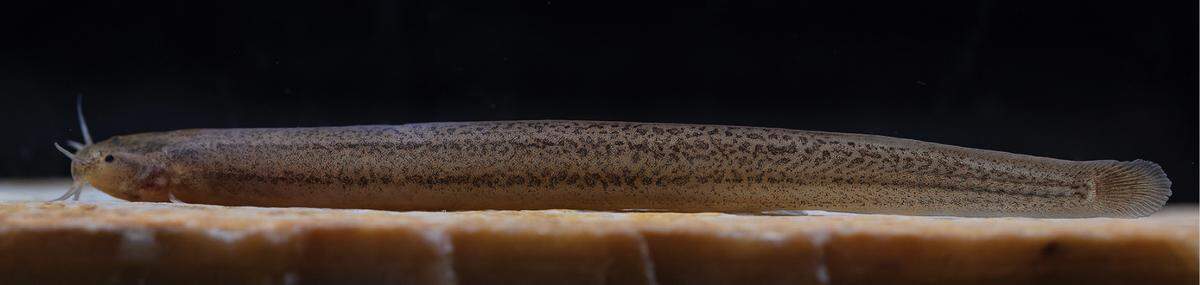
Listrura elongata is a fossorial, or burrowing, species that has evolved without its dorsal or pelvic fins, according to a study published July 4 in the journal Zoosystematics and Evolution.
The new species is known only from the Rio Camboriú basin, a small, isolated river basin in southern Brazil’s Atlantic Forest. It was discovered “inside a plant remnant similar to a fern stem with earthy” clay-like material stuck to it, according to the study.
Ten days after finding the first specimen, researchers scoured the stream for others like it, looking about 2,000 feet upstream to 1,000 feet downstream from where they found the first one.
No other catfish were found, and researchers said it is possible a flood from an upstream tributary carried in the first specimen, according to the study.
Researchers sampled 15 waterways in neighboring areas and discovered more populations of the new species in a small stream about 40 inches wide and up to 13 inches deep with a high concentration of amphibious plants, the study said.
“Further field studies in neighboring river basins were unsuccessful in finding other populations of L. elongata,” researchers said.
The new species is just over 2 inches long and is described as having a “pale yellowish grey” body with small, irregularly placed dark brown spots.
According to the study, skeletal comparisons between fish within the Listrura genus show “species either possess a well-developed dorsal fin or completely lack both the fin and its internal skeletal support” — there is no body structure in between.
The study also shows, for the first time, that the lack of dorsal fins in some of the catfish species in the Listrura genus, like in Listrura elongata, is not an inherited trait from an ancestor species, but rather an adaptation that happened independently among numerous species.
This is an example of convergent evolution, when species that aren’t closely related evolve to have similar features or behaviors, often as solutions to similar problems or circumstances, according to experts.
The research team included Wilson J. E. M. Costa, Caio R. M. Feltrin, José L. O. Mattos, Paulo J. Vilardo and Axel M. Katz.
This story was originally published July 4, 2025 at 3:30 PM with the headline "Long, slender fish — missing its fins — discovered in Brazil. It’s a new species."