
The Cooper apartments fire victims seek legal avenues to get answers, relief
AI-generated summary reviewed by our newsroom.
- Tenants pursue legal claims after 6-alarm fire displaces 800 at Cooper Apartments.
- Confusion over renters insurance prompts scrutiny of management’s liability.
- Lawyers explore class-action options amid allegations of negligence and poor safety.
Residents displaced by the fire at The Cooper apartments in Fort Worth’s Near Southside are seeking legal advice to get answers and looking into the possibility of filing a class-action lawsuit.
Tenants say they are upset about the lack of communication and assistance from management following the historic 6-alarm fire that damaged large sections of their apartment complex on West Rosedale Street and forced more than 800 people out of their homes. Some of them are looking for legal avenues to get compensation for the personal items they lost, the financial hardship of finding a new home and other damages suffered.
On June 30, Gov. Greg Abbott announced that he directed the Texas Division of Emergency Management to request the U.S. Small Business Administration join state and local partners in conducting a preliminary damage assessment. He also said that residents can submit a self-reported damage survey on TDEM’s website.
“This effort will help determine whether Texas is eligible for federal disaster assistance as we continue to assist our fellow Texans to recover and rebuild,” Abbott said in a statement.
Kaleb Godwin from KG Legal PLLC, a Texas business law, personal injury law, real estate law, contract law and estate planning attorney, has taken on some of The Cooper tenants as clients.
He said the process for the tenants is going to be that every tenant should make their own individual claim. While he thinks the claims should be resolved without turning into a lawsuit involving The Cooper and all of the affiliated parties, he doesn’t think that will be the case.
“I expect a fight and pushback and them to say that It was nothing that they could control,” Godwin said. “And if that’s the case, then ultimately each individual tenant will have the right to turn their claim into a lawsuit.”
Some tenants have expressed interest in pursuing a class-action lawsuit against the management company and other parties involved.
Godwin said that entails a separate process and that a court would have to certify it as a class-action suit. He is exploring that process while he reviews individual claims from the tenants.
One of the issues he is examining is renters insurance. Many tenants said they were confused by language in their leases and communications from management about insurance, which may have left them without coverage for personal damages.
Katie Steele, a lawyer for Varghese Summersett, said the firm is representing a number of tenants from The Cooper apartments fire as well.
“It’s heartbreaking — hundreds of residents lost their homes and most of their belongings in a matter of hours,” Steele said in an email. “No one expects to start their day and end it without a home, without their memories, and without the basic sense of security we all deserve. The tenants deserved better.”
She said If the fire was caused by negligence, like an electrical failure tied to poor maintenance or faulty electrical components, tenants may have strong legal grounds to hold the property owner or other responsible parties accountable. If the fire was fueled by negligence, tenants have every right to seek justice and demand accountability, she said.
“In Texas, tenants have a right to safe and habitable housing under the law,” Steele said. “After a historic, 6-alarm fire like the one at the Cooper complex, they may be entitled to compensation for personal injuries, lost belongings, relocation costs, and emotional distress.”
At the time of the fire, a contractor for Cano Electric Inc. was working on one of the HVAC units located on the roof of Building 1, according to a Fort Worth Fire Department report. The electrician told investigators that he installed a new breaker to replace one that appeared to be faulty. The new breaker auto-tripped, and when he went to disconnect the wiring he smelled smoke and called 911, according to the report. The electrician told the fire investigator that he had wired the new breaker the same way the old one was wired.
“Cano sends sincere condolences to all those affected by the fire and appreciates the efforts of all emergency responders at the scene,” said Debbie Cano, general counsel for Cano Electric, in an email. “Due to the recency and complexity of the event, Cano feels it would be premature and inappropriate to speculate or comment more substantially at this time. Cano is fully cooperating with investigators and all other associated parties and is motivated to fully understand what led to the fire.”
The Star-Telegram has reached out to the owners of The Cooper apartments, Lightbulb Capital Group, which listed the apartment complex and others in North Texas as their property online. Lightbulb Capital has not responded to the request for comment.
The complex is managed by Cushman and Wakefield. “We cannot comment as this is an ongoing investigation, but as always, the safety and security of the residents is our top priority,” a Cushman and Wakefield spokesperson said in a statement.
What concerns have tenants raised?
Alexandrea Carrera, a tenant on the first floor of Building 1 at The Cooper, said that she was working from home the day of the fire, on June 23, and during her lunch break, she heard banging in the hallway. She said that noise in her section of the complex was normal because of the amenities on the first floor.
“I hear more banging, but now I hear like yelling and multiple men yelling, so I thought that was a little strange and then ... out of the corner of my eye, I turned to look towards my patio, and I see fireman like running/briskly walking past my unit,” she said.
At this point, she said, she became concerned and changed her clothes and went outside to check what was happening. She noticed smoke outside and went back inside to grab her dog and cat.
From the time she heard noise and saw firefighters outside, about 30 minutes passed before she got a text message from the complex saying there was a fire, she said.
She said that in that time she didn’t hear any fire alarms, even though she has heard them go off at other times.
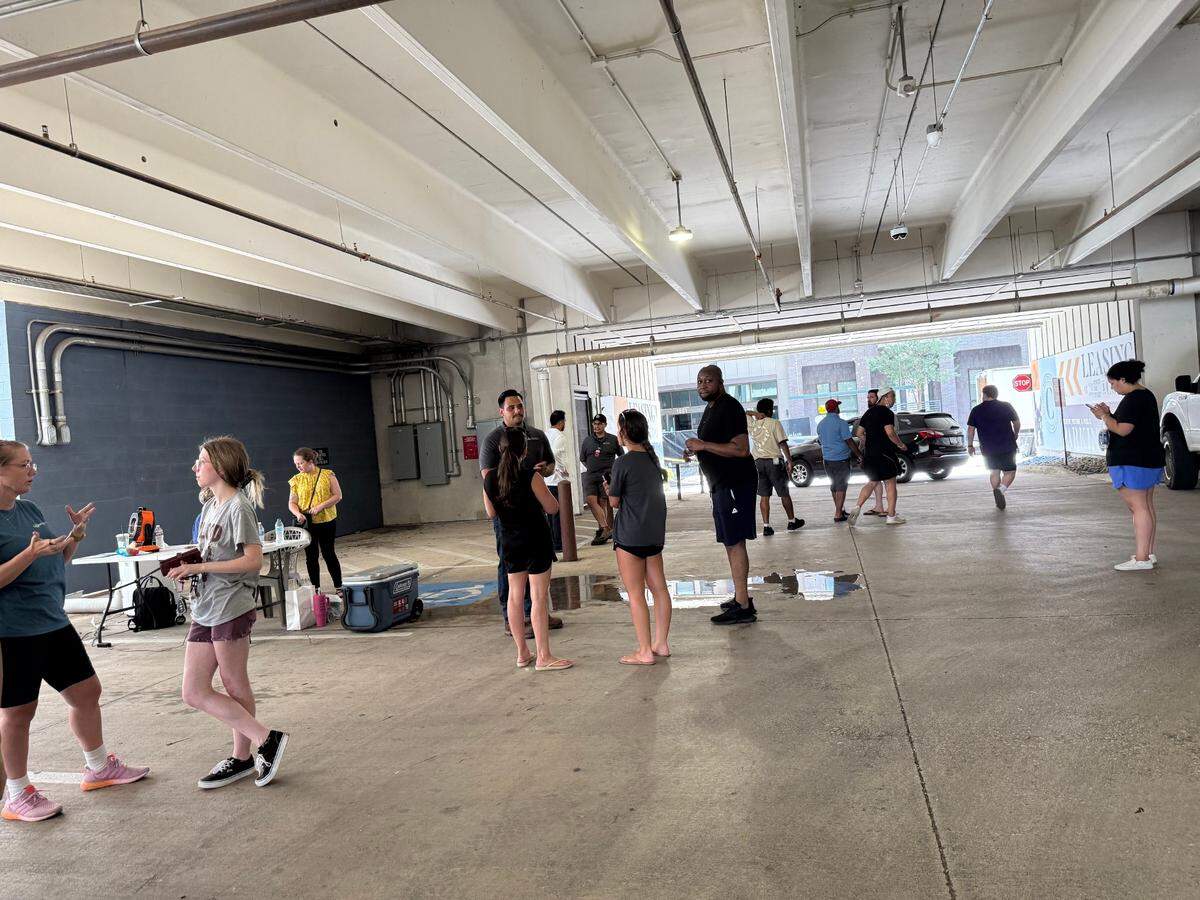
Carrera isn’t the only tenant who said that they didn’t hear the alarms inside their unit or in their hallway.
When she moved into her apartment, she had her own renters insurance policy, but a couple of months afterward she said she received an email from Cushman and Wakefield saying that mandatory insurance would be added to the rent fees.
“There wasn’t any sort of explanation of what their policy was,” Carrera said. “I don’t know, when you go into something like that and they tell you can have your own renters insurance or we’ll put you on our equivalent, you think it’s an actual equivalent.”
When she reached out to management through email after the fire, she said they told her that the policy paid through rent only covers liability for the building.
“Some residents who thought they were covered by the insurance included in their lease learned too late that it did not protect their belongings,” Steele said. “It appears that there may have been some shady dealings going on — and now tenants are paying the price for misinformation they never should have received.”
Tenants said that leaves them wondering why they were paying $14 a month for a policy that covers the building, but not their personal belongings and why it was labeled as rent insurance in their monthly statement.
“With respect to the insurance claim, then that could likely be enough to tip the scale to turn it into a class-action for a list of reasons,” Godwin said.
What can tenants do to protect themselves now?
Godwin said that tenants should keep a record of everything that was in their apartment down to their socks and an estimate of what everything cost. They should track down receipts for any big-ticket items lost in the apartment, appraisals or comparable items online.
Residents also should keep track of their other expenses caused by the fire such as hotel bills, food, gas, time off work, and moving costs, he said.
The attorneys said that tenants who have any evidence of reporting prior damage, electrical problems, smelling smoke, or other concerns about maintenance at The Cooper should save copies of those communications.
“As the property owner, Lightbulb Capital has a legal duty to ensure the premises are safe and compliant with code,” Steele said. “If they knew or should have known about a hazardous condition and failed to act, they may bear responsibility. Similarly, Cano Electric could be liable if its work on the HVAC system was faulty or contributed to the electrical failure that sparked the fire.”
Steele said that in the end liability depends on what each party knew, when they knew it and what actions they took or didn’t take to prevent the tragedy.