
A California rabbi relives family history with a visit to historic Fort Worth home
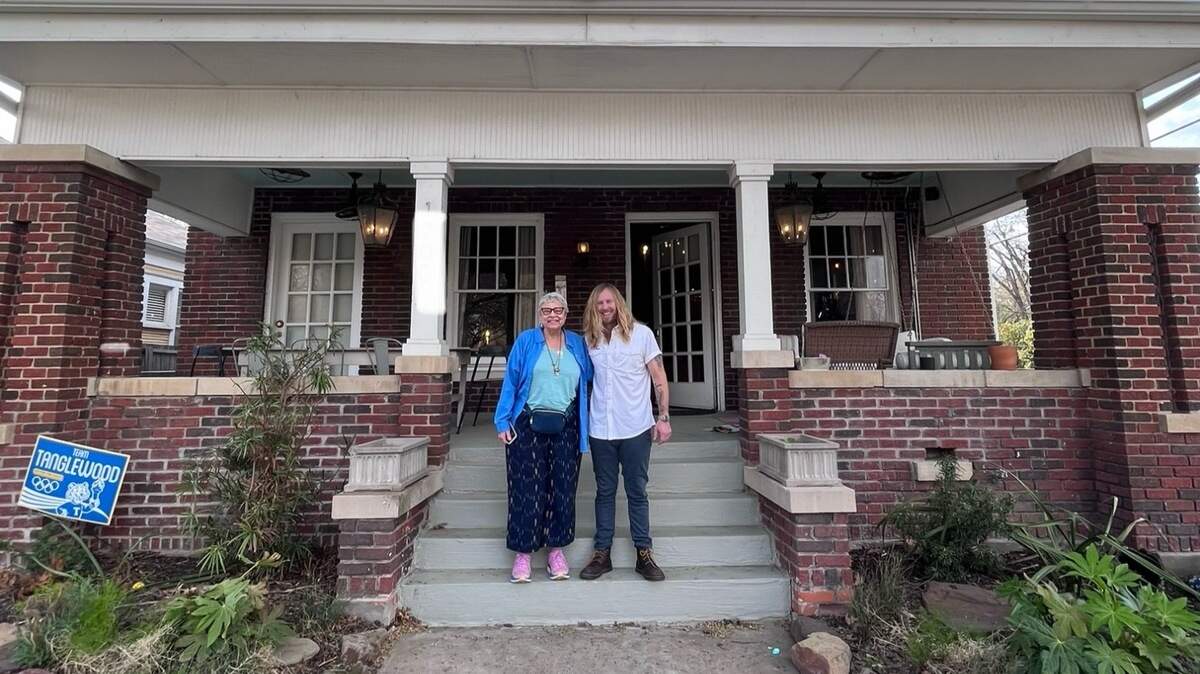
When Jamey Ice, a musician and entrepreneur who remodels century-old homes, received a text from a California rabbi who came to town to see Ice’s house on Sixth Avenue. Ice messaged back that he’d be there as soon as he got off work at 5:30.
At the front steps of his red-brick home, a dwelling with a wide front porch and a white picket fence in the National Historic Fairmount District, he met Rabbi Anne Brener, 77.
The rabbi told the 40-year-old homeowner that her mother, Eleanor “Honey” Schwartz Brener, was born there in 1923. Her aunts Thelma and Estelle and uncles David and Irving had also grown up in the two-story house.
They had memories of rolling up the oriental rug on a Saturday night and turning on the radio. After dark, their vintage Shamrock radio could tune-in radio waves from distant states. Whenever they heard a station playing music, they danced on the hardwood floor.
The floors were constructed with longleaf pine, rare timber harvested from virgin forests that once flourished in East Texas.
Rabbi Anne’s grandfather, Russian-immigrant tailor Joe Schwartz, who spoke with a Yiddish accent, had bought the four-bedroom home when it was new in 1919. He saved money for the mortgage from his shop at 106 E. 9th St., where he stitched clothing in the decades before ready-to-wear. After his wife Fannie died in 1926, he raised his five children through the Great Depression.
The tailor’s claim to fame was that he measured and sewed a custom suit for rancher Elliott Roosevelt, the son of FDR. From 1933 to 1944, Elliott Roosevelt was married to a local girl, Ruth Googins. Together they raised Hereford cattle at the Dutch Branch Ranch, acreage now largely under Benbrook Lake.
Rabbi Anne wears a keepsake from her grandfather — a metal thimble that dangles from a silver chain around her neck. It reminds her of his trade and his legacy.
Connection through a Hebrew tattoo
As the rabbi spun family stories, she noticed that Ice, who is not Jewish, had a Hebrew tattoo on his arm. The initial Hebrew words spell “Ozi v’zimrat Ya,” meaning “God is my strength and my song.” Those are the opening lines in Exodus 15:2, lyrics that Moses and the Israelites sang at the Red Sea.
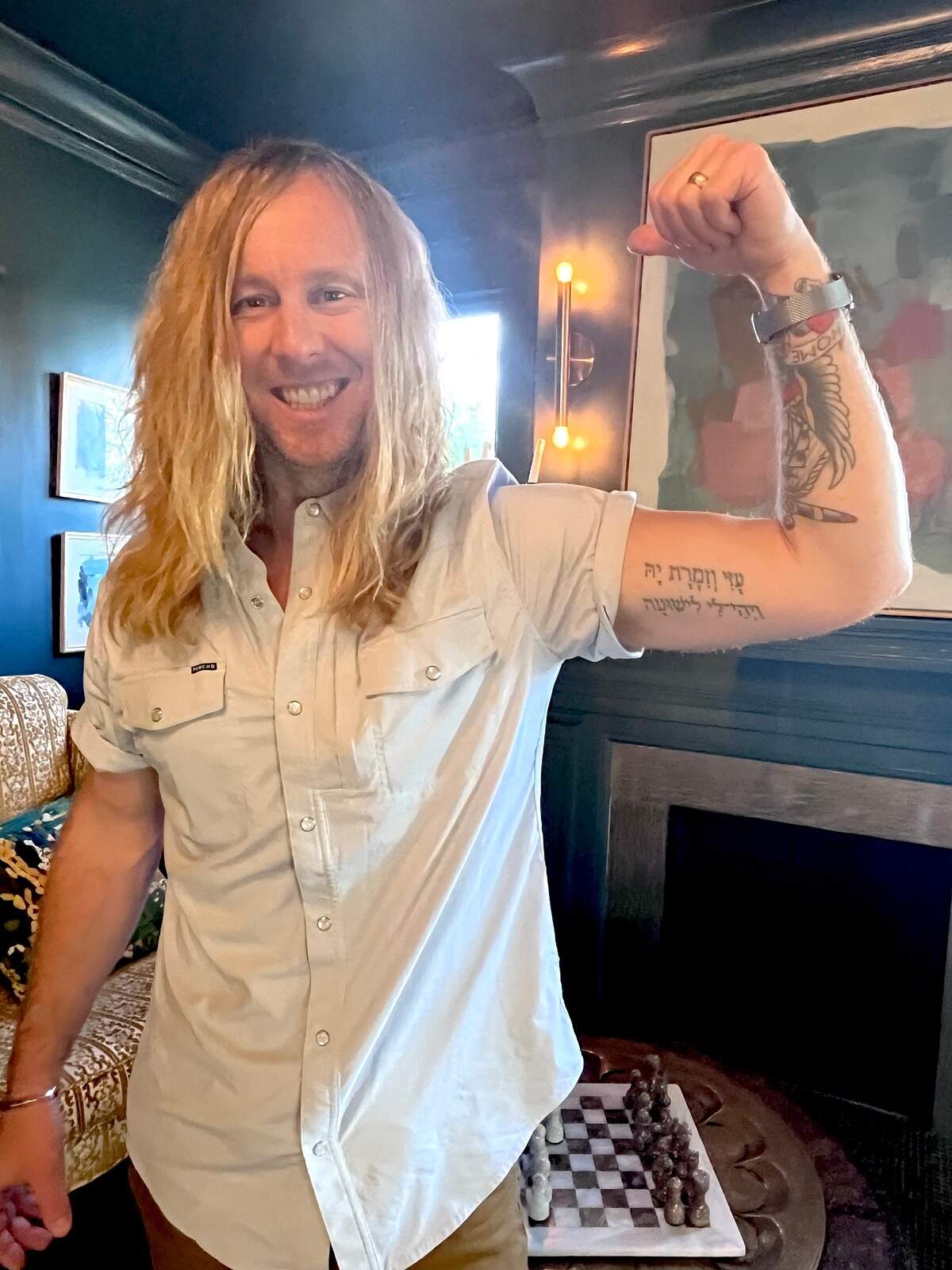
The rabbi began humming the lyrics and dancing. Ice joined her. “We were dancing around the kitchen,” he said. “She’s so cool.”
Rabbi Anne, ordained in 2008 from the Los Angeles campus of Hebrew Union College-Jewish Institute of Religion, is not a congregational rabbi. She is a professor at the Academy for Jewish Religion California, a seminary that trains and ordains rabbis, cantors, and chaplains.
A psychotherapist, Rabbi Anne leads workshops that explore spirituality and psychology. She is the author of “Mourning and Mitzvah,” a 313-page book that helps people follow a path from grief to healing. The volume’s 25th anniversary edition, from Jewish Lights Publishing, was updated in 2017.
During the rabbi’s visit to Texas, she connected for lunch with two cousins — Morton Meyerson, namesake of the Dallas Symphony Hall, and Janis Scarlet Meyerson, a yoga teacher. Janis formerly operated Jon’s Grill on South University Drive and recalled that after her brother Jon Meyerson’s death in 2001, Rabbi Anne sent her a copy of “Mourning and Mitzvah.” The two Meyerson cousins, though distantly related to Rabbi Anne, remain close with their California kin. They are linked by Mort Meyerson’s great-grandmother who was a sister of Joe Schwartz, the immigrant tailor.
The soul of an historic house
Rabbi Anne lived in the house on 6th Avenue until age 3, when her mother moved to New Orleans. The tales her family told still resonate.
“I’m writing ‘Stories from 6th Avenue,’” she said. “It started as a memoir and turned into stories. It’s fiction with a grain of truth.”
Coincidentally, Ice is CEO of 6th Ave Storytelling, which helps local entrepreneurs market their businesses. He hosts a You-Tube podcast titled “Stories with Soul. “
Last month, Ice posted on Facebook a photo and a few paragraphs about the rabbi’s visit. It drew a large, neighborly response.
It’s not unusual for homeowners living in historic houses to hear a knock on the door from strangers with ties to the dwelling. They yearn to visit the past.
“The soul of an old house resonates with people,” said Ice, who, with his wife Melissa, purchased their 6th Avenue house in 2012. It was so rundown, it was auctioned off on the Tarrant County Courthouse steps.
“Old houses have character and style. There’s a history,” he said. “What a reminder of why I love real estate. ... It’s always about more than just buildings. It’s about stories, legacy, connection.”
Hollace Ava Weiner, an author, journalist and archivist, is director of the Fort Worth Jewish Archives.
This story was originally published April 26, 2025 at 5:00 AM.