
Orphaned in the Holocaust, these sisters made it to Fort Worth. But then what happened?
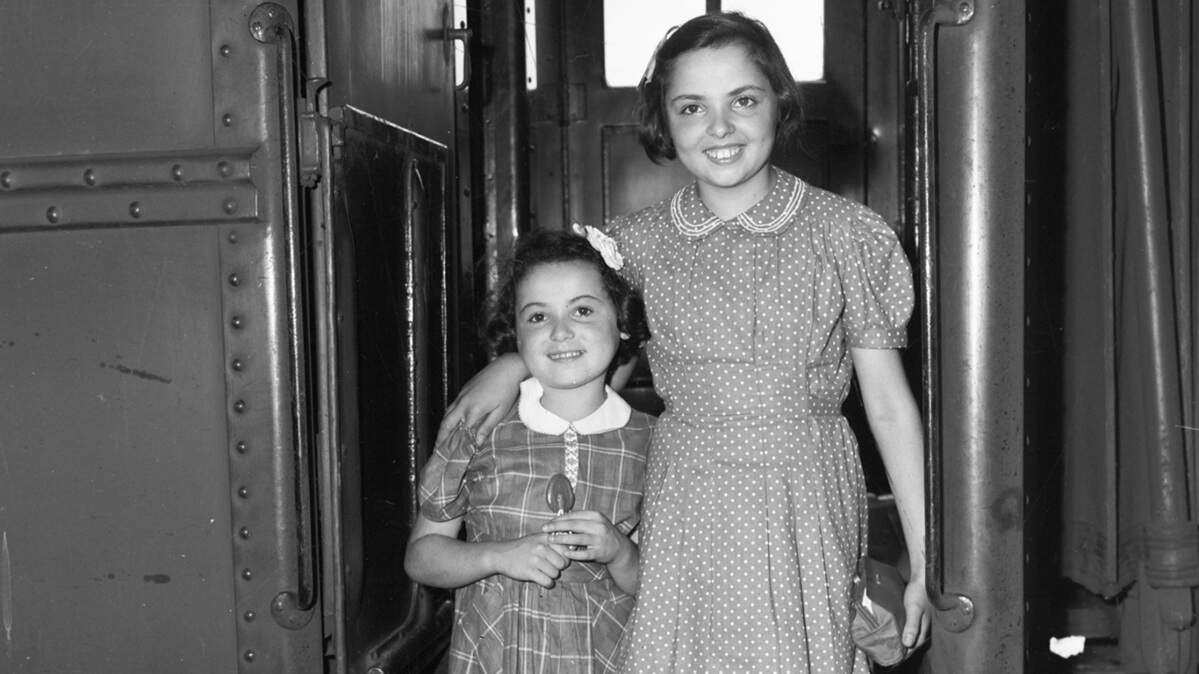
How to untangle the saga of the Kokotek sisters, Elsa and Inge, two Holocaust orphans whose heartwarming photo was snapped in Fort Worth in 1941? The photo was taken the moment they arrived at the Texas & Pacific Station into the welcoming arms of their aunt and uncle, Ruth and Sol Englender.
Local historian Susan Kline, assigned to assemble a permanent photo exhibit of passengers arriving at the rail terminal since it opened in 1931, was equipped to research captions for news pictures of FDR, Will Rogers, Amon Carter, porters, WACs, and traquerias who laid track for the railroad.
But the Kokotek girls had left barely a trace in Fort Worth.
Their aunt and uncle had changed the spelling of their last name, from Englender to Englander, which made them hard track in phone directories. The couple had moved multiple times as they climbed the social ladder in Fort Worth. Within a year of the refugee sisters’ arrival, their aunt and uncle had disowned the girls and turned them over to a social worker. When the children’s Aunt Ruth and Uncle Sol passed away in the 1970s, their obituaries did not mention the Kokotek nieces among the survivors, although several nephews were listed. Why the rupture?
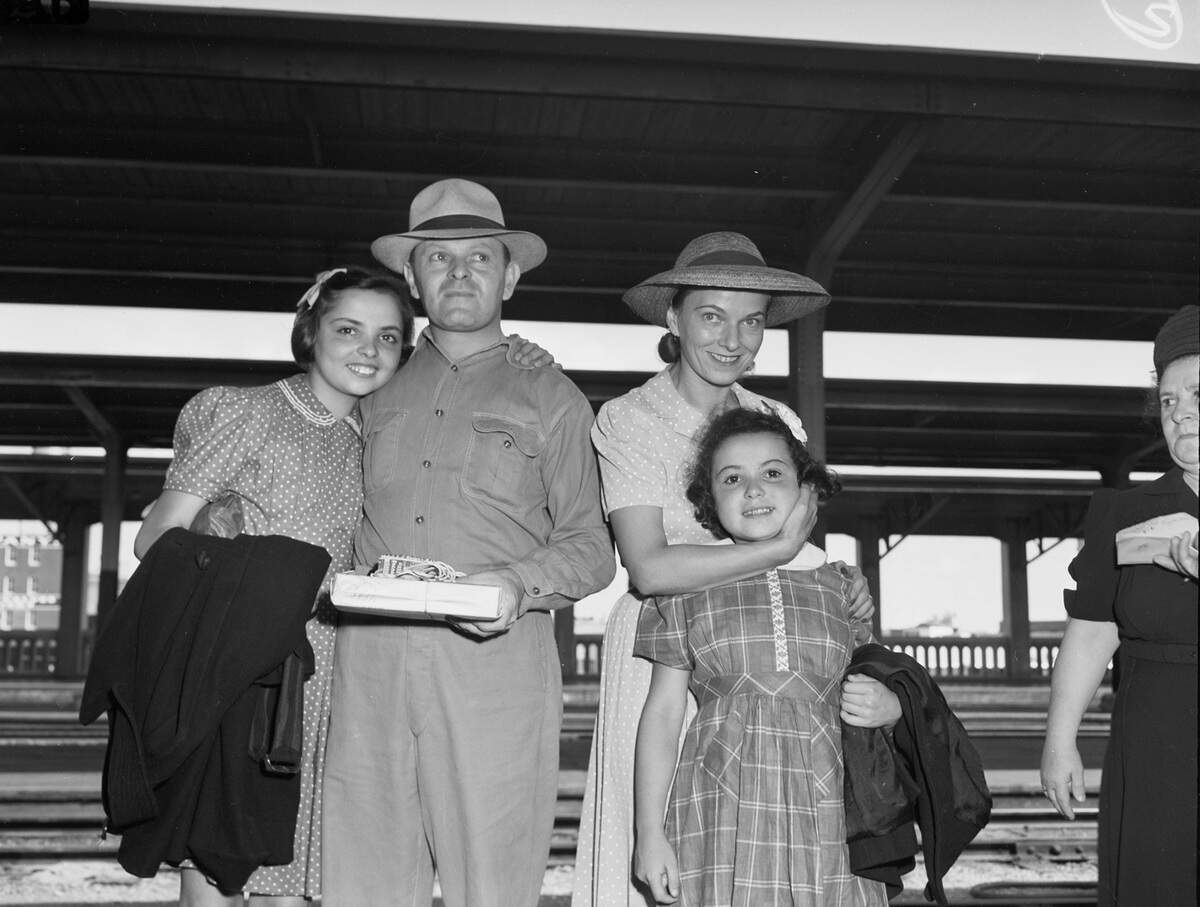
The Kokotek girls’ photograph came to my attention two years ago when the historian assembling the T&P photo exhibit asked me, as director of the Fort Worth Jewish Archives, to track down the sisters’ story. Gradually, I did — with help from yellowed membership records (called “dead files”) at Temple Beth-El; “clergyman cards” with genealogical details at Congregation Ahavath Sholom; news articles in the Texas Jewish Post, Fort Worth Press, and Star-Telegram; databases at Yad Vashem, the Holocaust authority in Jerusalem; and tech assistance from the Ackerman Center for Holocaust Studies at UT-Dallas.
Slowly, their saga came into focus.
Kinder Transport from Germany
The sisters had departed their hometown of Ludwigshafen, Germany, in 1938 on a Kinder Transport, a train that evacuated Jewish children from Germany and Austria. Their mother had died in 1935. Their father, Samuel Kokotek, was deported to Poland, suspected of espionage because he was in the printing business. That was his second arrest. Months earlier, he was placed in a French internment camp then released.
During this unsettled period, Samuel Kokotek had married his first wife’s sister, who gave birth to a baby boy.
When Samuel was deported to Poland, so were his wife and young son. Databases list them as living in Bedzin, a Polish town where Jews were crowded into a ghetto. They resisted their Nazi captors, died of hunger and disease or perished at nearby Auschwitz. (No specific death records have yet surfaced for Samuel, his wife, and son.)
When the Kinder Transport carrying Elsa and Inge arrived in Paris, it was met by the Oevre de Secours Aux Enfants, an international children’s rescue committee. Escorts whisked the youngsters to Chateau de la Guette in St. Denis, a 12th century castle 38 miles from Paris. Operated by the Rothschild Foundation, the chateau’s grounds became the temporary home for 130 young Jewish orphans as well as a physician, school teachers, maids, butlers and a chef. Elsa would forever remember the delicious food, comfortable beds, and French tutors.
When the Nazis invaded France in May 1940, the children were discretely moved to La Bourboule, a Rhone River ski resort in unoccupied France, where their schooling continued.
A Mercy Ship to the New York
The only safe port out of Europe was Lisbon, the Portuguese capital, where an international coalition was equipping Mercy Ships to transport asylum seekers to New York. With fanfare and newsreels, the first ship set sail June 10, 1941. There was apparently room for Elsa, who was 13, but not Inge, age 9. Elsa refused to leave her little sister behind. Both Kokotek girls were on board the second Mercy Ship, the SS Mouzinho, when it set sail Aug. 20. The ship anchored in New York Harbor Sept. 1.
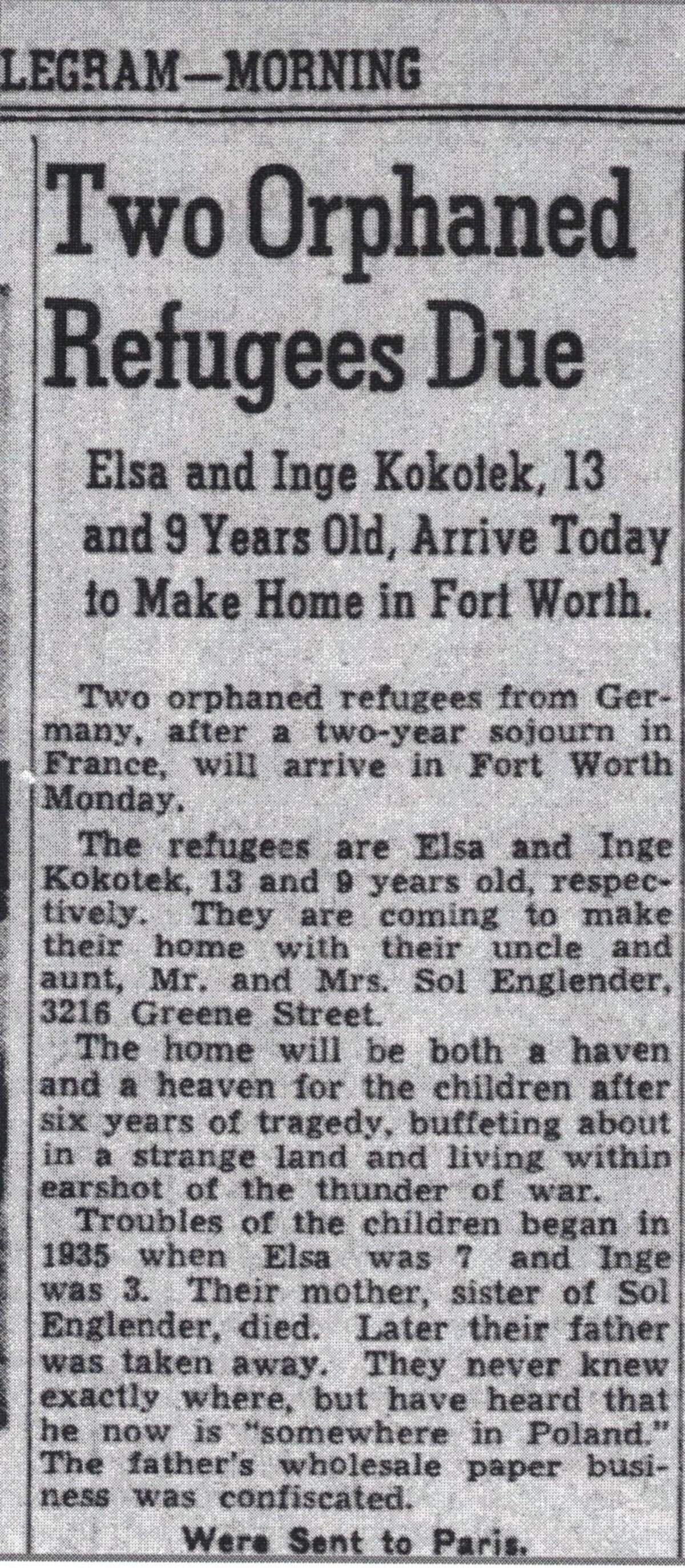
During the next week, the girls received new clothing and tickets for Texas. Once in Fort Worth, Elsa enrolled at McLean Junior High, rapidly learned English and became an honor roll student. At Temple Beth-El, she was photographed with the Confirmation Class of 1942.
Inge, the younger sister, never adjusted to Fort Worth. She hoarded food in her bedroom. She pulled off her dolls’ heads and buried them outside the house at 3216 Greene St. Her Aunt Ruth, sick with worry about her own daughter stranded in Europe, could not handle the stress. During the summer of 1942, she demanded that her husband Sol find another home for the girls.
Uncle Sol, an entrepreneur who manufactured burlap bags and ladies handbags, contacted the sisters’ social worker, a Mrs. Gibbs. She called the Jewish Federation of Dallas and drove the girls to the home of Les and Helen Jacobs. Helen, a wealthy volunteer who arranged housing for wartime immigrants, said the girls could spend the night at her house. That one night stretched into years.
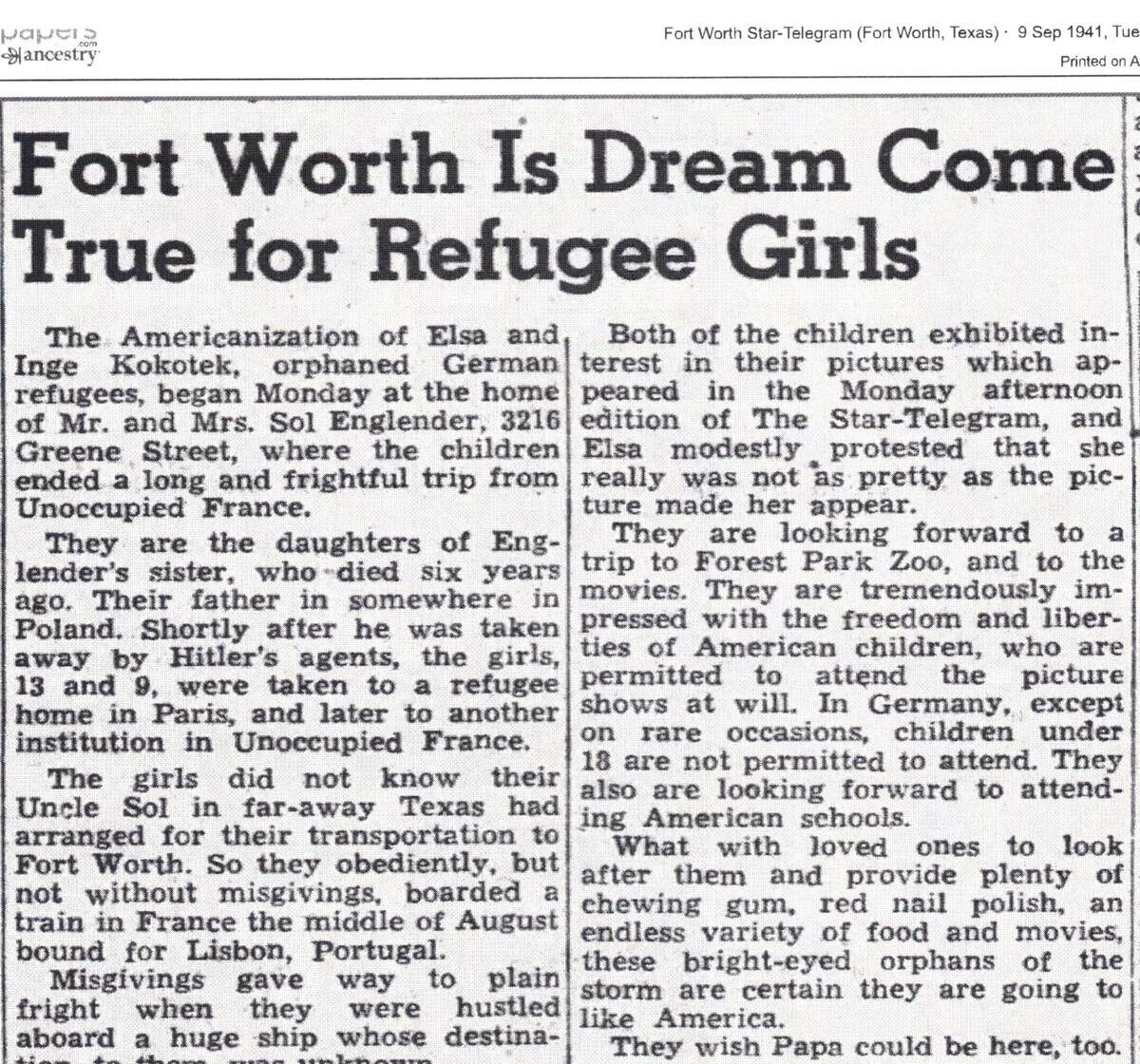
For Elsa, the transition was heavenly. The Jacobs’ daughter gave her hand-me-down clothes from Neiman-Marcus. Elsa lived with the Jacobs family until she married Milton Abramson in 1947 at Dallas’ Temple Emanu-El. The couple had two children, one grandchild, and three great-grandchildren. Elsa died in Dallas in 2020.
For Inge, adjustment remained traumatic. She ended up at a home for troubled teens in St. Louis. She ran away multiple times but eventually returned to Dallas with Elsa. She graduated high school and worked for 20th Century Fox in California. In 1961, she married William Kessler, raised two children, and died in Florida in 2006. There are four grandchildren in her family tree. They did not let the past define her life.
The Kokotek sisters were among the 1,000 unaccompanied Jewish refugee children who sailed to the U.S. while the Nazis were waging war in Europe. Had they stayed in Europe, chances are they would have been among the more than 1.5 million Jewish children who perished during WWII.
The Fort Worth photo exhibit, with 11 larger-than-life photos, is in a passageway inside the T&P Station. The historic display is a small part of a larger public works project called the T&P Passage, which involved constructing a well-lit, landscaped path from a bus stop at 221 W. Lancaster Ave. to the landmark, 12-story, terminal building. The T&P Passage and the photo exhibit formally open Dec. 2 with an outdoor ribbon cutting at the bus stop at 4 p.m. Eight of the Kokotek sisters’ out-of-town descendants plan to attend.
Hollace Ava Weiner, an archivist, author, and historian, is director of the Fort Worth Jewish Archives.
This story was originally published November 16, 2024 at 5:00 AM.