‘It’s a crisis in Fort Worth’: FWISD board names improving reading as top priority
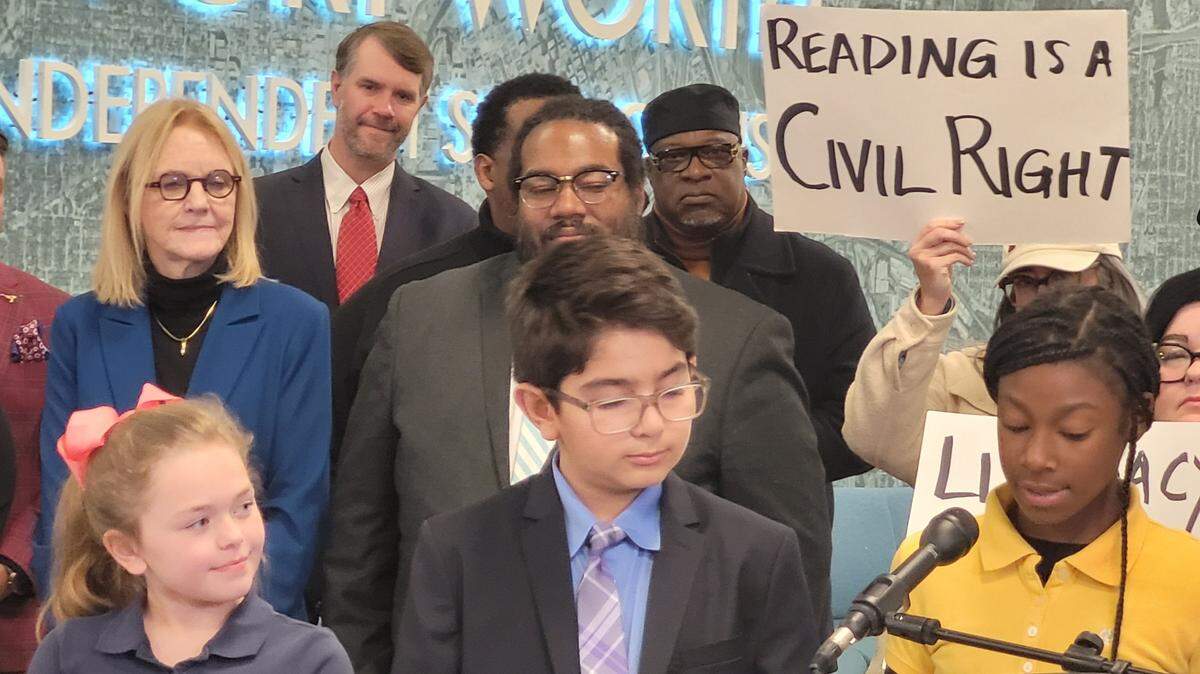
Officials and board members in the Fort Worth Independent School District are pledging to make improving student literacy the district’s top priority.
During a news conference Tuesday, Jan. 21, board members announced a resolution calling for Fort Worth ISD to ensure that all students are able to read on grade level. The resolution, which the school board unanimously approved Tuesday evening, directs the superintendent to develop a plan to move the district toward that goal.
The plan is ambitious; statewide, only about 52% of public school students meet or exceed reading at grade level.
Flanked by board members, Fort Worth City Council members, parents and students, Karen Molinar, the district’s interim superintendent, said the reading problem demands a city-wide commitment to literacy — one that goes beyond Fort Worth ISD. Several board members expressed hope that the other 18 school districts in Tarrant County will pass similar resolutions in the coming weeks and months.
“It’s a crisis in Fort Worth and Tarrant County,” Molinar said. “It demands our attention right now, and it has received it.”
Molinar acknowledged that district and city leaders have made similar proclamations in the past, to little effect. In 2017, Superintendent Kent Scribner gathered city leaders, including Mayor Betsy Price, to announce the 100x25 FWTX initiative, which was built around the goal of having 100% of Fort Worth third-graders on grade level in reading by 2025. Just weeks into the new year, the city is nowhere close to that goal: Only 31% of Fort Worth ISD’s third-graders were on grade level in reading on last year’s STAAR exam.
The difference this time, Molinar said, is that the goal will come with a detailed plan for reaching it. During the board meeting that followed the news conference, Molinar outlined the early stages of a literacy plan for the district, including developing a district-wide framework for how schools handle literacy instruction, aligning budgets and school resources behind literacy priorities and monitoring students’ progress.
Aside from the literacy plan, the board also adopted a five-year strategic plan at Tuesday’s meeting. That strategy calls for the percentage of third-graders reading on grade level to climb steadily over the next five years, with 50% meeting grade level on the state test by 2029. It outlines a number of steps the district should take to get to that goal, including looking at school turnaround models that have shown promise in similar districts and redirecting money toward literacy programs.
The plans come about five months after Fort Worth Mayor Mattie Parker spoke at a board meeting, calling for a community-wide effort to improve the district’s reading scores. Parker called the district’s academic outcomes “unacceptable,” and pointed to steady gains in other districts, even as state test scores have stagnated in Fort Worth ISD. Parker, who wasn’t at Tuesday’s press conference, called on the board and district leaders to partner with the city to fix the problem.
Fort Worth Mayor Pro Tem Gyna Bivens said the problem of illiteracy is an issue not just for schools, but also for the city more broadly. As it stands today, Fort Worth can still attract companies bringing high-paying jobs because the city has the talent pool those employers need. But if the city’s schools don’t produce graduates who can read well, employers won’t want to come here, she said.
Bivens encouraged families to get involved in their kids’ education. Parents need to ask teachers if their kids are reading on grade level, she said. Even out-of-town grandparents can get involved by reading to their grandkids via video call, she said.
“The future of Fort Worth depends on collective action to improve literacy, and we’re doing that,” Bivens said.
This story was originally published January 21, 2025 at 9:59 PM.