Wondering why art is popping up in your Fort Worth neighborhood? You voted to pay for it
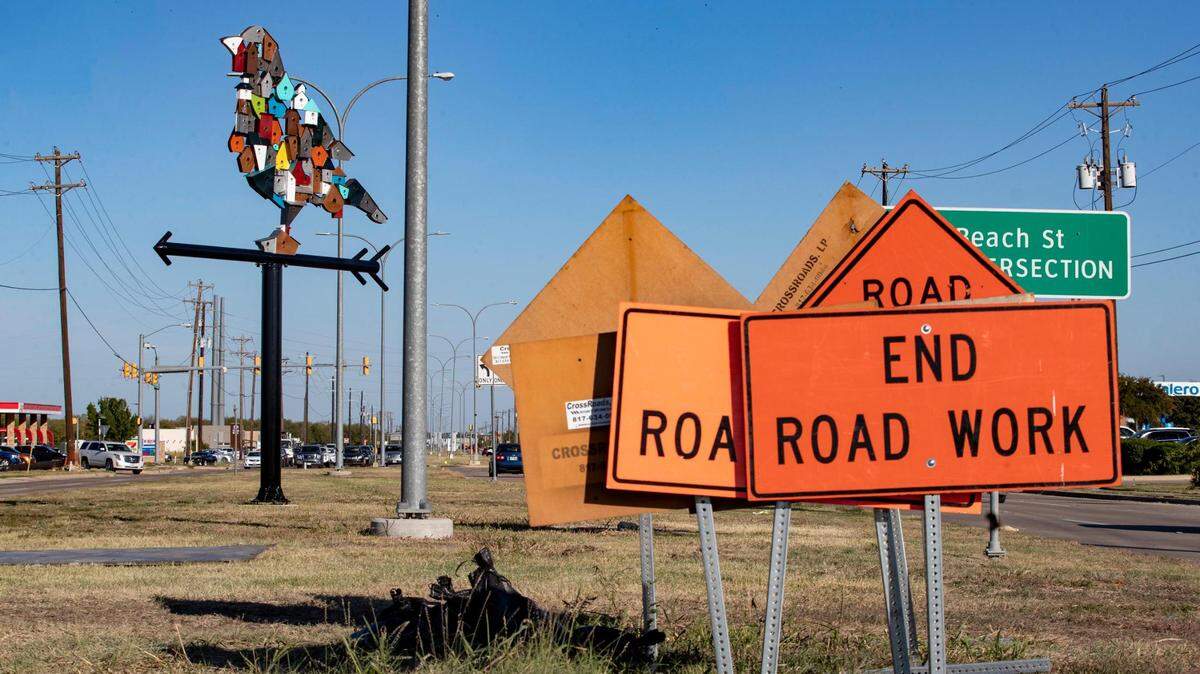
The statues blend in, yet somehow manage to stand out in the sprawling suburb in far north Fort Worth. They stand tall in the middle of medians between light posts on North Beach Street and Golden Triangle Boulevard.
There’s a bird statue made entirely of birdhouses. There’s an armadillo made of worn shovel heads. There’s a wolf made of chain link fence.
Those who have seen the statues have mixed reviews. Some are fans. Some wonder if they could’ve been placed elsewhere. Others wonder why the statues are even there at all considering all the other things the city isn’t taking care of, like the unkempt grass on nearby medians and construction on nearby roads.
The statues didn’t just pop up overnight. Funding for the North Beach Street project came from the city’s 2007 critical capital needs program, as well as the 2008 bond, said Martha Peters, director of public art at Arts Fort Worth.
And more could be on their way, thanks to an ordinance that put a tiny portion of bond program funding toward public art.
The city approved an ordinance in 2001 that created its public art program. That public art program gets 1% of bond program funding for street art projects to 2% of bond program funding for projects in parks and buildings, Peters said. Arts Fort Worth is the nonprofit that runs the program, and it has completed nearly 100 projects with bond funding since.
The public art program, which works with a public art consulting group, wanted to have an art piece that flowed through the North Beach Street corridor and could be seen by car and on foot.
Then came Alabama-based sculptor Christopher Fennell.
The neighborhoods around the site of his sculptures used to all sit on ranchland. When Fennell thought of ranches, he thought of barns, and then thought of the weather vanes that sit on top of those barns. So he decided to make a series of 12 weather vanes from Shiver Road to Timberland Boulevard with native animals as toppers, each made of materials he found both ironic and funny.
The red-tailed hawk sculpture is made up of aircraft wings that were cut up and put back together to resemble fish and feathers. Fennell said someone from the area called him about the rooster statue and couldn’t figure out why the it was made of baseball bats.
Fennell used to live on a farm with a mean rooster who would attack unless you got it first. But also, the colors of the bat match those of a Rhode Island Red rooster.
Public art can be found all over Fort Worth, and Fort Worth Public Art has even created self-guided tours so people can see all the pieces in specific areas of the city.
Public art, to Fennell, gives communities face. Without the Statue of Liberty, the New York Harbor would just be the New York Harbor. And St. Louis wouldn’t be the same without it’s famous arc.
More than 200 comments have appeared on a September NextDoor post from Cece Miller inquiring about the statues. One person wrote they thought the money could have been better spent — they didn’t want to look at art while driving. Another person wrote the statues looked like they didn’t belong there. Others commented saying they liked the display.
Miller, who lives just off North Beach Street, likes the statues, though she wonders whether they could’ve been placed in a better location like a park.
Others online have questioned whether the art is a good use of taxpayer dollars. On another Nextdoor post from September, someone commented that the city should put down sidewalks and repair the streets with tax money instead.
Peters sends this reminder to Fort Worthians — only “a penny or two on the dollar” is going toward the art. Plus, it helps make the city its own and makes it more livable.
“What it adds to a city is kind of intangible,” Peters said. “But if it wasn’t there, it just wouldn’t have the same kind of feel.”
And to Fennell? All good artwork causes some sort of reaction.
This story was originally published October 25, 2022 at 6:00 AM.