
Fort Worth has a long history of Easter egg hunts, dating back to at least the 1880s
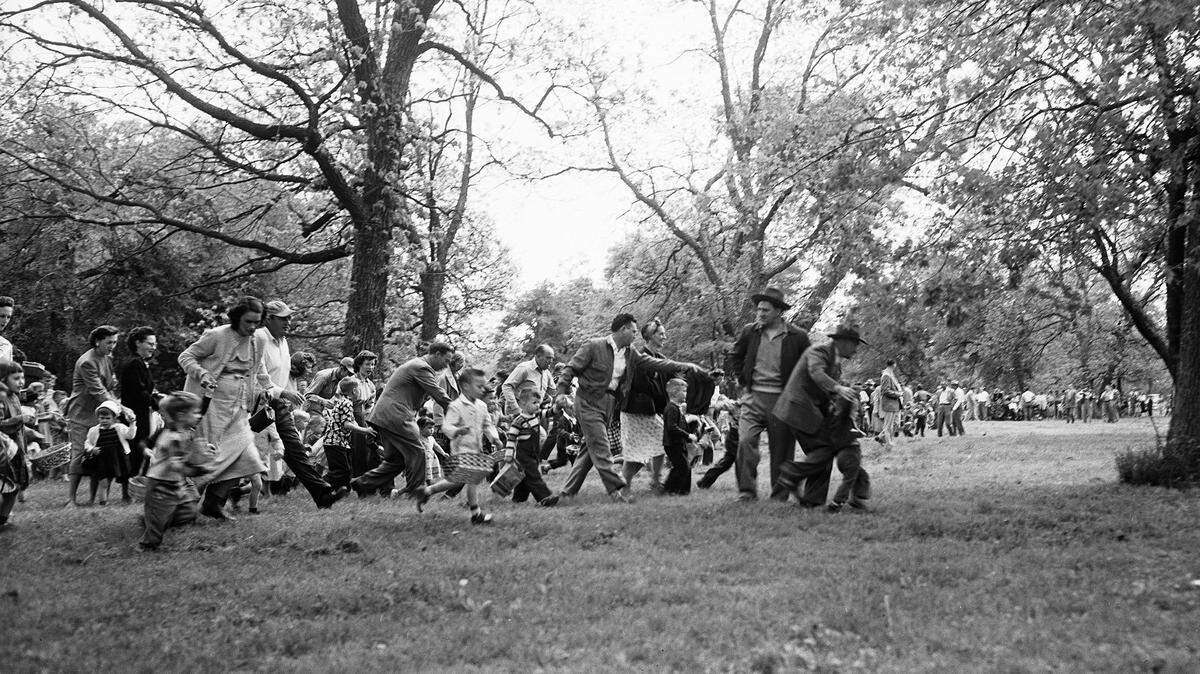
As with other major holidays in the Christian faith, Easter is layered with many symbols and observances, as well as complementary secular practices that have faith-based roots. Not the least of these is the Easter egg hunt.
In Christianity, the egg has been a symbol of rebirth since medieval times – and, therefore, associated with Easter and Christ’s resurrection. Others have traditions involving eggs, including Slavic peoples who decorated eggs beginning in pagan times, and Jews who see eggs as a symbol for spring and the circle of life and use them as part of Seder, a meal served to celebrate the beginning of Passover.
Dutch and German Protestants developed a tradition of dyeing eggs and eating them before or after Lenten prohibitions. Eastern Orthodox believers first dyed eggs red to signify the blood of Christ and, later, green for spring. German Protestant immigrants in the United States also adopted the Easter hare or rabbit as a judge of children’s behavior. The Easter rabbit was thought to lay eggs in the grass, which led to the concept of hunting for Easter eggs.
The date of the first Easter egg hunt is probably lost to time, but reports about hunts in the United States start popping up in newspapers during the early 1880s. The first mention of an Easter egg hunt in Fort Worth came in 1883. It noted that, “Germans in Fort Worth were busy yesterday preparing Easter eggs, and today the flaxen-haired Saxon children will be happy hunting the colored eggs in all out of the way places.” There was also a somewhat snarky note in an 1879 Fort Worth paper, which observed that chicken fights impacted the Easter egg business.
Fort Worth went all-in with a city-wide Easter egg hunt in 1897 overseen by the City Federation of Women’s Clubs. The venue was the newly dedicated City Park, later renamed Trinity Park. Among the more ordinary 1,000 dyed eggs were special prize eggs: one each colored gold and silver, four goose eggs, and an unknown number of spotted eggs. Local businesses contributed prizes. All 3,000 guests (2,000 of them children) paid a 10-cent park admission fee, and the money was used to fund park improvements. Willie Heffner, the 10-year old boy who found the gold egg, won a gold watch and chain contributed by jeweler J. E. Mitchell. Special prizes were reserved for children from the orphan’s home, whose admission fees were sponsored.

In 1906, the kindergarten association and Missouri Avenue Methodist Church hid 5,000 eggs in the park, and had 75 donated prizes available for the 3,000 children who attended. Easter egg hunt sponsors didn’t just include Christian and secular organizations. The Miriam Club, an organization for young, unmarried women started by the Fort Worth Council of Jewish Women, sponsored a 1920 Easter egg hunt for the children of the Tarrant County Orphans Home.
During the 1920s, there were a growing number of smaller club-sponsored hunts, not only for orphans but also for children in different school, neighborhood, or church groups. By 1930, the city-wide hunt featured 25,000 eggs hidden in six different parks, but a prominent Jewish couple, Queenie and Jack Danciger, also held an Easter egg hunt in their yard for their daughter Ruth and her friends. These events were social as well as religious – all part of belonging to the Fort Worth community.
Hunts continued to be popular during the Great Depression, but the number dipped during World War II when food was rationed to ensure that troops were at fighting strength. Baby boomer children brought a post-war resurgence in the number of Easter egg hunts. In 1953, Trinity Park hosted the hunt for white children, while Black children looked for eggs in Greenway Park. That pattern continued through the 1960s: the Jaycees hid 4,000 eggs in Trinity Park while a YMCA leadership class coordinated egg hunts at Lake Como and Sycamore Park and a group of B’nai B’brith teens sponsored a hunt for children at the Lena Pope home.

The number of local Easter egg hunts reported in the newspaper dropped drastically during the 1980s, but rose again during the 1990s and 2000s. The Covid pandemic shut down hunts located in city parks and probably many of those held in private yards. Here’s hoping that it is a custom that is revived, not only as part of a tradition in the Christian faith, but also for the joy and sense of community that it brings to youngsters everywhere.
Carol Roark is an archivist, historian, and author with a special interest in architectural and photographic history who has written several books on Fort Worth history.