Gas prices surpass $4 in Texas on Thursday, breaking another record, and keep rising
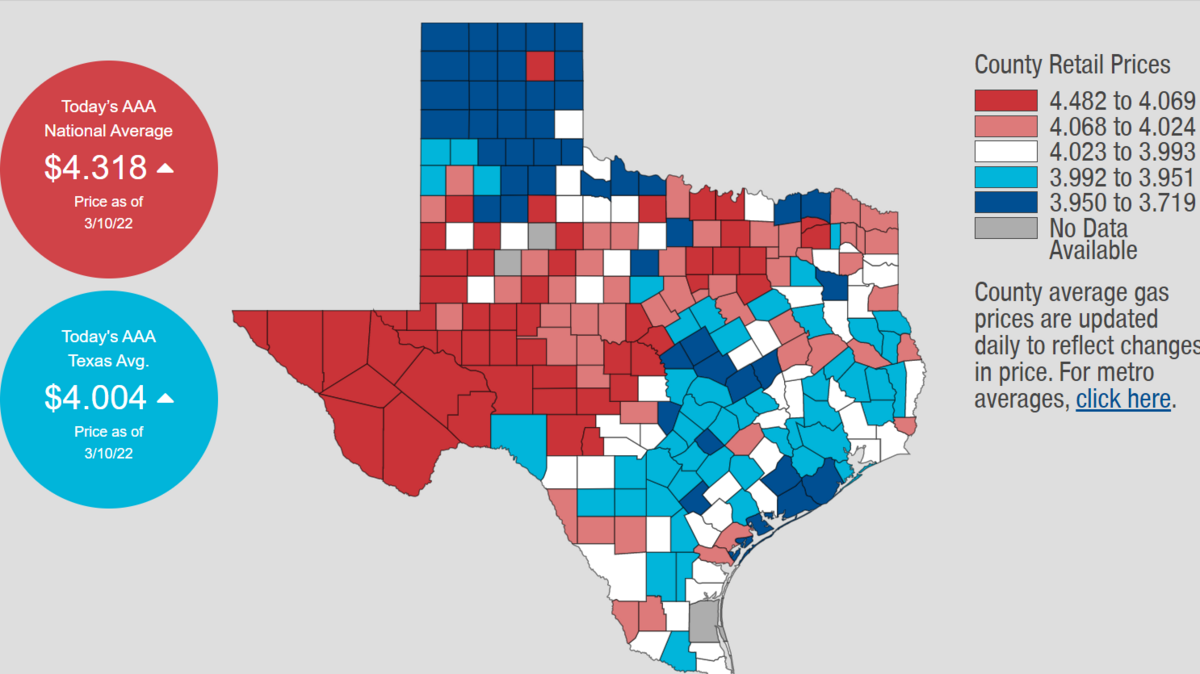
Surging gas prices broke another record in Texas on Thursday, hitting $4 per gallon, according to AAA Texas, while nationally the average price rose to $4.32.
In Tarrant County, gas is $4.07 on average, higher than the previous record set in July 2008. Gas has reached as high as $4.48 in western Texas counties.
“Gas prices are climbing at a weekly pace we’ve never seen before, breaking records that set in 2008 across the state,” said AAA Texas spokesperson Daniel Armbruster in a statement Thursday. “Prices are anticipated to keep rising due to Russia’s invasion of Ukraine and the impact it’s causing on crude oil prices.”
Statewide, Texans are now paying an average of $4 per gallon, up from $3.93 the day before, $3.38 a week ago, $3.15 a month ago. Compared to the $2.55 average a year ago, we’re paying $1.45 more now.
[Take our poll: Are gas prices changing your routines yet?]
——
President Joe Biden’s announcement Tuesday that the U.S. will ban Russian crude oil imports isn’t likely to be a singular cause of even higher gasoline prices for Americans, experts say — the U.S. gets only about 1.5% of its crude from Russia.
But if other nations follow suit, cutting off Russian imports as a sanction for invading Ukraine, gasoline prices here could skyrocket.
Texans could see $5 per gallon prices in that scenario, says Joshua Rhodes, a research associate at the University of Texas’ Webber Energy Group.
And the pain at the pump isn’t likely to go away anytime soon.
The state average will likely follow the nationwide trend, exceeding $4 a gallon, as early as this week.
“I’m afraid we may be in for a gasoline price in Texas that is higher than than any of us have ever seen before,” said Karr Ingham, a petroleum economist with the Texas Alliance of Energy Producers.
What effect will the ban on Russian oil imports have on the US?
Biden announced the Russia oil import ban before traveling to Fort Worth on Tuesday.
The news won’t have much impact on gas prices, experts say. “Our overall imports are small, and the Russian imports are a small share of those imports,” said Bill Gilmer, director of the UH Bauer Institute for Regional Forecasting.
So if that’s the case, why are prices rising?
The primary driver of gasoline prices is the cost of crude oil (currently $125 a barrel), which is set globally based on supply and demand. Right now, global demand is greater than supply, causing a rise in prices. The potential that Russia, the second largest producer of crude oil in the world, will produce and export smaller amounts of crude oil into the global marketplace, is causing an even greater surge in prices.
“What markets are doing is sensing the possibility that global supply may go down significantly, just because the amount of crude oil coming out of Russia may go down significantly,” Ingham said.
What role does the Texas oil and gas industry play?
Texas could help mitigate global oil supply concerns.
As the largest producer of crude oil in the country (producing 43% of U.S. crude oil), Texas could ramp up production to fill the void in global oil supply, according to Ed Longanecker, the president of the Texas Independent Producers and Royalty Owners Association. Currently, Texas is the fifth largest producer of crude oil globally, producing about 6% of all crude oil in the world.
“The Texas oil and gas industry has the ability and should move forward with increasing production to address supply shortages,” Longanecker said. “We’ve had two years of under-investment in domestic oil and natural gas production. The only way to help balance the market and to reach a supply demand equilibrium is to increase domestic production, especially with the announcement that we will be phasing out Russian imports of crude oil. And our operators are ready and willing to do so.”
We’ll likely set new records for oil production in Texas this year, Longanecker says.
“They have significant inventory of wells that they can start drilling and producing from in a relatively short period of time, which will increase the overall production from Texas and address those supply constraints,” Longanecker said.
We’ll see particularly more output in the Permian Basin, located in western Texas and southeastern New Mexico. It’s the fourth largest supplier of crude oil in the world.
With Texas producing more oil, we’ll see a positive effect on our state’s economy, Longanecker says.
“There will be benefits from an employment standpoint, obviously operators benefit from higher commodity prices, as do royalty owners in the state of Texas, and the state itself will benefit in the way of higher taxes that support all aspects of our economy,” Longanecker said. “But many prominent operators are being cautious with increasing their production because they want to avoid the more extreme periods of market volatility that we’ve experienced in the past. So there’s a balance and we have a long way to go to get to that point.”
Have we seen a spike in gas prices like this before?
We’ve seen gas prices spike like this in Texas three times before during conflict.
Gas prices spiked during World War II, then in 1973 because of an oil embargo imposed by the Organization of the Petroleum Exporting Countries, says Jim Klein, history professor at Del Mar College.
“Gas prices tend to jump immediately as a consequence of foreign events, but when those foreign events die down, or calm down, the price of gas starts to fall again,” Klein said. “There’s a lag of about maybe six months or so before the prices start to fall.”
They spiked most recently during the Iranian Revolution of 1979, to about $130 a barrel in today’s dollars.
The Texas oil and gas industry is historically made much more volatile during war, so the state will likely boom in the short-term because of the Russian war, Klein said.
How long will gas prices continue rising?
“It would be wise for consumers to settle into the notion that gasoline prices are going to be considerably higher for the foreseeable future, and let’s say just the rest of this year,” Ingham said.
For gas prices to start declining, oil supply will have to meet demand, meaning the U.S. will have to start producing more oil.
“The only way to address that,” Longanecker said, “is to increase output, and Texas can can lead in those efforts, which will eventually help to address those supply constraints.”
But even with increased domestic production, complicated by supply chain issues, it would still take months to push oil prices back down. Oil-producing countries Iran and Venezuela could also increase supply to meet global demand.
Another way we could see declining gas prices is if we stop using as much gasoline. That may happen involuntarily if we stop driving as much because gas is no longer affordable. Texans could decrease demand for oil by buying electric cars or taking another form of transportation.
According to expert projections, decreased demand is unlikely to happen. There’s going to continue to be significant demand for oil and natural gas for decades to come.
Last year, approximately 70% of American energy came from oil and gas. The Energy Information Administration forecasts that global energy demand will increase by 50% by the year 2050. And oil and gas demand will increase by 34% within that time.
On the other hand, gas prices could increase significantly more if Russia reduces its crude oil production by a large volume — by a third or one-fourth. If that happens, we could see the cost of crude oil rise to $150 or $160 a barrel, causing gas prices to surge. In that case, we could be paying $5 or $6 a gallon at the pump.
Gas prices will drop when the war between Russia and Ukraine ends, and Russia’s oil production gets back to normal, balancing out global supply and demand, experts say.
“Even though it’s painful, higher prices for crude oil and gasoline means ultimately that markets are at work trying to solve this problem,” Ingham said. “Consumers should certainly understand that this is a marketplace at work trying to solve this problem for them by incentivizing additional supply as quickly as possible.”
This story was originally published March 8, 2022 at 4:55 PM.