
Principal at Fort Worth’s San José Mission School had a heart for her Mexican students
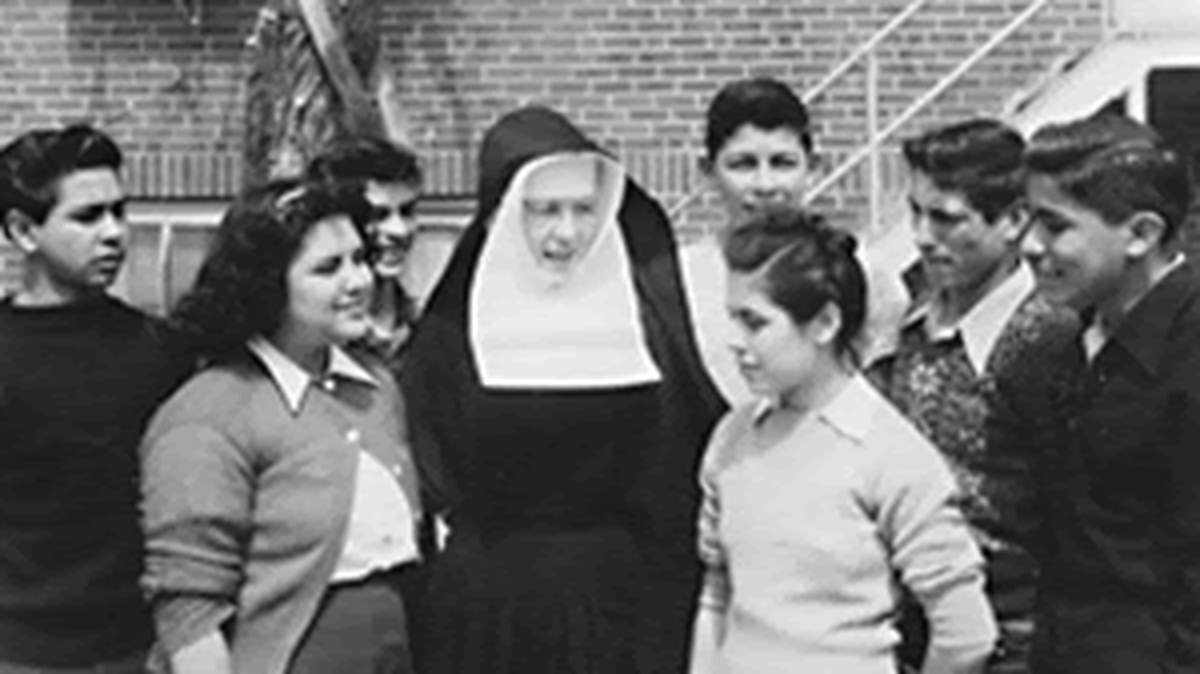
James Reza, a life-long resident of Fort Worth, recalled telling the Star-Telegram his memories of 20th century life in Cowtown. The paper sought his testimony along with 99 other individuals for an article by Jessie Milligan, “100 People, 100 Years,” published Dec. 31, 1999.
His recollection: “Uncle Joe in his Army uniform and I were run out of a restaurant downtown Fort Worth in 1943 after being told, ‘”Sorry, we don’t serve Mexicans.”’
Recently, he shared his memories of Sister Lawrencia, teacher/principal of San José Mission School formerly located at 14th and Commerce. Aware that a good education was pivotal to overcome discrimination, Sister Lawrencia told Reza as a San José student, 1942-1950, “I want you to be as good as the gringo boys.”
Established in 1926 as the Catholic school for Northside Mexican American students, the Sisters of St. Mary of Namur taught a rigorous curriculum with a focus on English mastery. Reza said many students were Spanish dominant at the start of the school year but within three months, they were reading English primers.
Esperanza Ayala, a former San José student, said she was grateful that Sister Lawrencia used her Spanish first name, instead of Anglo-izing it to Hope as they did when she transferred to All Saints school. Sister Lawrencia respected her Mexican roots.
Ayala recalled Sister Lawrencia visiting students’ homes, nurturing friendships with Northside families, attending quinceañeras, weddings, funerals, and birthday parties. She corresponded with Ayala’s current husband Michael Ortiz Ayala while he was in the Merchant Marines, 1944-1946, and other former students during World War II and the Korean War.
When Sister Lawrencia discovered Ayala absent from Mount Carmel Academy at the start of her sophomore year, she informed her mother, Maria Felan Padilla. Padilla intercepted her daughter at North Side High School where she tried to enroll with friends and sent her back to the Catholic school for girls. Ayala graduated from Mount Carmel as valedictorian.
Sister Lawrencia advocated for poverty-stricken Mexican students, scolding parents who sought to withdraw their children to work in the fields. Reza said she explained to them that for their children to avoid the migrant worker life and to attain well-paying jobs, they needed to stay in school.
She solicited donations from rich patrons, clothes from Leonard Brothers, food from Swift Meat Packing, and bread from Mrs. Baird’s Bakery. She convinced the Star-Telegram to hold a Goodfellows Christmas celebration at San José, gifting candies, fruits, and toys to the students.
Sister Lawrencia and other sister/teachers inspired San José students to believe in their intelligence and to set high standards, resulting in alumni owning businesses and graduating from professional schools.
She said to Jim Jones, Star-Telegram religion reporter, “I love those Mexicans. I do. I’m a gringo myself, but they don’t think of me as a gringo. ... They know deep down I’m a Mexican.”
Born in New Waverly, Texas, as Beatrice Bednarski to Polish immigrants, she overcame her parents’ preference for her to marry. Two siblings had entered the convent.
Sister Lawrencia’s and the other sisters’ salaries were $25 per month, partly used to ride the city bus daily from Our Lady of Victory Academy and College on South Hemphill. No student was turned away because of tuition from the education table. Sister Lawrencia gladly served Fort Worth Mexicans in the 20th century a feast of education, discipline, and love.
Author Richard J. Gonzales writes and speaks about Fort Worth, national and international Latino history.