
Fort Worth has a history with the Roosevelts - Teddy, Franklin, Eleanor. Elliott, too
They surely were the best-known cousins ever to come to Cowtown.
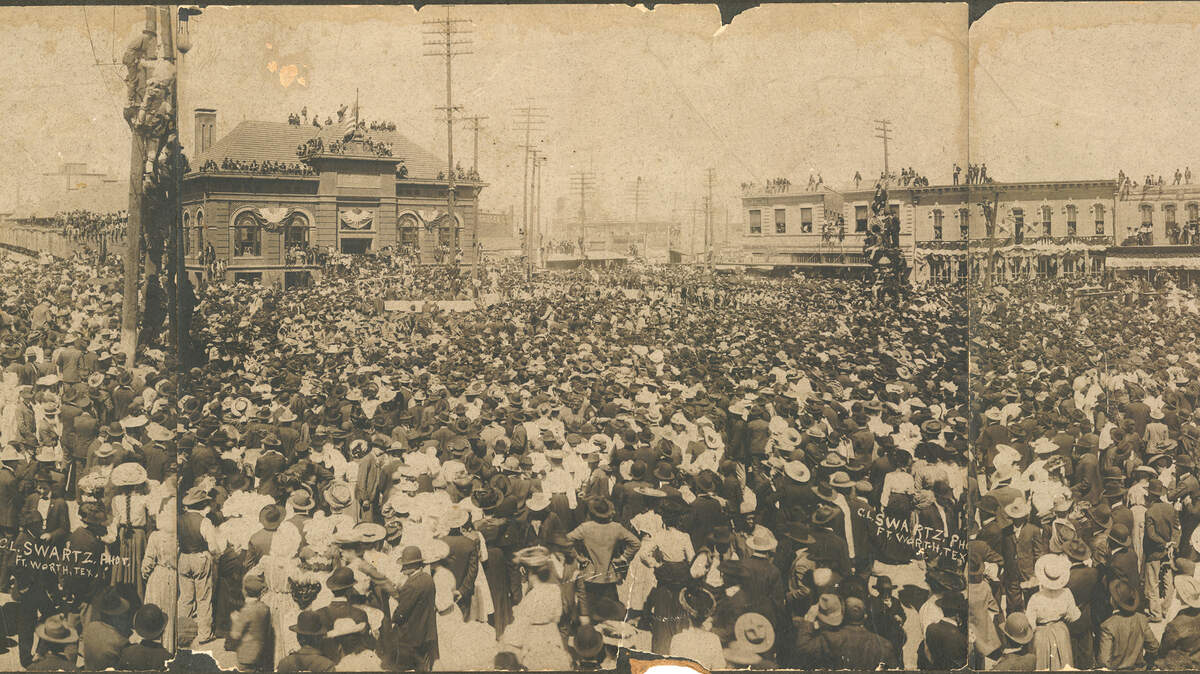
On April 8, 1905, Theodore Roosevelt became the first president to visit Fort Worth. The Fort Worth Telegram said that Roosevelt’s 75 minutes in Fort Worth were a “continuous ovation” as an estimated 30,000 people cheered as he was paraded through downtown, planted a tree at the Carnegie Library and gave a speech near the Al Hayne Memorial.
In 1910, just before Theodore’s fifth cousin, Franklin, was elected to the New York State Senate, Franklin’s wife Eleanor gave birth to son Elliott. Eleanor and Franklin were fifth cousins once removed.
A year later ex-President Theodore Roosevelt returned to Cowtown as the guest of honor at a breakfast hosted by cattleman Burk Burnett.
Fast-forward to March 1933. Now it was Franklin’s turn to be President Roosevelt. Son Elliott was now 23 and married. Just as FDR took office, Elliott was in Fort Worth to attend the Stock Show. He met socialite Ruth Googins, daughter of Swift packing plant manager Joseph B. Googins. A “friendship” developed.
Elliott’s wife Elizabeth took exception to the friendship and filed for divorce. Five days after the divorce was granted, Elliott and Ruth were married.
Elliott moved to Fort Worth, and the couple bought 1,300 acres south of Benbrook to establish Dutch Branch, their country home and stock ranch. Elliott became an executive of Texas State Network, whose flagship radio station was KFJZ.
The First Couple visited their son and daughter-in-law at Dutch Branch often. FDR made at least five trips to Fort Worth. Eleanor visited even more often.
When Eleanor came to town, she gave speeches, toured public schools and the Botanic Garden, attended the Stock Show.
When FDR came town he usually was met at the Texas & Pacific passenger station by Star-Telegram publisher Amon Carter, who hosted Roosevelt at his Shady Oak Farm or in his suite at the Fort Worth Club.
In 1936, Carter accompanied FDR to Marine Park, where FDR made a speech. Carter then showed FDR around the Frontier Centennial, which Roosevelt would officially open by remote control a month later.
In 1937, Carter took FDR to Shady Oak Farm, where the leader of the free world fished for bass. The Star-Telegram reported that FDR caught a 3-pounder “but only after he spit on his hook like any schoolboy fishing in the creek.”
In 1938, Carter again greeted FDR at the train station. FDR gave a speech on his son’s radio station KFJZ.
Four years later, America was at war, and FDR was commander in chief. He made a tour of defense plants, including Fort Worth’s Consolidated Aircraft bomber plant, where he watched B-24s being assembled.
In 1943, America was still at war as FDR passed through town on another rail tour. Security at Dutch Branch was tight. The Star-Telegram wrote that “military police ‘rode fence’ on the ranch in armored cars.”
But the Cowtown-Roosevelts connection was severed in March 1944 when Ruth divorced Elliott.
A year later Ruth’s ex-father-in-law picked up his pen and unknowingly obliterated much of the physical evidence of the Cowtown-Roosevelts connection.
On March 2, 1945, six weeks before he died, FDR signed the Rivers and Harbors Act, which provided for construction of lakes to control flooding of the Trinity River. One of those lakes, Lake Benbrook, put much of the Roosevelts’ Dutch Branch under water.
Mike Nichols blogs about Fort Worth history at www.hometownbyhandlebar.com.