
Queen Tut was Fort Worth’s first royalty. She weighed 7,500 pounds, lived at the zoo.
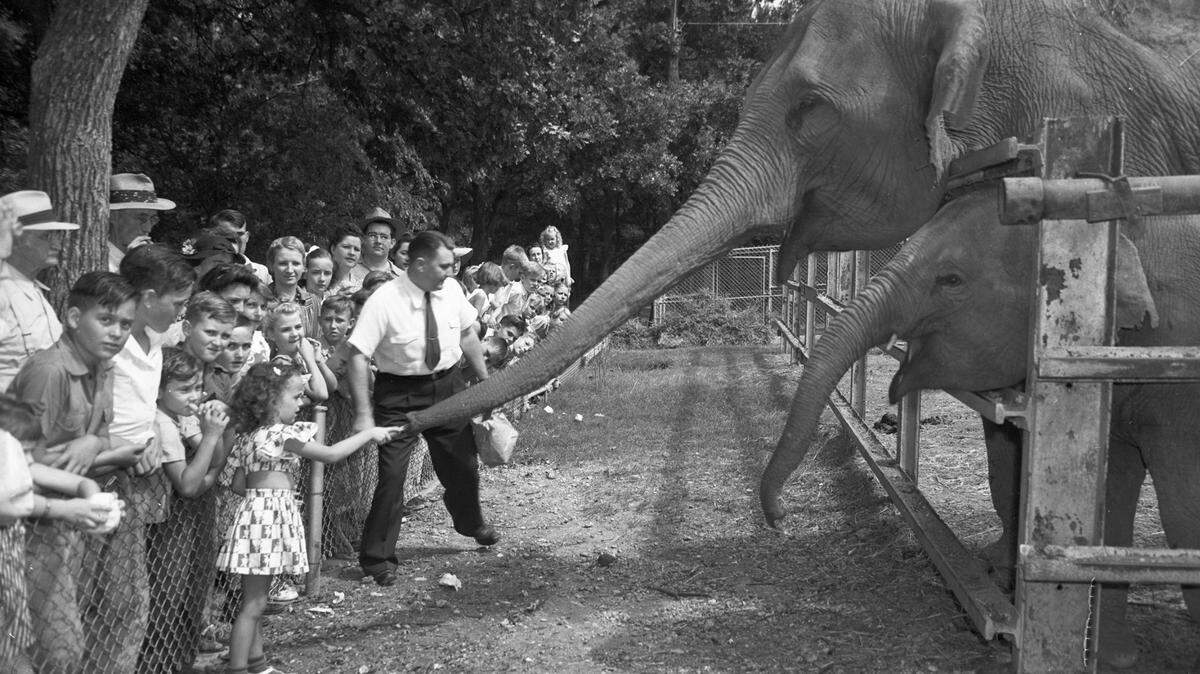
She was Fort Worth’s first royalty, and she wore the crown at the zoo for 41 years.
In 1923 Fort Worth residents — mostly children — donated $3,500 so the city Parks Department could buy a 3-year-old female elephant. She was a mere slip of a girl: 4 feet 7 and 1,100 pounds. Price tag: $3,500 (that’s $3.18 a pound).
The Parks Department and the Star-Telegram sponsored a contest to name the elephant. “Queen Tut” was the winning name.
Upon her arrival on Sept. 17, 1923, Queen Tut became the zoo’s first superstar. Every day, patrons, especially children, lined the railing in front of Queen Tut’s pen to marvel at the gentle giant and to feed her peanuts.
But Queen Tut especially got the royal treatment on her birthday each August. As many as 20,000 people attended the celebration.
Getting Queen Tut gussied up for her big day required the services of two zookeepers working seven hours. For her pedicure, the men used a small ax, a blacksmith’s 18-inch file and a heavy knife. A brick wrapped in a chamois cloth was a nail buffer; axle grease was the nail polish. She was shaved (with a blow torch!) and dusted off (with a broom!). A gallon of neats-foot oil was applied to her hide, a beauty treatment she got twice a year for her health.
Queen Tut’s birthday party always featured a cake big enough to feed her and her thousands of guests, enough party hats for every head, and music performed by the likes of Milton Brown and the Chuck Wagon Gang.
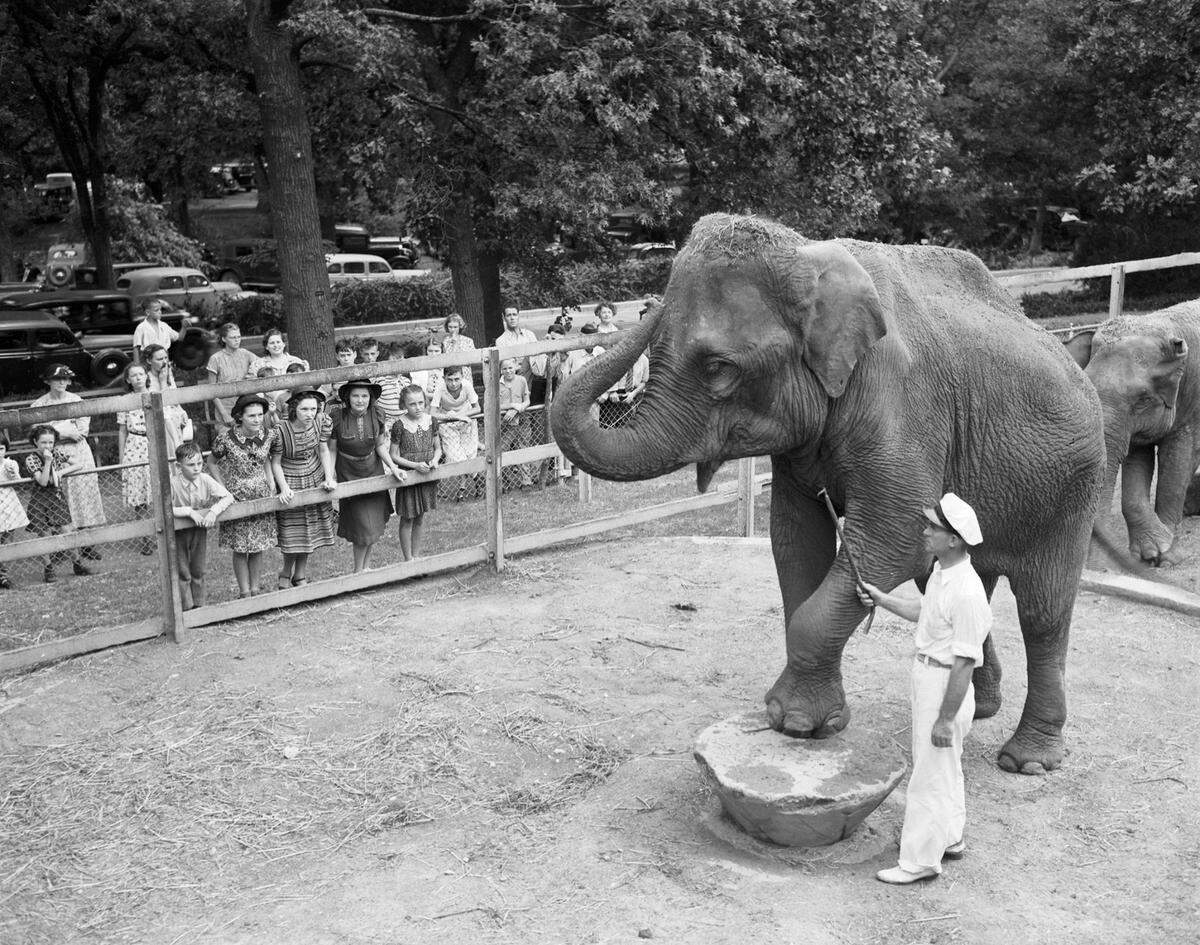
At each party, Queen Tut performed some of her tricks: She balanced on two feet on a drum, placed one foot — lightly — on the stomach of a prostrate handler, curtsied to guests, walked on three feet around a ring.
When three flags were placed around the ring, Queen Tut picked up the first two with her trunk and tossed them dismissively over her shoulder. But the third flag — the Stars and Stripes — she held above her head with her trunk and waved as she marched around the ring.
She also performed her interpretation of the Black Bottom dance.
By 1934, Queen Tut had reached her grown weight of 7,500 pounds.
Queen Tut’s long reign was due, in part, to her docile nature. Not all elephants in captivity share that trait.
On July 12, 1940, zookeeper Jim Brown went into the elephant shelter to give Queen Tut and the zoo’s other elephant, Sugar, their breakfast. Sugar attacked Brown. Tut was outside the shelter, heard Brown’s cries and came into the shelter. She drove Sugar out and stood in the doorway until zoo employees arrived.
Brown suffered two broken collarbones, a concussion and cracked ribs. He said that was not the first time Queen Tut had driven Sugar off when Sugar had attacked workers.
Sugar was given a death sentence.
Soon after the tragedy, the Star-Telegram sponsored a fundraising drive to buy a 2-year-old elephant from a New York zoo. She was named “Penny” for the pennies that children donated to buy her.
Queen Tut died in 1964 at age 44.
Even in death Fort Worth’s first royalty performed one final act of noblesse oblige: Queen Tut’s body was donated to science, given to the University of Texas at Arlington so students could compare her skeleton with that of mammoths unearthed in the area.
Mike Nichols blogs about Fort Worth history at www.hometownbyhandlebar.com.