Bobby Brown, Yankees great and Fort Worth cardiologist, dies at 96
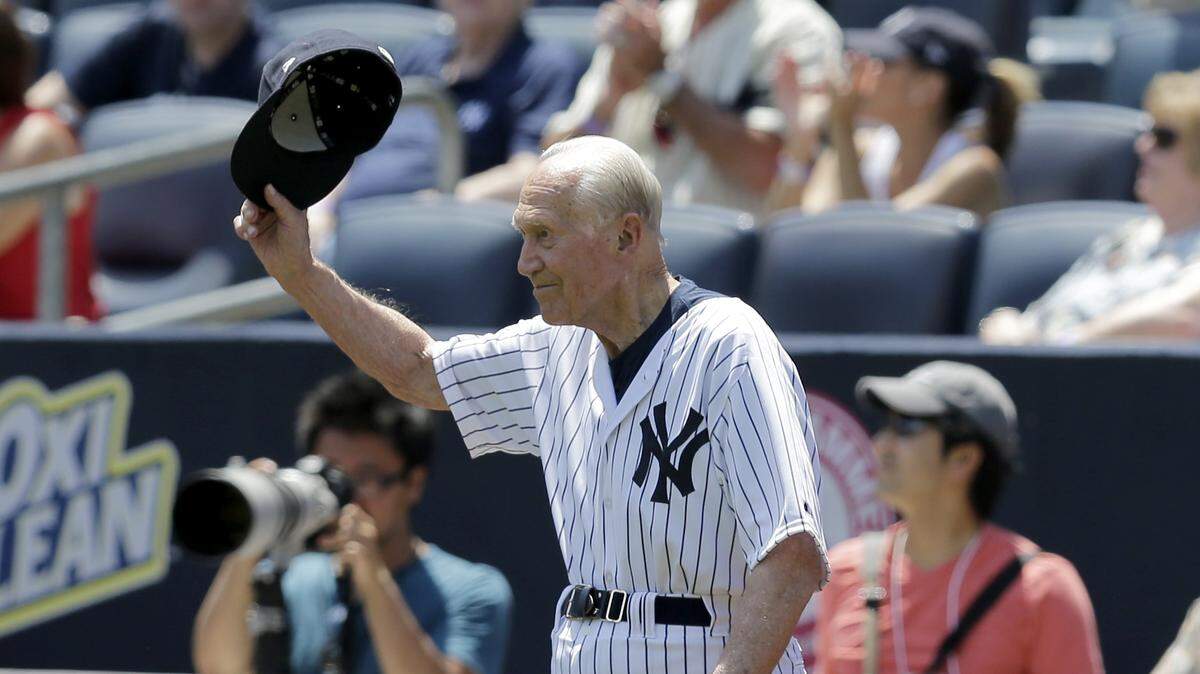
Dr. Bobby Brown, the former major-league player and Korean War doctor who became a practicing cardiologist in Fort Worth and later president of the Texas Rangers and the American League, died in his Fort Worth home Thursday morning, his children said.
He was 96.
Brown, who had been in declining health the past few years, fell ill 10 days ago and was in hospice care. His wife, Sara, died in 2012.
Brown had called Fort Worth home for more than 60 years, coming to Cowtown to enter private practice in 1958. While considered a clutch hitter for four World Series-winning New York Yankees teams, baseball was only a small part of Brown’s remarkable life.
“Dr. Bobby Brown led an extraordinary life which included great accomplishments on the baseball field and as a leader and executive in our game,” MLB commissioner Rob Manfred said in a statement. “Dr. Brown’s achievements outside of baseball were even more impressive. “
Brown’s baseball career
Robert William Brown was born Oct. 25, 1924, in Seattle but was raised in California. The Yankees started to scout him at age 13, and by the time he was finishing at Galileo High School in San Francisco in 1942, 15 of the 16 MLB teams that existed at the time were interested in signing him.
But Brown didn’t make his MLB debut until 1946, pulled away by college and the Navy even though he was drafted but never served in World War II.
His biggest accomplishments on the baseball field came with the Yankees in the 1940s and 1950s. He was part of a platoon at third base, where he logged most of his games over an eight-season career from 1946 to 1954 because the Yankees had future Hall of Famer Phil Rizzuto playing his natural position, shortstop.
While a .279 hitter with 22 homers in the regular season, Brown batted .439 in 17 World Series games as the Yankees won championships in 1947, 1949, 1950 and 1951.
Brown had won four world titles by age 26.
He drove in five runs in the final two games of the 1949 World Series, in which he batted .500. That team included Hall of Famer players Rizzuto, Joe DiMaggio, Johnny Mize and Yogi Berra, Brown’s roommate. It was the first of seven championships for Hall of Fame manager Casey Stengel.
Hall of Famer Whitey Ford joined the Yankees in 1950, and another Hall of Famer, Mickey Mantle, debuted in 1951. Brown played only 29 games with the Yankees that season before being drafted into the Korean War by the Army medical corps.
He returned from overseas for the 1954 season, but chose medicine over baseball and retired from the Yankees.
“Few people who have worn the pinstripes have lived such an accomplished, fulfilled, and wide-ranging life as Dr. Brown, who was beloved by our organization for his warmth, kindness and character,” Yankees managing general partner Hal Steinbrenner said. “He represented the pinstripes with elegance throughout his playing career and in subsequent decades as a frequent, welcome guest at Old Timers’ Day.
“We also hold the utmost respect for the myriad of other accomplishments in his life — from service to our country, his stewardship of the American League and his longtime career as a cardiologist. The Yankees extend their deepest condolences to his family, friends and loved ones as we reflect on his incredible life.”
It would be 20 more years before Brown would return to baseball, stepping aside from his Fort Worth practice in 1974 to serve as Rangers president as a favor to owner Brad Corbett.
The Rangers had lost more than 100 games in 1972 and 1973, their first two seasons in Arlington after moving from Washington. But the 1974 club, the “Turnaround Gang” managed by Billy Martin, finished second in the American League West (88-76) and featured AL MVP Jeff Burroughs, AL Rookie of the Year Mike Hargrove, and future Cy Young pitcher Fergie Jenkins.
“The Texas Rangers organization is extremely saddened by the passing of Dr. Bobby Brown,” the club said in a statement. “He lived an extraordinary life while excelling in both the medical and baseball professions, and he had a huge impact on the Dallas-Fort Worth community.”
Brown returned to baseball 10 years later, replacing Lee MacPhail as American League president after getting some consideration to replace Bowie Kuhn as MLB commissioner.
He wanted no part of that job, but while commissioner’s job was vacant in 1992 and 1993, Brown presented the Toronto Blue Jays with the World Series trophy. He retired Aug. 1, 1994, 10 days before the players went on strike, which led to the cancellation of World Series that year.
“The toughest part was just trying to be fair to everyone, trying to do what’s right,” Brown told the Star-Telegram in 1994. “Making a decision that wouldn’t bite you five years into the future because of the precedent being set. In the last few years, the economic pressures on the game made the decision-making process so difficult.”
Dr. Bobby Brown
Brown’s biggest accomplishments in life came off the field.
After starring in baseball as a teenager, Brown went to Stanford and earned the nickname “Golden Boy” for his play, demeanor and lofty academic goals. He chose pre-med after realizing chemical engineering wasn’t all he thought it would be.
“I always liked being with people and dealing with people, so I went into pre-med instead,” he said in 1994.
The Navy sent Brown to UCLA in 1943 as part of the V-12 Navy College Training Program, where he continued to play baseball and study medicine. Less than a year later he had been transferred to Tulane, where he again pulled baseball and medical school double duty until completing his naval commitment in 1946.
He quickly signed with the Yankees and debuted that year, late in the season. Medicine, though, was never far away. He continued his studies at Tulane, and also worked in the offseasons at various hospitals.
The Yankees knew of his pursuits, and called on him one day in 1951. Stengel had fallen ill at the ballpark, and Brown was asked to examine him in the clubhouse. The diagnosis? A kidney stone.
Brown oversaw a field-battalion aid station in Korea and worked at the Tokyo Army Hospital during his 19-month stint. While in Tokyo, DiMaggio had brought his new bride along with him for a series of baseball clinics.
Well, Marilyn Monroe fell ill. A jealous DiMaggio declared that the only doctor who would examine her was Brown.
After the war, Brown had only one more year of baseball left in him. He had told The Sporting News in 1949 that the day would come when medicine would overtake baseball as a career path.
“Inevitably, there will be a day when I will have to say to myself, ‘The time has come. Hang up your spikes and your uniform, put away the bats, and get down to working out the Oath of Hippocrates,’” Brown said.
After retiring from baseball, Brown spent his residency at San Francisco County Hospital until 1957, then returned to Tulane for a cardiology fellowship that lasted into 1958.
A med school friend, Albert Goggans, had already relocated to Fort Worth, invited Brown for a visit to see if he would like to join his practice there.
He never left, except for his 10-year run as AL president in which he also had a home in New York, where MLB is headquartered.
Brown never looked back with regret at leaving baseball for medicine.
“I had many thrills in baseball,” Brown told the Star-Telegram in 1994. “But as far as what’s important, as far as making a contribution to society, there’s no question that medicine provided me with that opportunity.”
This story was originally published March 25, 2021 at 11:08 AM with the headline "Bobby Brown, Yankees great and Fort Worth cardiologist, dies at 96."