
One-legged tightrope walker wowed crowds in Fort Worth and elsewhere. But who was he?
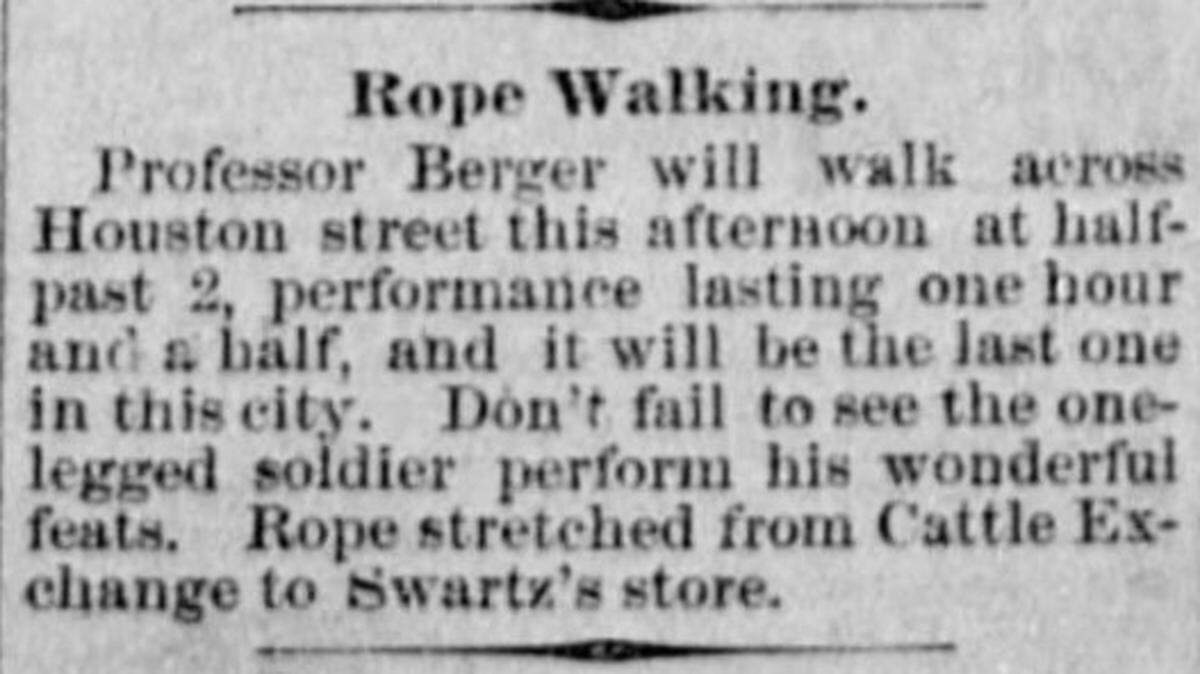
One sunny Friday in 1883, dozens of spectators gathered downtown on Houston Street, craned their necks and gazed skyward as a one-legged tightrope artist performed on a high wire suspended between the roofs of a hardware store and a dry goods emporium.
The acrobat, billed in the Fort Worth Daily Gazette as Professor Berger, was a wounded warrior, an amputee who had fought in the Civil War. His muscular right leg was intact, but his left was an artificial joint, a wooden peg-leg with a notch at the base to ease his slide across the rope.
On his back was strapped a cast-iron stove. During his 90-minute aerial act, the tightrope walker cooked flapjacks and swung on a trapeze. His spellbound audience clapped and tossed coins into a hat to reward the performance.
Five days later, Feb. 21, 1883, a larger crowd gathered, this time a block south at Third and Houston. For his encore, the Rope Walker suspended a thick cable diagonally across the intersection, from Schwartz Bros. tailor shop to the Cattle Exchange Saloon.
The following weekend, he was in Dallas, billed as “M. Berg,” performing two stories above Main Street.
Undoubtedly folks around Texas and throughout the country were familiar with the nimble performer, a 19-century gymnast who nowadays might compete in the Paralympics. In addition to taking his pop-up show to Fort Worth, Dallas, Austin, Galveston and Waco, he’d performed above city streets in Chicago, Cincinnati, Grand Rapids, Milwaukee, New Orleans, Pittsburgh, and Wheeling.
He worked under several stage names — Professor Daniel De Huone, Professor Berg or Joseph Berg. And he always promoted himself as a veteran of the Lost Cause — without disclosing whether he’d fought for the Union or the Confederacy.
By March 3, 1883, the itinerant acrobat was in Corsicana, the Navarro County seat 50 miles southeast of Dallas. His rope was strung 30 feet in the air, diagonally across a Collin Street intersection. In the middle of his act, in mid-air, the rope broke from its mooring. As the crowd gasped, the rope walker plummeted to the hard-packed dirt road below. He landed on his good leg in a cloud of dust. He’d crushed the leg and broken an arm.
Good Samaritans carried him to the nearby Malloy Hotel. A team of physicians came to his bedside. So did a minister who apparently whispered last rites in his ear. The Rope Walker responded that he was Jewish and asked for a rabbi. The town had no rabbi, so a Jewish merchant was summoned. Together they recited a prayer in flawless Hebrew.
When the performer died 10 days later, he was buried in Corsicana’s Hebrew Cemetery beneath a tombstone chiseled with the epitaph: “Rope Walker.” He took his name to the grave.
For nearly a century and a half, the man’s identity has bedeviled researchers.
Between 1958 and 1973, Texas writer and raconteur Frank X. Tolbert wrote five columns about the mysterious Rope Walker for the Dallas Morning News, reprinting one in the book “An Informal History of Texas.”
In 2010, Bryan Edward Stone, a history professor at Del Mar College, devoted the prologue of his book, “The Chosen Folks: Jews on the Frontier of Texas,” to the Rope Walker. He described the tale as an existential metaphor for “Jews poised ... on the high wire between identities.”
A decade ago, the Rope Walker captured the curiosity of Jim Yarin, a Massachusetts genealogist and paralegal. Yarin began digging for clues in digitized nineteenth-century newspapers, Civil War documents and government records. Published this year, Yarin’s book, “The Rope Walker: A Texas Jewish History Mystery,” has indisputably documented the itinerant performer’s name (Moses Berg), his rank (private, Co. B, 7th Kansas Cavalry) and his veteran’s pension number (#19378).
The Rope Walker was born around 1842 in Alsace, an area that historically passed back and forth from Germany to France. He had brown hair and gray eyes, stood 5-feet, 9-inches tall and boasted that he’d won gymnastic medals in England and France. He immigrated to New York before the Civil War, enlisted with the 7th Kansas Cavalry (aka Jennison’s Jayhawkers) in 1861, and was wounded on Christmas Eve 1862 in the Battle of Middleburg, Tenn.
He told audiences that he’d lost his left leg to a cannon ball. But Yarin suspects that the leg was amputated well after the war following an aerial accident. “He had a penchant for falling,” the skeptical author writes.
The Rope Walker spent 15 years as an itinerant performer, sometimes with a circus, other times with a traveling troupe in a wagon. He petitioned for American citizenship in 1880. That same year, the U.S. Census misspelled his last name as “Burke,” but got the first name, Moses, correct. The census taker identified him as a “Crippled ... Acrobat” — a description the author characterizes as “completely accurate.” In 1881 he married Sarah Hochster, an immigrant, at a small Manhattan synagogue. Then he went back on the road.
Following the Rope Walker’s death and burial in Corsicana, his widow successfully applied for his veteran’s pension of $24 a month. Documents filed with the U.S. Pension Office included Moses Berg’s marriage certificate, his Navarro County Death certificate, and an affidavit signed by the Texas physician who treated him after his fall.
Why his tombstone does not include his name or date of death remains a mystery.
Hollace Ava Weiner, a former Star-Telegram reporter, edited the anthology “Lone Stars of David: The Jews of Texas” and is director of the Fort Worth Jewish Archives.