
Fort Worth’s I.M. Terrell school has a proud legacy of dedicated Black teachers
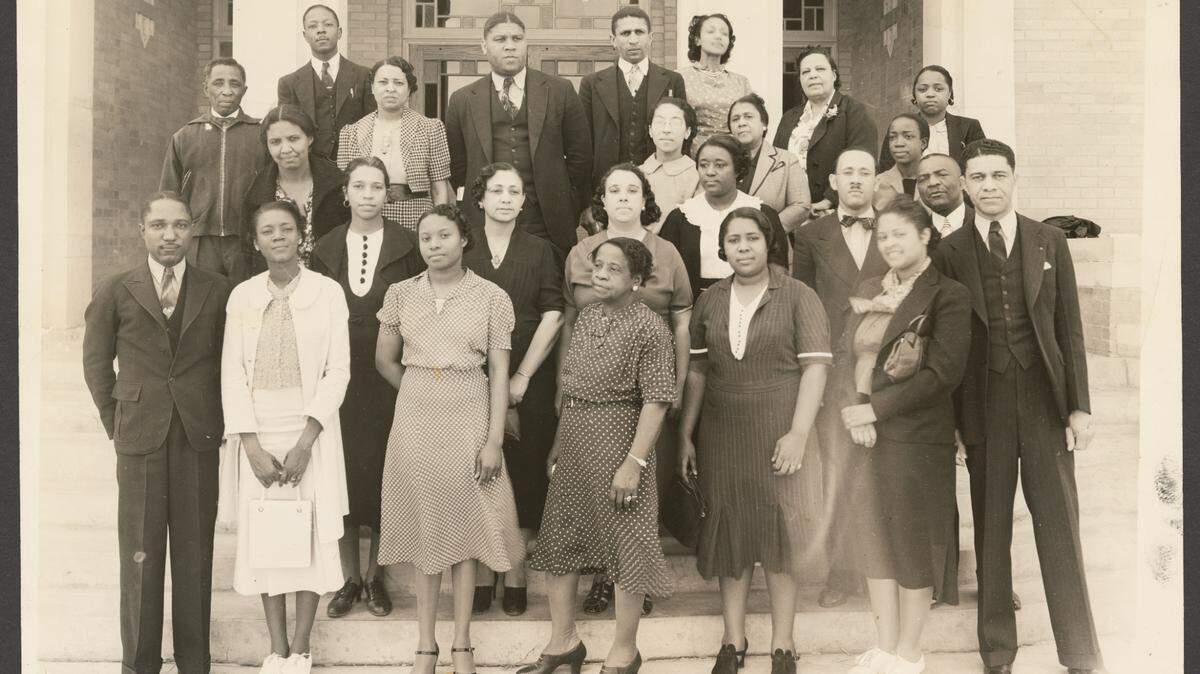
Teachers were the heart and soul of I. M. Terrell High School. In alumni interviews, Terrell High graduates frequently recounted the faculty’s dedication and the high expectations teachers had of their students.
Terrell’s educators imparted not only day-to-day lessons, but the skills and resilience their students needed to operate in a racially segregated environment.
Fort Worth public schools for African Americans were operating by at least 1881. In 1909-1910, a Negro High School building was constructed at 1201 E. 13th. It was renamed in 1921 for I. M. Terrell, the respected former principal and Supervisor of Negro Schools. By that time, the building was seriously overcrowded, and some students had to take classes in other schools. The building still exists today as Tarrant County College’s Opportunity Center.
Facing even greater school overcrowding, in 1931 the school board considered enlarging and converting the white Andrew J. Chambers or Third Ward School as a high school for Black students. It was not until 1936 that the major expansion began, and the first classes were held in the new building in the fall of 1937. That building is now the historic core of the I. M. Terrell Academy for STEM and VPA.
The photograph that accompanies this column shows the teaching staff of I. M. Terrell on the steps of their new building shortly after it opened to students. Their pride is evident, despite the fact that Black teachers were paid barely half of what Fort Worth’s white teachers received.
Among the educators in the photograph is the legendary Hazel Harvey Peace (third row, far right) – then Hazel B. Harvey – who at that time taught English but was later the highly respected Dean of Girls. She is joined by Lafayette B. Williams (second row, second from right – wearing a bow tie), who initially taught English but also served many years as a beloved vice principal, and Lillian B. Horace (fourth row, second from right with pin on her jacket), another distinguished educator who was Dean of Girls when the new Terrell building opened.
Others who can be identified include physical education instructor Marion C. Bates (top row, center – the man who looks like he’d be a football linebacker), chemistry teacher A. Maceo Johnson (front row, far right), and choral music teacher Alberta Majors Ward (front row, third from left) who preceded the renowned Adlee Trezevant in that position.
Lady George Munchus Forde, the daughter of early Fort Worth physician George M. Munchus, was perhaps the first to teach Black history in Fort Worth schools between 1933 and 1941 as part of what her obituary called a “pilot project” for the school district. She may be the person standing second from the left on the front row, but that needs to be verified.
More than half of the Terrell faculty who taught when the new building opened were still teaching 20 years later. Among them – but not yet identified in this photograph – were Juanita Bates (biology), Mary T. Blanche (English and history), Jennie R. Bledsoe (home economics), William F. Bledsoe (history), Clara Johnson Jones (history), LaBerta D. Phillips (English and journalism), Eloise W. Pyle (art), and Mamie E. Wise (Latin and English).
If you can identify someone in this photograph, please send the information to info@tarrantcountyblackhistory.org. Help their legacy live on.
Carol Roark is an archivist, historian, and author with a special interest in architectural and photographic history who has written several books on Fort Worth history.