
This building was prominent in African American history in Fort Worth
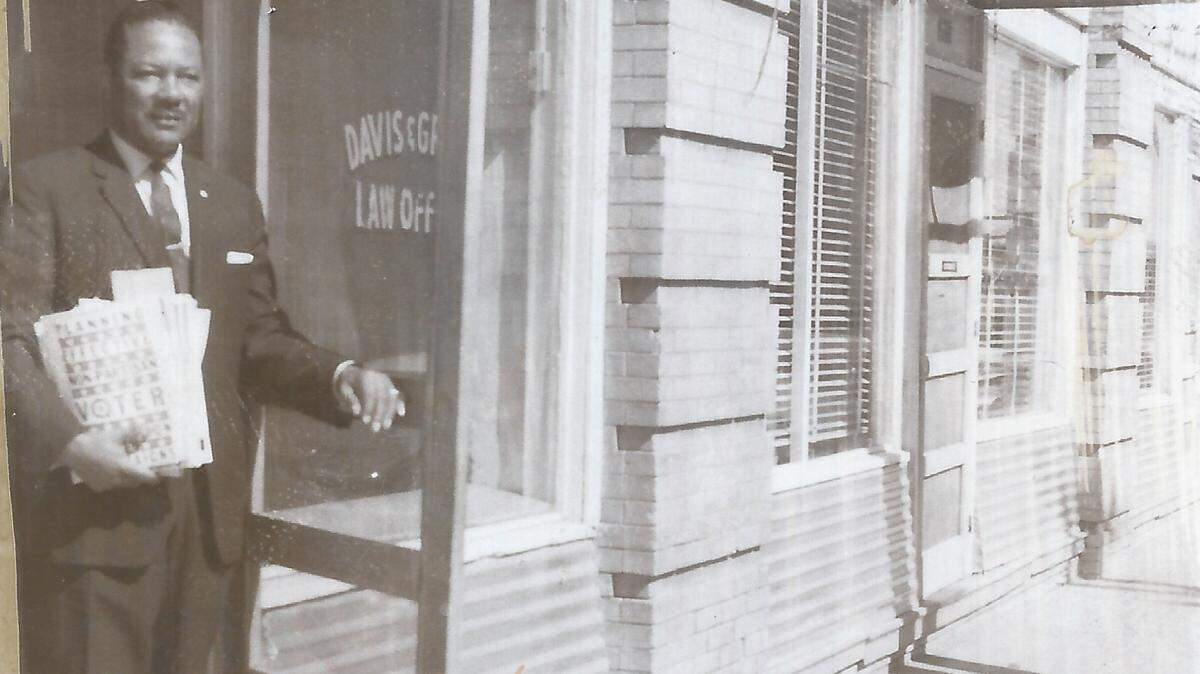
Insurance agent Ralph J. Diamond stands quietly in the door holding a pile of voter information pamphlets.
His demeanor and the deceptively ordinary appearance of this old Polaroid photograph don’t immediately reveal either the historical significance of the location or the groundbreaking work that went on inside the building’s walls.
The building depicted is the African American Masonic Temple, built in 1907 by the powerhouse banker and Republican political activist William Madison “Gooseneck Bill” McDonald. By 1912 it housed McDonald’s Fraternal Bank & Trust Co. on the ground floor, along with offices for three African American physicians, a drug store, and a barber shop.
Lodge meeting rooms were on the upper floors so that the public couldn’t see the rituals being performed as they walked by. A photograph of the entire building is in the Dallas Public Library photographic archives.
The Masonic Temple stood at the corner of Ninth and Jones in the heart of Fort Worth’s black business community, on the current site of Fort Worth Central Station (Intermodal Transportation Center). For decades, the building served as one of a few secular meeting places for African Americans and hosted everything from conventions to lectures, dances, exhibitions, and work space for black Red Cross volunteers.
By 1960, when the photograph accompanying this column was taken, McDonald had been dead for a decade, and his bank had closed. Another Fort Worth powerhouse, however, occupied one of the ground floor storefronts – attorney L. Clifford Davis worked there along with his newly-minted legal partner Willie Earl Griggs.
Born in Arkansas, Davis received his law degree from Howard University in 1949. After practicing for a few years in Arkansas and teaching at Paul Quinn College (then in Waco), he moved to Fort Worth in 1954 and shortly thereafter opened his office in the Masonic Temple. Federal Judge Joe Ewing Estes gave Davis’ career a boost when he saw that Davis was admitted to federal court practice in 1955.
From this office, Davis put together lawsuits that sought to integrate public schools in both Mansfield and Fort Worth – a struggle that took decades – and worked for the desegregation of Fort Worth’s public swimming pools. He also served as president of the Tarrant County Precinct Workers Council, which took a leadership role in championing the voting rights of area African Americans. It is likely that Diamond was participating in one of the Council’s voter education projects.
The Masonic Temple was a victim of urban renewal efforts that flattened many blocks on the southern end of downtown during the mid-1960s. Davis moved his law office and eventually traded it for one in the courthouse, where he served from 1983-1988 as a criminal district court judge and then became a visiting judge. On Oct. 12, 2019, Judge L. Clifford Davis celebrated his 95th birthday, a person who was in the middle of Fort Worth’s civil rights history and made a lot of it possible.
Beginning next spring, the Portal to Texas History will feature this photograph and over 200 others from the Tarrant County Black Historical & Genealogical Society’s collection, scanned as part of the Portal’s Rescuing Texas History project.
Carol Roark is an archivist, historian, and author with a special interest in architectural and photographic history who has written several books on Fort Worth history.