
Los Firmes - the Fine Ones - drove their flashy lowrider cars across Fort Worth & Texas
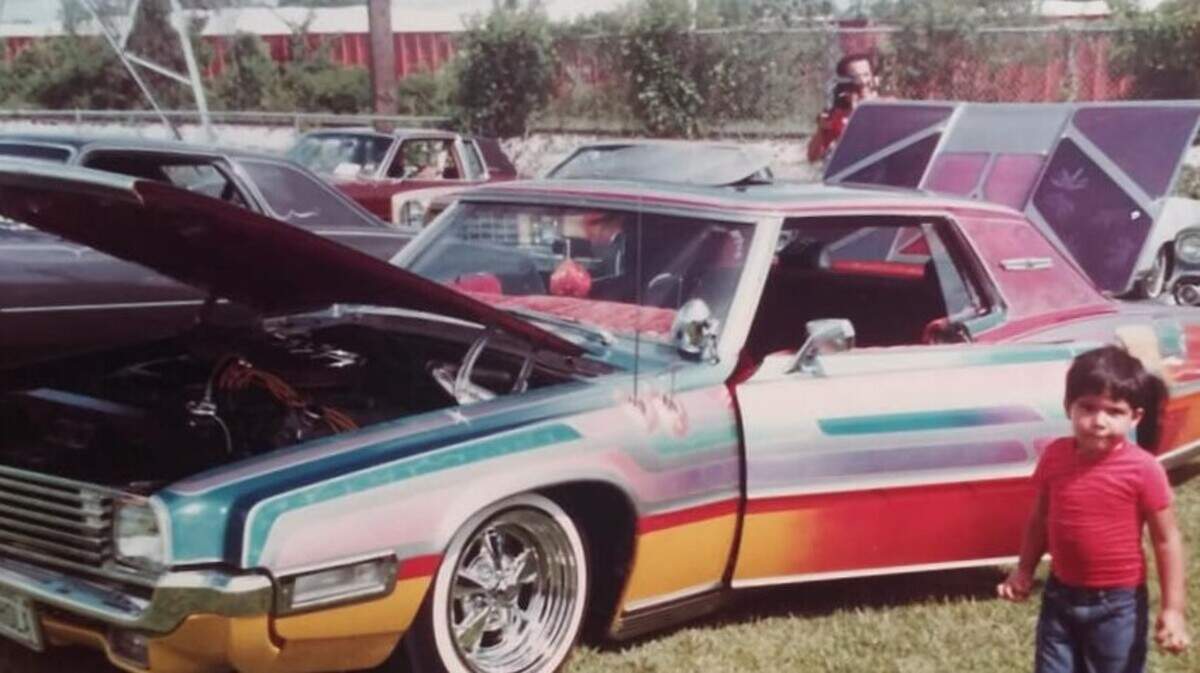
Throughout the 1980s, the Fort Worth Los Firmes (the Fine Ones) car club drove their “rides” slow and low along University Drive in a caravan of 1940s to 1970s classic cars. Bystanders watched in awe at the ’64 Impala, ’58 Chevy truck, ’48 Plymouth, ’69 Malibu, and other lowrider cars cruised from Trinity Park to Northside Fort Worth for their monthly meeting.
Lowrider culture originated in the 1940s in Southern California, where Chicano car enthusiasts invested thousands of dollars in brushed metallic paint jobs, curved chrome fenders, crushed velvet seats, welded chain steering wheels, spoked hubcaps, show pipes, and velvet dice that hung from rear-view mirrors. Hydraulics elevated and lowered cars to inches from the street surface. The art of Chicano car styling proliferated throughout United States barrios and internationally.
At lowrider car shows, owners would bounce their rides like bucking broncos. Some owners drew flaring titles on the cars’ hoods or doors such as “Tweety Pie” and “Tequila Sunrise.” A familiar saying among lowriders was, “we’ll pay the chrome bill before the phone bill.”
Stereotypical attitudes painted them as “pachucos” or a Mexican American subculture of thugs. Although some may have fit the description, the majority of lowriders or bajitos (low ones) focused on accessorizing their rides and creating mobile, artistic autos. Their cars weren’t made for speed, but instead, slow-motion, mechanized beauty.
Lee DeLeon, charter member of Los Firmes, recalled in the 1980s the club transformed from male-only to family-inclusive cruising. They wore 1950s-style, blue jackets with Los Firmes blazoned on the back, and donned hats with drooping brims. Members and their families would hold meetings in Rockwood Park, where they discussed who would represent the club in upcoming car shows, organize fund raisers for their children’s parties, and traded advice on how to improve their rides’ appearance and performance.
Los Firmes traveled to Houston, Waco, Abilene, Dallas, Grand Prairie, and Wichita Falls to compete for money and trophies at lowrider shows. During one trip from Houston, Tony Perez’s Monte Carlo broke down in Midlothian around 11:00 p.m. Sunday. Two local residents took Perez into town and returned with the necessary repair parts. Soon after, Los Firmes, in gratitude, contacted the mayor and agreed to hold a free lowrider show. The mostly white, Midlothian residents admired the club’s stylized rides, hydraulic jumps, and mechanical, and artistic skills. In 1982, Perez, 24, crashed his Monte Carlo on Camp Bowie Boulevard, resulting in his death.
As an employee of Coors Distributing Co., DeLeon recalled the owner John McMillan allowed Los Firmes to hold meetings in the hospitality room. The distributor’s parking lot soon filled with colorful, lowrider cars. On one occasion, McMillan asked DeLeon about his next car show. After DeLeon stated he wouldn’t attend because he couldn’t afford to purchase a new set of tires to compete, McMillan instructed the office accountant to write a $500 check for DeLeon’s expenses.
Fort Worth Latinos reveled in seeing the Los Firmes’ flashy cars in the Sept. 16 (Mexican Independence Day) and Cinco de Mayo parades. To attract North Side community support for All Saints Catholic Church and Fort Worth Boys Club fundraisers, they showcased their cars.
In sync with Chicano culture, Los Firmes cherished carnalismo or brotherhood — a valued trait that kept families united and rides hopping and cruising low and slow.
Author Richard J. Gonzales writes and speaks about Fort Worth, national and international Latino history.