
Built in 1920 as the Beth-El synagogue in Fort Worth, this building still serves God.
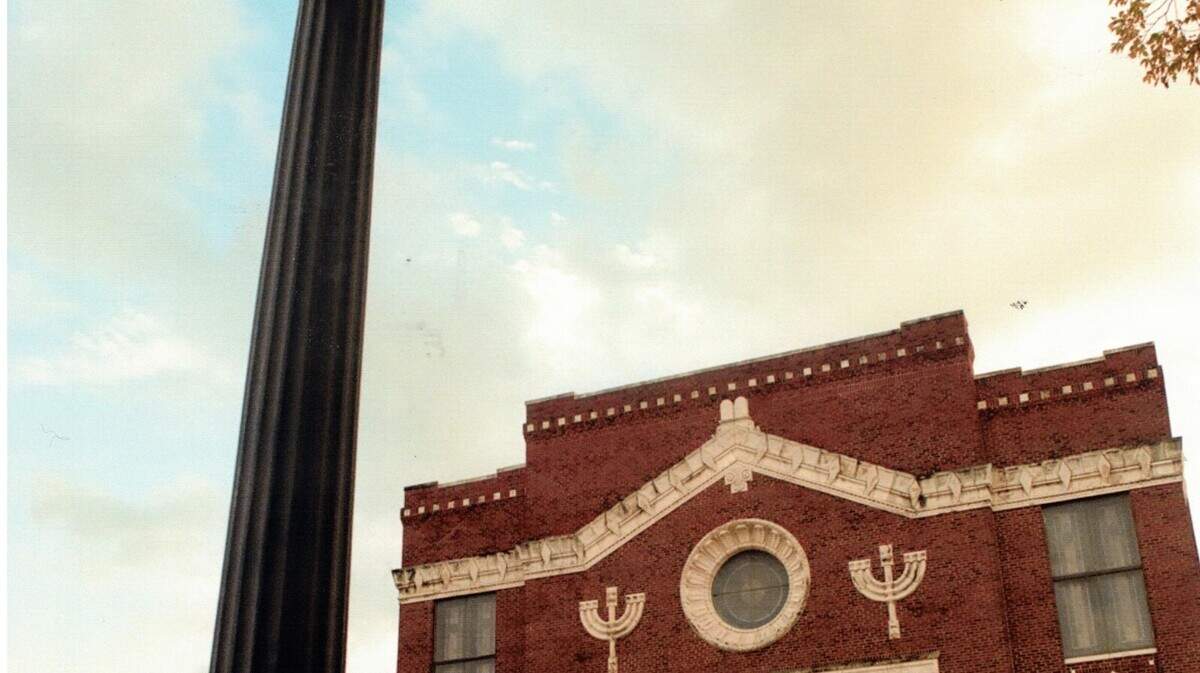
One hundred years ago this month, bricklayers and carpenters worked overtime to finish constructing Beth-El synagogue — a red brick house of worship with limestone trim at the affluent corner of West Broadway and Galveston. To keep workers on the job, temple president Herman Lederman, a tobacconist, handed out free cigars.
Contractor William Bryce, for whom a street in Arlington Heights was later named, knew he faced a deadline. The Jewish High Holidays that year began at sunset on Sunday, Sept. 12.
Bryce also realized he wasn’t going to be paid in full. Due to wild inflation, he had submitted a cost-plus contract. What began as a $75,000 job ended up with a $139,000 tab and a deficit of $78,500. Desperate Beth-El board members called lumberyards, begging donations of building materials. Architect John J. Pollard, whose work includes the Forest Park gate, kept revising the blueprints because the congregation could no longer afford a planned gymnasium, rooftop garden, billiards room or ballroom.
Adding to Beth-El’s woes was Prohibition, the law of the land since Jan. 1, 1920. Prohibition forced out of business Beth-El benefactors who were liquor distributors, saloon keepers, and restaurateurs. Congregants reneged on building fund pledges. Membership at Beth-El dropped from 150 families to 120.
Despite setbacks, Beth-El opened in time for Rosh Hashanah, the Jewish New Year. Prayers and second mortgage bonds kept the temple afloat. The last dollar on the mortgage was finally paid in July of 1946.
Then, the unthinkable happened. On Aug. 29, 1946, hours after a B’nai B’rith smoker in the social hall, fire erupted. A three-alarm blaze consumed all but the brick walls of Beth-El. Water dousing the flames flushed thousands of poker chips and playing cards into the street.
Fortunately, the 36,700-square-foot building had “good bones.” The interior was rebuilt, redecorated, and fireproofed. Beth-El reopened two years later for the High Holidays. Soon after, trustees banned card-playing and gambling on the premises.
The red brick synagogue served the congregation until the end of the century. By then, the Broadway neighborhood on the city’s Near Southside had deteriorated. Most of the three-story homes that once graced the area had been demolished. Beth-El’s members had migrated southwest into the Hulen Street corridor, where a soaring contemporary synagogue was nearing completion at 4900 Briarhaven Road.
A parade of congregants carried the Torahs to the new house of worship. Also removed and embedded into the architecture of the new synagogue were the limestone friezes on the Broadway building’s façade — two massive stone candelabras, a quote from Psalms, and a set of Ten Commandment tablets.
For the next decade, the neoclassical house of worship at 207 W. Broadway Ave. remained vacant. Initially, the Fort Worth school district bought the property for $950,000 but, within a few years, put it back on the market. The corner changed hands several times. To keep drunks and drug addicts from trashing the interior, a chain-link fence was erected around the periphery. The appraised value plummeted to $269,000. At that price, the century-old house of worship, which boasted excellent acoustics, ten classrooms, a catering kitchen and basement stage, was looking like a bargain.
As property values tumbled, rebirth was underway. Developers, investors and nonprofits envisioned turning the neighborhood into a trendy enclave with eclectic shops and entertainment outlets moving into vintage brick buildings and warehouses. City planners dubbed the area South Main Village. An experimental theater, Amphibian Stage, opened in 2000 at 120 S. Main. The Markeen Apartments, constructed in 1909, were refurbished, leased, and elevated to the National Register of Historic Places.
In the spring of 2010, the temple at 207 Broadway was sold to an evangelical church — I Jesus Zion Ministries. The church, led by Pastor David Donovan, had started in 1984 inside the Grand Theater, a dilapidated Southside movie house shuttered in 1981.
The new congregation thrived. The pastor dreamed of a larger, more visible location. The corner of Broadway and Galveston turned into a good fit. The church is now celebrating its 10th year in a century-old building that continues to serve God and the community.
Hollace Ava Weiner, a former Star-Telegram reporter, is an author, archivist and director of the Fort Worth Jewish Archives.
This story was originally published September 5, 2020 at 7:00 AM.