
This photo taken in Fort Worth was part of a national campaign against child labor.
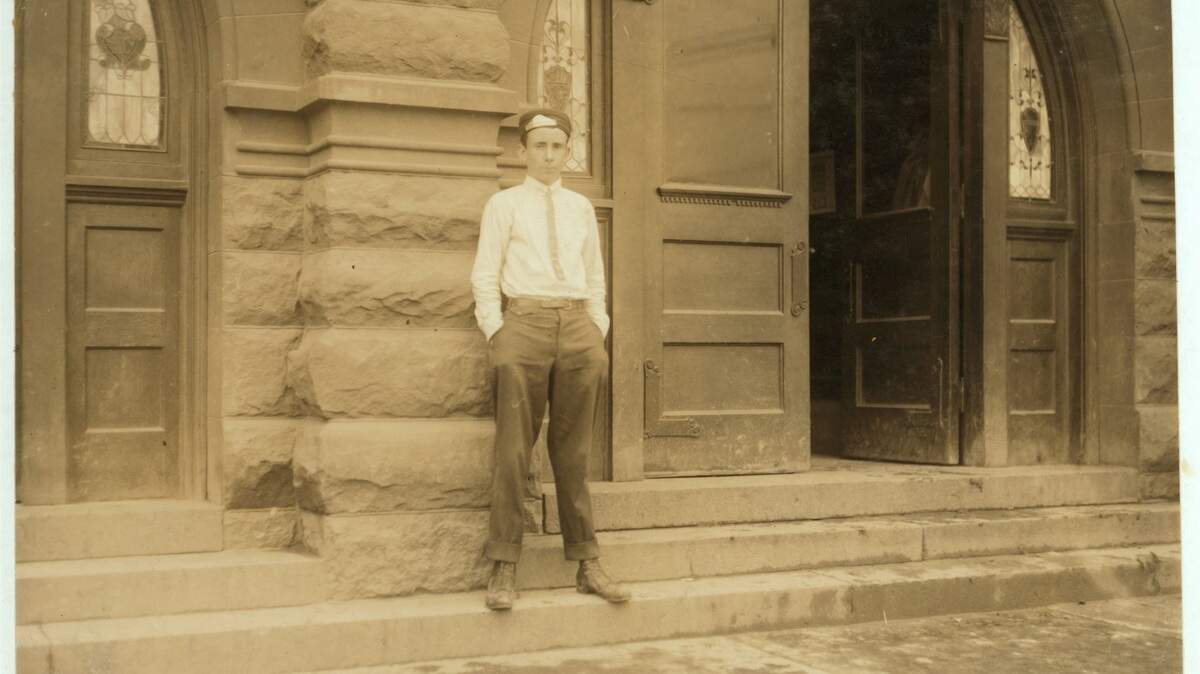
Sociologist Lewis Hine used a powerful tool in his battle to expose the horrors of child labor in early 20th century America – a camera.
Today, we tend to think of child labor in terms of human trafficking – underage girls and boys brought illegally to this country to work in the sex trade or other “below the radar” jobs. At the turn of the 20th century, it was much more prevalent and legal.
Throughout New England and the East Coast, children lost fingers and hands in textile mill machinery. Children as young as 4 hand-shucked oysters for the seafood processing industry, with 7- and 8-year-olds working up to 15 hours a day. Fueled by cocaine and other drugs, delivery boys worked similar hours and made frequent deliveries to red light districts.
The industrialization of America resulted in growing numbers of child workers. Jane Addams and other progressives formed the National Child Labor Committee to protect children from dangerous and debilitating working conditions. They hired Lewis Hine to show the American people what child labor did to children.
During the fall of 1913, Hine made a three-month-long trip to Texas to photograph children working in lumber mills, making deliveries, and picking cotton. San Antonio’s messenger boys, in particular, caught Hine’s attention, and he called the city, “one of the worst [places for] child labor in the state.”
He stopped only briefly in Fort Worth, barely poking his head out of the Texas & Pacific Railway station on the southern end of downtown. There Hine found Eugene Dalton, a former delivery boy, who was working 17 hours a day, seven days a week, to support his widowed mother and younger sister.
Hine’s photograph of Dalton was captioned with the details necessary to prove his point about the evils of child labor: “Some results of messenger and newsboy work. For nine years, this sixteen year old boy has been newsboy and messenger for drug stores and telegraph companies. He was recently brought before the Judge of the Juvenile Court for incorrigibility at home. Is now out on parole, and was working again for [a] drug company when he got a job carrying grips [suitcases] in the Union Depot. ... His mother and the Judge think he uses cocaine, and yet they let him put in these long hours every day. He told me ‘There ain’t a house in The Acre, (Red Light) that I ain’t been in. At the drug store, all my deliveries were down there.’ Says he makes from $15.00 to $18.00 a week.”
The thousands of images had their desired effect. Shocked audiences pushed, and in 1916 Congress passed the Keating-Owens Act, which established minimum working ages and better working conditions. By 1920 there were about half as many child workers as there had been a decade earlier.
Dalton’s unsmiling face predictably conveys a sense of apprehension and distrust. He was, however, one of the lucky ones. Dalton found a stable job with the Union Pacific Railroad, married, and had a family. Others were not – and still are not – so lucky.
Carol Roark is an archivist, historian, and author with a special interest in architectural and photographic history who has written several books on Fort Worth history.