Black people targeted by Fort Worth police Tasers at over twice their population rate
Even Black people have had difficulty believing Black people are and have been disproportionately targeted by police for aggressive actions.
But police documents and videos are changing some of those minds.
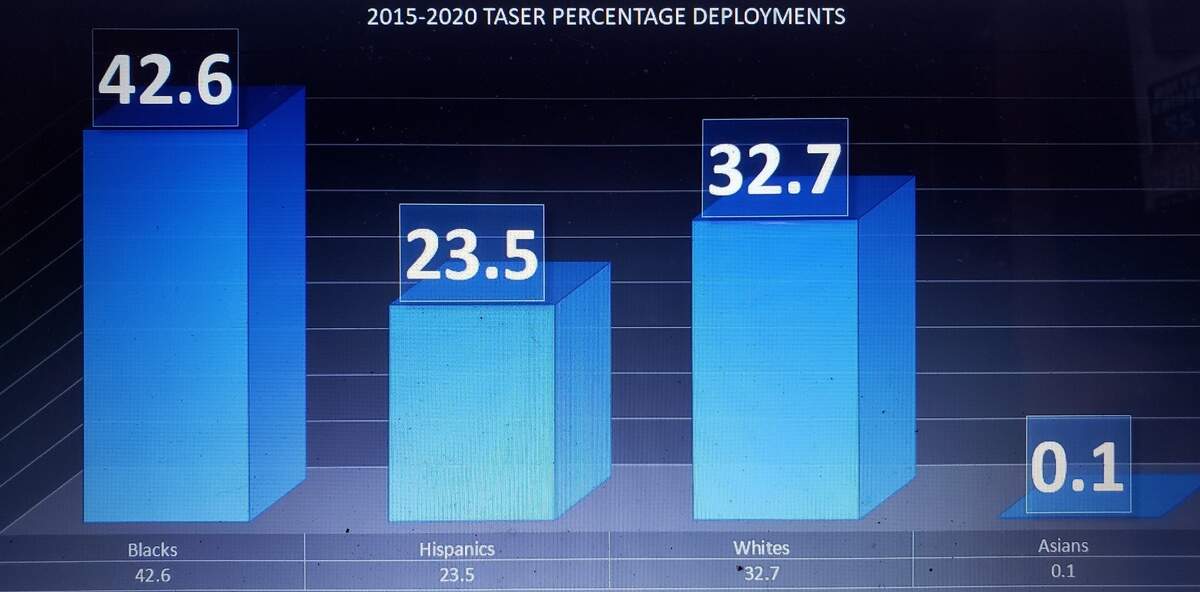
Fort Worth Police Department records show that since 2015, Black people have been the targets of about 43% of police Taser deployments while making up 19% of the city’s population. About 33 percent of people tased were white and 24 percent were Hispanic.
Fort Worth criminal attorney Leon Reed, who is Black, says he sees police reports, body camera footage and witness statements that never become public knowledge. That constant flood of evidence has changed his mindset, Reed said.
“You know, for a long time even I was doubting what my clients were telling me,” Reed said. A client would say — “No, Mr. Reed I was standing there and the next thing you know the officer slapped me three times and kicked me in my stomach.”
“Naw, he didn’t do that,” Reed said he would reply, and his client would respond, “Yes, he did.“
The evidence would force him to believe, Reed said.
“I have access to the victims and then you have your Rodney King moment where it shows up on video and you can no longer turn a blind eye,” Reed said.
Reed walked from Fort Worth to Austin to try to meet with Gov. Greg Abbott concerning the need for police reform. Reed, who arrived in Austin on Aug. 18, said he needed about 15 minutes of Abbott’s time. On Sunday, Reed was still in Austin waiting for Abbott to meet with him.
The police department, city leaders, faith and thought leaders in Fort Worth have been apathetic to the disproportionate police use-of-force issues faced in minority communities, Reed said, and have continued to repeat the myth that Fort Worth is one of the safest cities in the nation with one of the best police departments in the state.
“Safe for whom?” Reed asked. “When you say things like that, that tells me you are not including me in your matrix. We’re getting report after report that’s telling you the same stuff. The citizens have been consistently complaining and people have been consistently dying.
“It hurts when people don’t recognize your humanity, and in a lot of ways, these people have not recognized our humanity. The city leaders have to own their part in this if they want the city to heal. This stuff will not get wished away. This will have to be worked away.”
Use of force and de-escalation
Fort Worth police say that each use-of-force incident, including Taser deployments, is reviewed by the involved officer’s chain-of-command up to the appropriate assistant chief for any improper action or misconduct and that most are deemed to be within policy.
So far in 2020, Fort Worth police records show a decrease in Taser deployments that is likely due to a greater emphasis on de-escalation tactics and fewer interactions with the public because of the coronavirus pandemic, police said in an emailed statement. The department defines deployment as any time an officer tries to use a Taser to stun someone, whether the Taser probes hit the targeted subject or not.
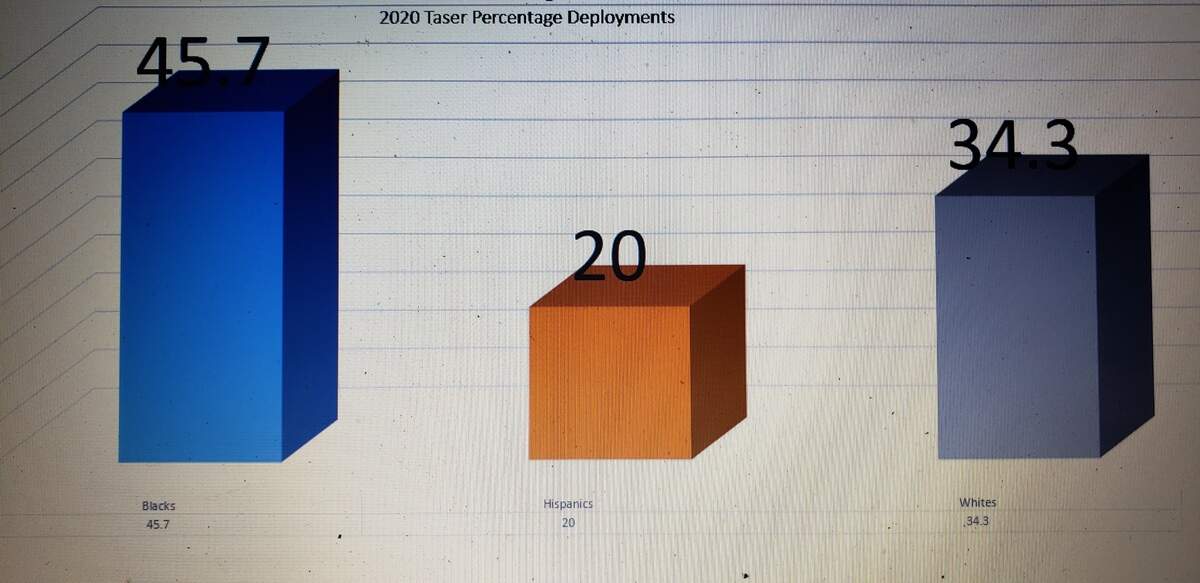
Department personnel would not speculate on whether the number of times Tasers were used, the race of the officers using the Tasers, or the race of the people who were the targets indicated an issue without first reviewing each interaction, the statement said.
There were clusters of Taser deployments in the figures provided, and police explained that many of those likely stemmed from the same incident. For example, if an officer deploys a Taser and it fails, and then a second officer fires his Taser, this would be recorded as two incidents when in fact it is the same use-of-force incident, police said.
If you take out the suspected duplicate cases, there have been approximately 700 unique use-of-force Taser instances since 2015, but the percentages are largely the same regarding who is being targeted, the statement said.
Fort Worth police are phasing out the Taser X-2 and incorporating the new Taser X-7, which has faster probe speed, less probe spread, and communicates wirelessly with camera and evidence logs.
The Taser X-7 maintains the five-second cycle automatic shut-off incorporated after the April 2009 death of Michael Jacobs, a mentally ill 18-year-old Black man who died shortly after being shocked twice with a Taser by officer Stephanie Phillips.
Then Police Chief Jeffrey Halstead said Phillips violated police department protocol by deploying her Taser for longer than five-seconds — the first trigger pull lasted 49 seconds. A Tarrant County grand jury declined to indict Phillips in Jacobs’ death, which was ruled a homicide.
But the city later settled a lawsuit with the Jacobs family for $2 million, the largest settlement Fort Worth has made regarding a police use-of-force incident in the past 10 years.
Old habits die hard
Cory Session, a city of Fort Worth Race and Culture Task Force member in a leadership position with the Innocence Project of Texas, said he saw and reported a problem with police officer Taser use soon after the committee began examining records provided by the city in 2017, following the arrest of Jacqueline Craig and her two daughters.
Craig became a public figure on Dec. 21, 2016, after she called 911 to report that a neighbor had assaulted her son for littering. As Fort Worth police officer William Martin responded to the scene, he asked Craig, “Why don’t you teach your son not to litter?”
The situation escalated as a crowd gathered and Craig and her two daughters were eventually arrested. Martin pulled and pointed his Taser at Craig — a Black woman — and her 15-year-old daughter before wrestling them to the ground and handcuffing them.
The charges against the Craig family were later dropped, but not before a video of the arrest took off on social media. By Dec. 20, 2017, the video had been viewed more than 5 million times on Facebook.
During his study of criminal justice issues in Fort Worth, Session said, he found that officers were much less likely to deploy a Taser against a woman and more likely to deploy a Taser against a man of another race.
There were fewer incidents of Taser use when a white officer was involved in an encounter with a white resident, but the frequency of Taser deployments increased when white officers encountered Black residents, Session said.
“You go to the white side of town and you talk, you go to the Black side of town and pull your gun out,” Session said about police.
Session suggested that some officers were making decisions on what tactics might be applicable based on details provided by dispatchers and the location of the call.
“The officer gets out and he’s already amped up,” Session said. “Officers have to not be in an aggressive state when they receive a call. You don’t get to shoot first and ask questions later. (Officers) have to have an open-minded posture. They have to take the ingredients on the scene and make judgments based on that.”
Session says officers need more implicit bias training and more diversity training, but adds that the problem of overly aggressive policing in Black communities may only be solved by the passage of time.
“This generation of bias, that has to be consumed,” Session said. “Because it’s hard to change a mind that was taught something or has believed something for 25 years straight. It’s hard to break those habits.”
Expert review
A panel of police experts raised some general questions about what they saw regarding Fort Worth police officers’ Taser use.
The eight-member Police Expert Review Panel was announced by the city in November 2019 and is chaired by criminologist Alex del Carmen and former Arlington police chief and deputy city manager Theron L. Bowman. Both del Carmen and Bowman have extensive experience in police pattern or practice investigations, according to Fort Worth city officials.
The panel’s interim report released in July stresses that the experts’ observations and recommendations are preliminary and that police conduct and policies remain under examination.
“The Review Panel observed that Fort Worth officers use Tasers as a weapon of first resort, often pulling them at the very beginning of an encounter,” the report said. “We observed situations where officers immediately resorted to a Taser without attempting de-escalation techniques that might have proved more effective than threatening to use a Taser.”
“We heard from a few officers that Tasers are their ‘primary’ form of de-escalation and that they will display a Taser during virtually every encounter,” the report says later.
Community members report that encounters with officers are often hostile and threatening, and say officers are often aggressive from the beginning and shout and curse at them, the report says. Community members also reported there is often little or no effort to engage or de-escalate, according to the report.
The panel’s report says that displaying a Taser at the start of an encounter makes it more difficult to talk or employ other types of de-escalation tactics later.
In one Taser case review that did not specifically identify when a Taser was deployed, officers stopped a man suspected of being intoxicated, the panel’s report said. When an officer asked the man for his identification, the man said it was in his car and started to go back to the car to get it when the officer grabbed him to arrest him. A second officer ran up and immediately told the man, “You need to relax or I’m going to bust your face,” according to the report.
The report didn’t specify the race of the man or the officers.
When the man asked why he was being arrested, the officers told him he did not need to understand, the report said.
In several other reviews, panel members said similar language was used when individuals appeared confused as to why they were being arrested. Rather than take time to explain why they were being stopped or arrested, officers expected people to do as they were told, the report said.
Police policy
Taking a Taser from its holster is not considered a use of force, according to police.
Officers are prohibited, except in emergencies, from using a Taser against people in high-risk categories, such as small children, pregnant women, the infirm and the elderly.
Exceptions to the policy include the prevention of death or serious injury to an officer or another person.
The expert panel’s report recommended that people with disabilities, people in mental health crisis and people with substance abuse disorders be added to the list of high-risk populations.
“The dangers associated with Tasers for persons with disabilities increases significantly,” the report said.
Within the documents that were provided for its review, the panel did not identify a coherent policy that instructs officers on when Taser use is authorized or appropriate, and it labeled the lapse a “serious gap in training and policy,” the report says.
Fort Worth Police Department policy directs officers to use de-escalation tactics consistent with the LEED model, which stands for Listen and Explain with Equity and Dignity, if possible, before using force.
If circumstances permit, officers should allow people to give their side of the story, explain what they are doing, explain what the individual can do to comply, and the likely outcomes of compliance and non-compliance.
Officers should avoid physical confrontation unless force is immediately necessary to prevent direct harm to others or to stop behavior that may result in serious harm to others, according to police policy.
Unconscious thoughts
Members of the professional review panel reported other instances where officers did not follow Fort Worth police policy. There were several examples in which officers immediately resorted to aggressive and profane language in interactions where a person did not pose an immediate danger and that person was not offered an adequate explanation for their detention, according to the panel’s report.
Review of the files also revealed encounters that start with officers yelling a command, often with weapons drawn, under circumstances where no apparent threat is present, panel members reported.
In other cases, officers failed to take time to permit a person to calm down or comply, take advantage of distance, or wait for backup that might have had a calming effect, the report said. Officers frequently curse at arrestees, use what the officers perceive to be slang in a racially offensive way, or mock or humiliate arrestees, the report said.
Many of the cases reviewed involved a person in mental health crisis but there was no indication that a Crisis Intervention Team officer was called or consulted.
The panel reported there was no indication use-of-force incidents were analyzed to determine if a different course of action may have avoided the need to use force against a person in mental health crisis. Rather, every review observed was limited to whether force was “lawful” and did not extend to whether it was avoidable, necessary or appropriate, the report said.
Throughout their interviews panel members heard that the level of tension and mistrust between officers and the community has increased in recent years.
Some senior officers attributed the increased incidents to the rushed hiring and training of the last four academy classes. Department officials said some officers have a “para-military” mindset, which would involve more aggressive tactics when interacting with community members, the report said.
The department’s use of force coordinator said de-escalation had only recently been emphasized in the training curriculum and described the department as being “in transition” on the issue, the report said.
In a previous statement in response to the review panel’s interim report, police department officials said use-of-force policy and general orders will be changed to enhance accountability and further clarify de-escalation and duty-to-intervene expectations. Efforts will be made to ensure that officers recognize these are serious policy violations when not followed, a department news release said.
Fort Worth Police Chief Ed Kraus has also said the department is adding officers to bring the Crisis Intervention Team up to 20 from six and make it more responsive.
The department is also working to identify funding to provide mental health peace officer training and certification to every eligible officer. The department is researching other agencies nationwide, evaluating how to most effectively divert non-police calls directly to mental health providers, according to the report.
Charles Hayes, a former Dallas patrol officer turned author, argues that Americans are having this big argument over what ideas police form in their conscious mind while refusing to consider that police responses are often based on their unconscious thoughts.
There are indications that the portion of the brain that processes certain emotions, such as fear, become enlarged when a person is subjected to or perceives constant threats, according to Hayes.
To combat these unconscious thoughts, police management must be obsessive about use-of-force and diversity training — otherwise use-of-force will inevitably get out of control, Hayes says.
“You don’t have to hate someone to treat them differently,” Hayes said.