This Fort Worth program is finding dyslexia in kids who school districts missed
When Caroline James’ son Andrew was in elementary school, his teachers would often get frustrated when he refused to participate in reading activities. They told James and her husband that Andrew needed to show more effort.
James knew her son’s trouble in the classroom did not stem from a lack of effort.
“I would sit next to Andrew at our dining room table while he was doing work, and I was like, this child can’t read,” James told the Star-Telegram. “He would get written up because he pushed his papers off his desk once. And I would tell his teachers, he can’t read. It’s not a lack of effort.”
James, a former assistant principal in the district, now knows Andrew has dyslexia, something he was never tested for by Fort Worth ISD. Like Andrew, hundreds of other kids in Fort Worth also struggle in reading and language arts classrooms. James is hoping to find and assist those kids through Literacy Roundup, a partnership between Fort Worth and the Sid. W. Richardson Foundation which was started last year.
The Rainwater Charitable Foundation, a Fort Worth-based nonprofit, donated over $330,000 last week to help expand Literacy Roundup’s dyslexia screenings to more locations across the city.
James and her team screened more than 400 students for dyslexia last year. They have screened more than 150 so far this summer and hope that number grows to over 800. It became a Texas law in 2018 that schools must screen for dyslexia, but James and others involved with Literacy Roundup think there are still hundreds of students in Fort Worth ISD and other school districts in the Dallas-Fort Worth Metroplex that are undiagnosed. Literacy Roundup is working to find those kids because their school districts are not, they said.
The Texas Education Agency reports that just 6 percent of students in Fort Worth ISD are dyslexic. Numbers in other nearby districts are also small: 5.3% in Lake Worth ISD, 6.1% in Crowley ISD, 6.2% in Castleberry ISD, and 8% in Eagle Mountain-Saginaw ISD. Of the 150 kids screened by Literacy Roundup so far this summer, 53 of them have shown signs of dyslexia, James said.
The Yale Center for Dyslexia and Creativity estimates that around 20% of the United States population is impacted by dyslexia, significantly higher than the percentage of students in Fort Worth ISD that TEA says have the learning disability. A Fort Worth ISD official has said one factor contributing to that gap is that dyslexia occurs along a spectrum and students who have mild cases may not be identified in screenings.
“There’s a large position of the community that wants to sort of stick their head in the sand and say everything’s fine,” James said. “And I get that. As a parent, I really get that. Schools should be doing a better job finding these kids. Do I wish Literacy Roundup wasn’t needed? Absolutely. But if they aren’t going to find those kids with dyslexia, then I am.”
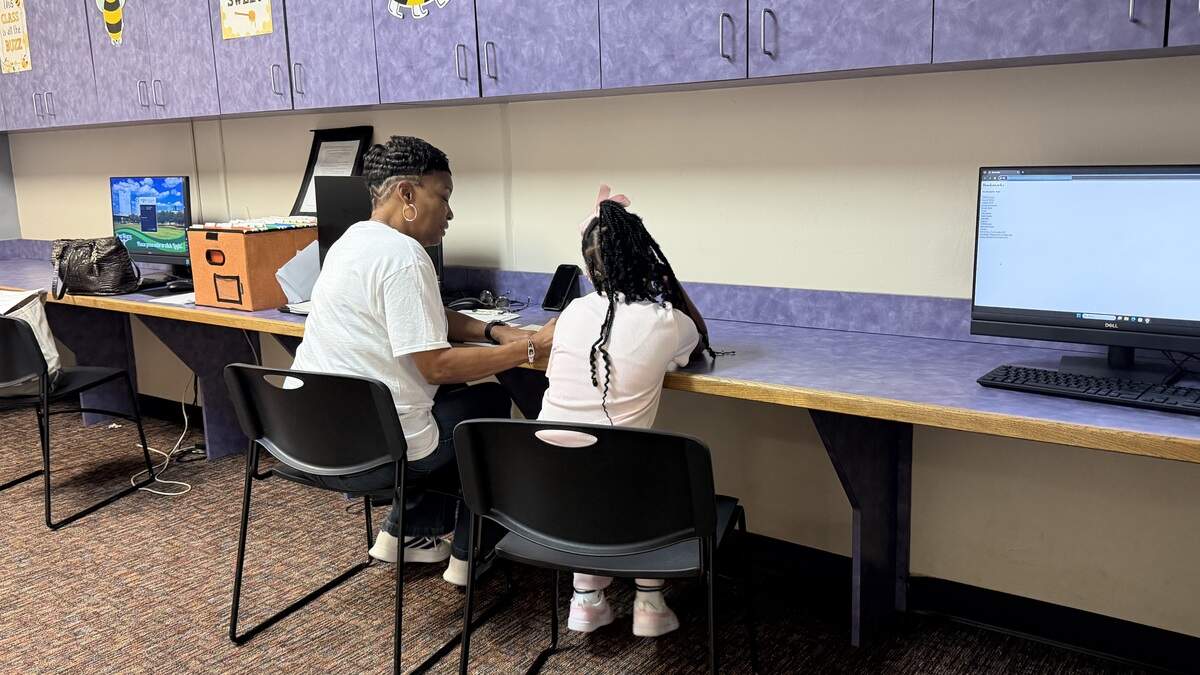
Literacy Roundup’s dyslexia screening test takes about 15 minutes, and each test is done one on one with a child. The test begins with letter and word recognition, and also includes a “nonsense words” portion to see if kids can spell and pronounce fake words, like “prab” and “twint.” That’s because a lot of kids “beat the test” by memorizing what words look like without actually knowing how to spell them, James said.
The screening also includes a portion that requires the student to read a passage out loud to measure comprehension and fluency. A final score is given through DIBLES, a system created at the University of Oregon, at the beginning, middle, and end of the year to track progress.
When a child shows signs of being at risk for dyslexia, James and her team walk parents through their options. Since Literacy Roundup is affiliated with the city and not a school district, it’s on the parents to take the next steps to ensure their child’s district follows through with an Individualized Education Program.
Schools have 15 days to respond once a parent submits a letter requesting their child be tested for dyslexia. James and her team provide a letter template in both English and Spanish for parents who don’t know what to write. Once the school responds, it then has 45 days to complete an evaluation, then 40 days to hold an Admission, Review and Dismissal meeting to create an IEP. That process can be dragged out and oftentimes deadlines aren’t met, James said. Some parents in Fort Worth-area districts have tried for years to get their children tested, she said.
“Schools will sometimes say, ‘Well, let’s just wait and see how they do in this grade,’ and they won’t sign the consent for testing,” James said. “Once the consent is signed, the timeline is firm. But there have been times, if a parent takes this up to school in August, it may be Christmas before they’re getting services. And that’s if everything goes the way it’s supposed to go, and that almost never happens.”
James usually attends ARD meetings with parents as schools create IEPs for children who Literacy Roundup originally screened. Those meetings can be overwhelming for even the most prepared parents, James said.
“There’s me and a mom sitting on one side, and then there’s the diagnostician, the speech therapist, the occupational therapist, all of them lined up behind their computers,” James said. “It’s this us-against-you scenario. And it’s not OK.”
“I took a binder of everything that I had to have for all of my son’s ARD meetings [to a city council meeting.] It was thick,” she said. “And I slammed it on the podium and said, ‘I am a reasonably educated person. I have two master’s degrees. I was a teacher, I was even an administrator, and I struggled with supporting my child. This is a broken system.”
Literacy Roundup is holding dyslexia screenings across Fort Worth
Literacy Roundup, which is held as an extension of Camp Fort Worth, screens for dyslexia at 13 community centers across the city. Those locations include the Atatiana Carr-Jefferson, Betsy Price, Andrew Doc Sessions, Fire Station, Como, Chisholm Trail, Eugene McCray, Handley Meadowbrook, Highland Hills, Martin Luther King Jr., Northside, Thomas Place and Victory Forest community centers.
The program was launched by the city and Sid W. Richardson Foundation as a way to address Fort Worth’s overall literacy and reading crisis. Pete Geren, who was named chairman of Fort Worth ISD’s state-appointed Board of Managers this spring, is president and chief executive officer of the Sid W. Richardson Foundation.
Several districts in and near Fort Worth are below the state average in reading proficiency rates, according to data from the Fort Worth Education Partnership. Those districts include Fort Worth ISD, Lake Worth ISD, Castleberry ISD, and Everman ISD. James thinks undiscovered and undiagnosed dyslexia is a major reason why.
Organizers purposely plan Literacy Roundup events so they don’t feel like school. They are included with other Camp Fort Worth activities, like sporting events and gym time, and are held in smaller groups for more personalized literacy instruction. They also stray away from using computers.
“Anytime you’re letting a computer do the job instead of listening to a child read, I feel like you’re going to miss them,” James said. “If you’ve ever seen a kindergartener on a computer, they get distracted. I mean, if you’re not sitting with a child and having them read to you, how are you going to know?”
Fort Worth ISD recently made cuts to speech, reading specialists
After the TEA took over Fort Worth ISD, appointed a new superintendent and replaced the school board with a new Board of Managers in March, state-appointed Superintendent Peter Licata and his staff have made sweeping changes to the district, including a reduction in force that impacted several key positions related to special education services and speech therapy.
Those positions included diagnostic evaluation specialists, occupational therapists, speech therapists, ARD managers, special program directors, elementary literacy directors, special education analysts and emergent bilingual teachers.
Licata has previously stated that the elimination of those positions would not decrease the amount of resources available to students, and they were made because the overall number of enrolled students in the district has continued to decrease in recent years, but overall staffing numbers have not reflected that drop.
James believes there may be hundreds of students who have undiscovered and undiagnosed dyslexia, and she expects that over time the number of students who need those services will increase, while the number of staffers who can provide them has decreased.
“You don’t call a plumber to fix your lighting in your dining room,” James said. “You need a specific person trained in academic language therapy.”
James and her team also believe students are slipping through the cracks because a lot of children with dyslexia have above average IQs, and they can work around it for a while in lower grades by memorizing what words look like instead of actually comprehending them.
“A kid with dyslexia often has above average IQ,” James said. “My son Andrew had a lot of words memorized — that’s why you have a lot of kids that get to third or fourth grade, and they’re missed. They’re smart, they’re great workaround artists. They’re reading the room, they’re reading you, they’re reading the pictures, but they still can’t read. There is still no excuse not to find them.”
The Sid W. Richardson Foundation is a funder of the Star-Telegram’s Crossroads Lab. The Star-Telegram retains independence in all coverage decisions.