Judge temporarily blocks Ten Commandments posters in some Texas school districts
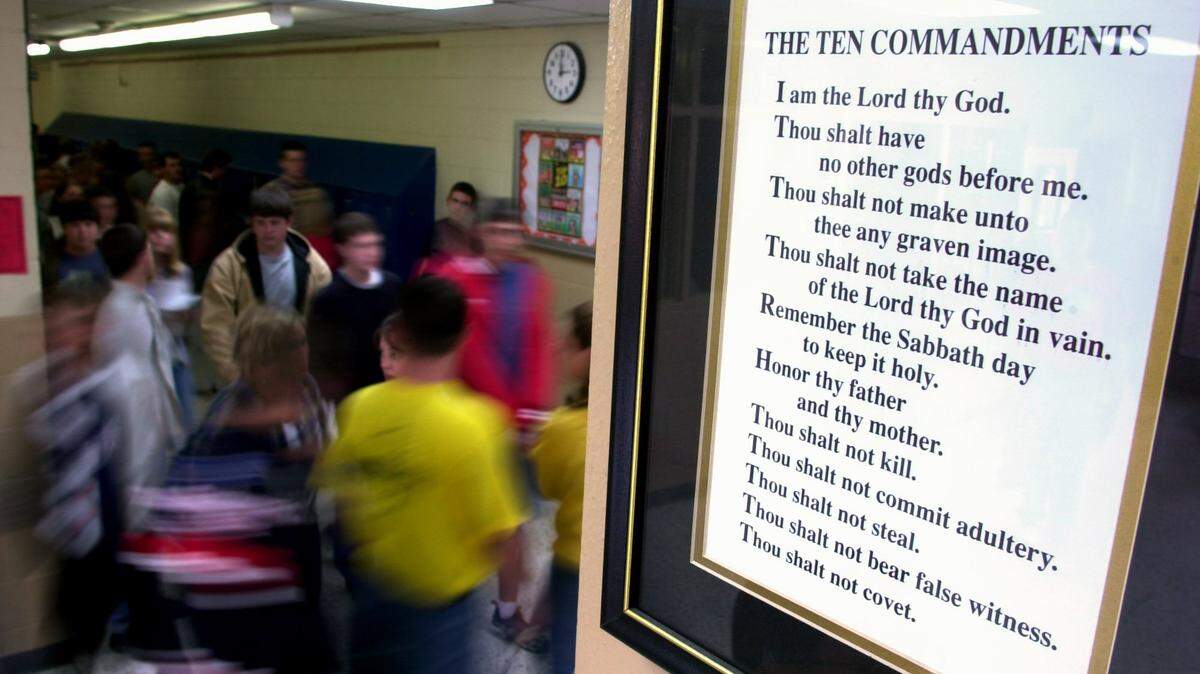
A Texas law requiring all public school classrooms to display the Ten Commandments was temporarily blocked by a federal judge on Wednesday. The pause applies to the 11 school districts named in the case, including Austin ISD, Houston ISD and Plano ISD.
Judge Fred Biery, of the U.S. District Court for the Western District of Texas, issued a preliminary injunction that pauses Senate Bill 10 from taking effect in those school districts. The decision came out of a lawsuit filed by the American Civil Liberties Union and other organizations on behalf of several plaintiffs from different walks of faith whose children attend the school districts. The lawsuit alleges Senate Bill 10, which is set to take effect on Sept. 1, violates the Establishment Clause and the Free Exercise Clauses of the First Amendment.
Another pending lawsuit was filed in June in the Northern District of Texas by a group of reverends who are also challenging the law.
Judge Biery wrote in his decision that most people “just want to be left alone, neither proselytized nor ostracized, including what occurs to their children in government run schools.” He determined that the legislation “crosses the line from exposure to coercion,” and it could cause certain students who don’t subscribe to the Ten Commandments to become outcasts.
The judge also noted that the plaintiffs’ expert witness in the case had a more persuasive argument about the Founding Fathers’ intent of the First Amendment compared to the defendants’ expert, who are both professors with backgrounds, respectively, in constitutional law and religious history, in addition to religious liberty and church-state relations.
“Even though the Ten Commandments would not be affirmatively taught, the captive audience of students likely would have questions, which teachers would feel compelled to answer. That is what they do,” Biery wrote.
Heather L. Weaver, senior counsel for the ACLU’s Program on Freedom of Religion and Belief, celebrated the decision in a statement, noting that public schools are not Sunday schools.
“Today’s decision ensures that our clients’ schools will remain spaces where all students, regardless of their faith, feel welcomed and can learn without worrying that they do not live up to the state’s preferred religious beliefs,” she said.
Officials from Plano ISD, the only North Texas district involved in the lawsuit, did not immediately respond to a request for comment on the preliminary injunction.
Sen. Phil King, a Republican from Weatherford who authored the bill, said in a statement on Wednesday that he expected legal challenges to come forward and believes the temporary injunction will be overturned on appeal.
“Though this injunction applies only to 11 school districts, we are not surprised, as we expected this law to be challenged by the ACLU and other liberal groups,” King said. “I have the highest level of confidence that this injunction will be overturned on appeal, and in the next few days I will be meeting with the state’s litigation team to discuss our next steps.”
What does the Ten Commandments bill say?
Senate Bill 10 requires the Ten Commandments to be posted in all public school classrooms on a poster or framed copy of the religious decree that is at least 16 inches wide by 20 inches tall. It must be visible and legible from anywhere in the classroom by a person with average vision.
There are various versions of the Ten Commandments. The exact language that state lawmakers required to be displayed in classrooms is:
“I AM the LORD thy God.
Thou shalt have no other gods before me.
Thou shalt not make to thyself any graven images.
Thou shalt not take the Name of the Lord thy God in vain.
Remember the Sabbath day, to keep it holy.
Honor thy father and thy mother, that thy days may be long upon the land which the Lord thy God giveth thee.
Thou shalt not kill.
Thou shalt not commit adultery.
Thou shalt not steal.
Thou shalt not bear false witness against thy neighbor.
Thou shalt not covet thy neighbor’s house.
Thou shalt not covet thy neighbor’s wife, nor his manservant, nor his maidservant, nor his cattle, nor anything that is thy neighbor’s.”
Implementation in North Texas schools ahead of Sept. 1
In recent weeks before Wednesday’s preliminary injunction, the Star-Telegram has reached out to attorneys, nonprofit organizations, school districts and teachers to ask for their insights into the law and its rollout in Texas.
The language in Senate Bill 10 does not specify what potential consequences school districts could face if they do not display the Ten Commandments in their classrooms. Districts aren’t required to purchase the posters with local dollars, but must display them if they’re donated and meet the requirements outlined in the legislation.
In an interview last week with the Star-Telegram, Sen. King said he expected the posters to be hung up in classrooms throughout the school year after the law takes effect Sept. 1. When asked about students and families who don’t have a Judeo-Christian background being exposed to the Ten Commandments in public classrooms, he said some of the commandments are universally followed regardless of religion.
“I haven’t met a family yet, whether they’re Muslim or Christian or even agnostic that doesn’t want their child every day to read, ‘Obey your parents. Don’t steal. Don’t lie. Don’t harm others,’” King said. “There’s no single document that has more shaped Western civilization, law and culture more so than than the Ten Commandments. It’s such a part of our legal heritage, our ethical heritage.”
King said he was using campaign funds to purchase posters for all schools in Senate District 10 and highlighted a coalition of several conservative groups, known as Restore American Schools, that have banded together to coordinate the purchase and delivery of posters throughout Texas. According to its website, there have been about 4,300 Texas schools adopted with more than 152,000 classrooms impacted.
Texas Values, an Austin-based nonprofit, is part of this coalition. Director of Policy Jonathan Covey said volunteers can look up nearby schools to find out which ones have and haven’t been adopted. From there, they can purchase posters, have them shipped to their home and then deliver them to the school’s administration office.
“The Ten Commandments have a long history in our country, and we want to give students the truth by showing them that they’re a foundation for our moral law and for our legal system in the United States,” Covey said.
Mark Tilley, division director of legal services for the Texas Association of School Boards, said the organization has fielded questions about scenarios in which school districts receive a smaller number of donated posters compared to total classrooms.
“The bill is silent on that. It doesn’t direct administrators or school districts how to deal with there being fewer posters than you have classrooms,” he said. “I think it’s going to be up to the administration to determine which classrooms they go in, because there’s not any guidance in the bill itself.”
Dennis Eichelbaum, a member of the Texas Council of School Attorneys, said he’s seen some school districts reword the commandments to use different language than what’s presented in the law. It’s unclear what penalties would look like for districts that don’t use the exact wording or that don’t have them hung up.
“We add to that the Fifth Circuit having struck down the Louisiana version of the same or similar state law, the Supreme Court having ruled previously that a Kentucky school could not post the Ten Commandments (Stone v. Graham), and recently another court ruled a similar law unconstitutional, and schools are perplexed as to what they should do,” he said.
Fort Worth ISD rollout unclear
Fort Worth ISD officials said in a recent statement that they were reviewing implementation processes to meet compliance with the law. As of Monday, a district spokesperson said the district was unaware of any posters that have been donated to Fort Worth ISD.
“As specified in the legislation, school districts are not required to allocate public funds for the purchase of these displays but must accept donated posters that meet the statutory size, content, and design requirements. The district is currently reviewing implementation procedures to ensure compliance with the law by the effective date,” officials said.
Steven Poole, executive director of the United Educators Association, said in a statement that teachers were focused on getting ready for students ahead of the first day of school, which was Aug. 12.
“Teachers are working hard to get their classrooms ready for their students. Districts will have to figure out how to comply with the Ten Commandments law, especially in light of a lawsuit by parents and clergy. As for teachers, their main concern is getting ready for their students on the first day of class,” Poole said.
A Fort Worth ISD teacher told the Star-Telegram this week that they have not received any guidance from district officials regarding the requirement to have the religious decree hung up in their classrooms. The teacher, who asked to remain anonymous, called the posters “ridiculous” and a “complete waste of time and money.”
“Texas has other issues that need prioritizing, and adding those posters does nothing to solve our societal problems. Religion is a personal thing and should be kept as such,” the teacher said. “The posters might be useful if they were made out of bulletproof material so we could use it as a shield against an active shooter. THAT’S a bigger concern to most teachers in my opinion. Texas legislators are more concerned about culture wars they’ve created rather than working toward purposeful solutions for real issues.”
This story was originally published August 20, 2025 at 2:45 PM.