‘A lot of talking at people’: Fort Worth ISD holds second meeting on school closures
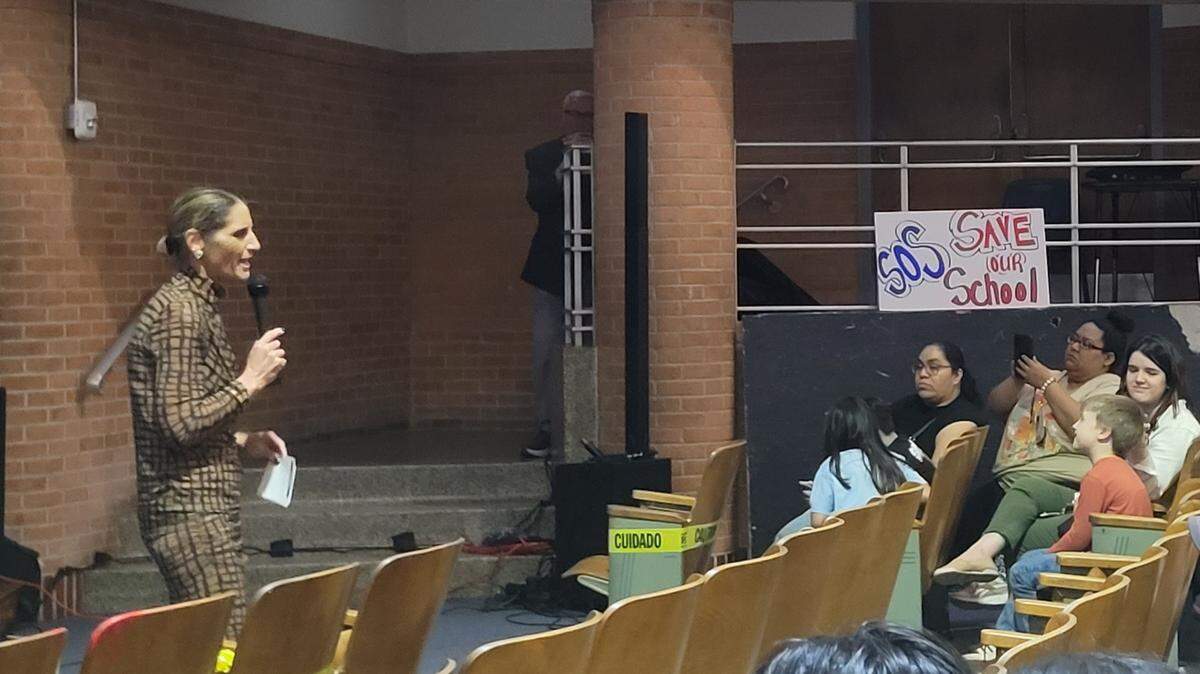
Matt Craig spent most of Wednesday evening sitting in a crowded auditorium and listening to plans to close his kids’ schools.
Dressed in a black De Zavala Elementary School T-shirt, Craig said the meeting was the third or fourth he’s attended on the issue of campus closures in the Fort Worth Independent School District. Although he was glad for the opportunity to come listen, he said he hasn’t been impressed with the shape the meetings have taken.
“I don’t feel there’s a lot of community input,” Craig said. “I think there’s a lot of talking at people and not listening to them.”
Craig was one of hundreds of parents, community members, teachers and students who gathered Wednesday evening in the auditorium at Diamond Hill-Jarvis High School for a meeting on facilities planning. The meeting was the second of three the district is holding this week, the latest step in school leaders’ efforts to talk to the community as Fort Worth ISD hammers out details of a new facilities master plan. That plan, which district leaders expect to release sometime this spring, is expected to include campus closures. Although plans haven’t been finalized, Fort Worth ISD leaders presented scenarios showing what could happen to schools in the northern and central parts of the district.
School closures could create longer commutes
Craig has kids enrolled at De Zavala and Paschal High School. He said he’s concerned about the possibility of the district closing De Zavala and Daggett Middle School, where his younger kids would go when they’re in sixth grade. Under all three scenarios presented for the Paschal pyramid, De Zavala would close and its students would go to E.M. Daggett Elementary School, which is a short walk from Daggett Middle School.
But Craig said his bigger concern is that the district could close the middle school and send those students to McLean Middle School, about three miles southwest of Daggett. That move was listed as a possibility in one of the three scenarios for the pyramid. If that were to happen, when his youngest kids reach middle school, they would have a 20- to 25-minute car ride to McLean every morning, instead of a short walk to Daggett, he said.
As was the case at this week’s previous facilities planning meeting, Fort Worth ISD officials didn’t allow for an open mic question and answer session at Wednesday’s meeting, instead opting to take written questions from the audience and answering as many as time allowed. Craig said he was disappointed that the meeting format didn’t offer opportunities for an actual discussion among parents and school leaders.
During the presentation, Tracy Richter, vice president for planning at the consulting firm HPM, walked through several scenarios for schools in the northern and central parts of the district, which included campuses that feed into Carter-Riverside, Diamond Hill-Jarvis, North Side and Paschal high schools. Richter outlined areas where schools are under-enrolled, in poor condition or too small to be cost-effective to operate.
As an example, Richter pointed to Washington Heights Elementary School, which was built with money from the district’s 2013 bond issue. Although it’s relatively new, the building is only designed for 420 students, making it one of Fort Worth ISD’s smallest. Furthermore, he said, Washington Heights is “a pitching wedge” from Milton Kirkpatrick Elementary School, which is about the same size as Washington Heights.
Operating schools as small as those two doesn’t generally make fiscal sense for school districts, Richter said. Bigger schools tend to be more cost-effective than smaller ones, he said — Fort Worth ISD spends more than $15,000 per student at schools with fewer than 300 students, compared to about $9,000 per student at schools with enrollments upwards of 600.
Richter acknowledged that conversations around school closures are difficult because those campuses become a part of the identity of the neighborhoods around them. But when facilities problems are standing in the way of the district’s other goals, leaders need to look for other options, he said.
FWISD’s enrollment drops by thousands
Fort Worth ISD leaders have been weighing the possibility of campus closures for more than a year, largely in response to a steady decline in the district’s enrollment. The district has seen its enrollment drop by about 12,000 students over the past five years. School officials point to a range of factors contributing to that decline, including increased competition from charter schools, a declining birth rate nationwide and housing trends that lead families with school-aged kids to move to the outer reaches of the city, in neighborhoods that are part of suburban school districts.
Karen Molinar, Fort Worth ISD’s interim superintendent, said all of the scenarios presented Wednesday night are just options. She emphasized that district leaders haven’t made any final decisions about what the future looks like for its campuses, and encouraged families to stay engaged in the planning process. Fort Worth ISD leaders are asking parents and community members to fill out a survey on what they’d like to see the district do.
Molinar, who was named the lone finalist for the permanent superintendent job last week, said one of the biggest challenges in creating a facilities plan is predicting what Fort Worth ISD will need years into the future. In doing so, the district has to plan not only for its current students, she said, but also for those who haven’t been born yet.
“These decisions are not just for the students that we’re currently serving,” Molinar said. “These are five, 10, 15-year plans.”
Schedule of future meetings
Thursday, Feb. 27, 6 p.m. at Benbrook Middle-High (Southwestern Region: Arlington Heights, Benbrook, South Hills, Southwest & Western Hills pyramids)
Monday, March 3, 6 p.m. Virtual meeting for all district schools.
This story was originally published February 26, 2025 at 10:29 PM.