
More questions than answers for community at Fort Worth ISD meeting on school closures
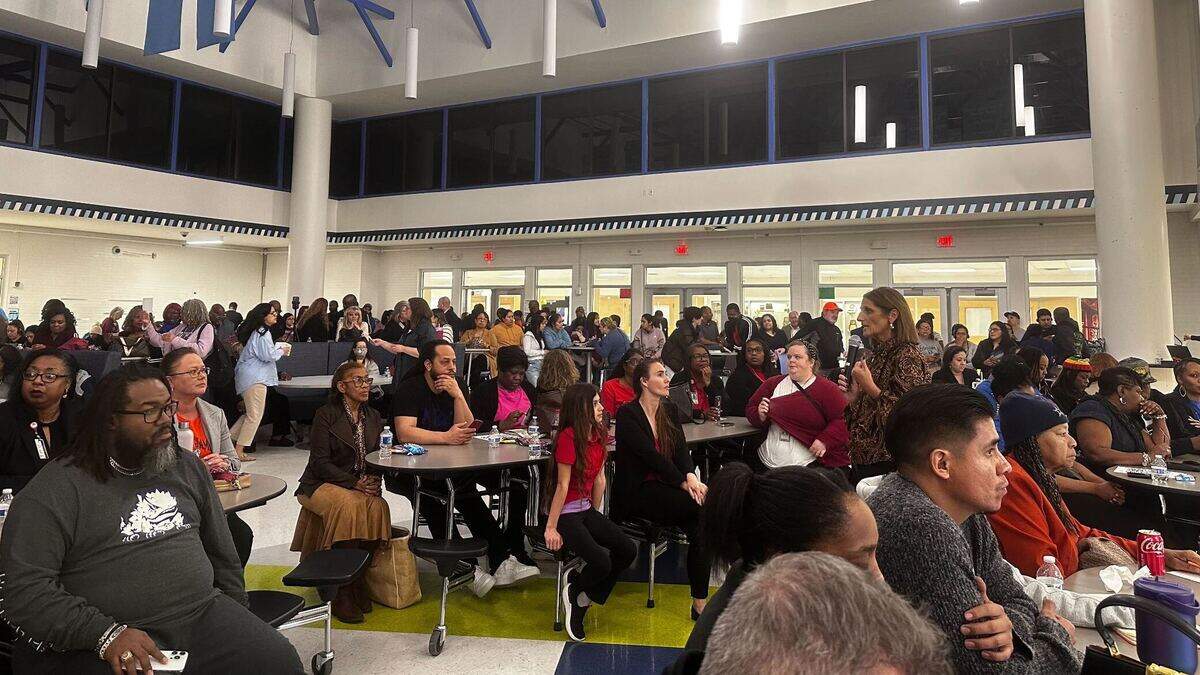
Hundreds of community members showed up Monday night at O.D. Wyatt High School for the first of several meetings hosted by the Fort Worth Independent School District to gather community feedback on possible school closures.
“Tonight is not about recommendations,” Interim Superintendent Karen Molinar said. “There’s no recommendations that are ready to go before the board to take action. It’s a very long process that we started over a year and a half ago. We’re at a point in the process now that we actually are putting together names of schools to consider and have conversations about.”
Molinar said a decrease in enrollment, declining birth rate in the city and families who leave the district for more affordable housing, are some of the “whys” that led the school board to start this conversation about possible closures.
“It’s very important tonight that we engage, but more importantly, that we hear your feedback,” Molinar said.
Monday’s meeting was focused on the district’s eastern region of schools, including the pyramids of elementary and middle schools that feed into Dunbar, Eastern Hills, Polytechnic and Wyatt high schools.
Tracy Richter, vice president of planning services at consulting firm HPM, made a data-driven presentation to the crowd inside Wyatt’s cafeteria.
Richter said the process is intended to create a five-year, 10-year and 15-year vision to determine what Fort Worth ISD will look like in regards to enrollment, programs and facility standards.
The district has seen a significant decline in enrollment, over 12,000 students, in the last five years, Richter said. There are $630 million in deferred maintenance needs, and that is projected to reach $1.2 billion in five years.
Richter said the smaller schools with under 300 students cost more per student, around $15,000, compared to larger schools at $8,000 to $9,000 per student.
“This process isn’t just about that. You’re going to see a lot of data, but ultimately it tries to get to the solution around how do we make programs and schools stronger to ensure that the vision for literacy and numeracy and graduation come to fruition,” Richter said.
“If you lean too much on the data, you can ignore the needs of the community. If you lean too much on the community feedback, you could ignore the data, and so you’ve got to find a good balance between,” he said.
The deputy superintendent of operations, Kellie Spencer, emphasized that no decisions will be made at this point and that recommendations will not be made to the board until late spring, or possibly later. District officials said if decisions are made this year to close schools, those schools will not close next school year but the changes will be made gradually.
“The community’s feedback is crucial in shaping the facility master plan. We want to ensure we are making the right decisions for each community and the district as a whole,” Spencer said.
After Richter’s presentation community members were given a paper and pencil to write down their questions or comments for the school administration.
While some people in the crowd were raising their hands waving the white paper with their questions jotted down to be passed forward and waiting to hear the answers, others were expressing concerns that not enough papers were provided for everyone and that questions were being picked by the administration but only generalized answers were given.
The questions were answered based on common themes like criteria for school closures, how a closure would affect the employment of teachers and how schools will manage staffing, among others.
Diana Stagner, a parent who has her child enrolled in one of the elementary schools, said she appreciated that district officials shared data that will be used in their decision making. “They (the district) went through a lot of trouble to just describe what options that we have as parents,” she told the Star-Telegram.
“I have a better picture of what’s going on,” Stagner said. “I think they still have some work to do, but I appreciate that I can see what’s behind their decision.”
Like many community members, Stagner was disappointed that the meeting did not include an open-mic conversation. “Having us write the questions down, it feels like they kind of filtered them out and don’t really directly answer us,” she said.
Stagner added that Fort Worth ISD is not really doing enough to address inequalities between different pyramids. There are schools that are old and need a lot of renovations, she said. “They’re just trying to reuse, combine and consolidate, but they’re not really trying to give us new buildings,” Stagner said.
A special education teacher for the district told the Star-Telegram that she plans to attend all three meetings this week to see what’s being said across the district.
The teacher said that she doesn’t agree with how the task force that worked on the options under discussion was selected. She said she along with another teacher from her school applied to be on the task force but neither one of them got selected.
“I believe that the school board members should have been the ones responsible for picking the people to represent their district, and that once those people were selected, they should have met with their communities to find out what their communities wanted,” she said.
The teacher said the presentation by Richter was not productive because he gave out a lot of high-level information “almost like a lawyer,” she said. She added that visual aids, such as boundary maps, would have helped attendees understand the proposed changes and their impact on the community.
“You have people up there giving presentations that haven’t stepped foot into the schools, even upper administration that haven’t stepped foot into the schools,” the teacher said. “They don’t know the teachers. They don’t know the kids. They don’t know the dynamics of the environment.”
Marcial Gonzalez, a former student and parent who has his son in the fifth grade at Glen Park Elementary, said, “I feel like they’re trying to fix the issues. But it seems like growing up in the district, the issue has been ongoing. So, you know, it wasn’t too clear. There’s a lot of options out there, and there was really nothing. I guess they’re testing the waters to see what can be done.”
Gonzalez said all the questions asked by community members were not answered. “They were flipping through the papers. I do feel like it would have probably been better for the mic to be passed to individuals instead of, you know, writing stuff down or putting it on a survey at the end of the day,” he said.
Keisha Braziel, PTA president at David K Sellars Elementary, said it seemed like the district was not prepared for the number of people who showed up for Monday evening’s meeting.
Braziel said the information should have been released before the meeting, so that people could “digest” it all or could just come and ask questions instead of hearing the presentation.
“There are different types of learners, so some people get a clear understanding when they leave, and some people are more muddled than when they got here,” she said.
Talking about a possible timeline for school closures, Richter said “zero” schools will be closed next school year. “A typical plan over five years would be going through a sequence of making sure that we’re closing buildings in the right order and that we have the right things in place for those students to walk into,” he said. “So the plan could look like three schools in year 2 and 3, another three schools in year 4 and three more in year 5.”
Toward the end of the meeting, community members were asked to fill out a survey to provide feedback to the school board on the draft options for each pyramid within Fort Worth ISD. More information about the process and additional background data can be found on the Facilities Master Plan website.
The drafted options show 14 to 21 elementary schools are being considered for reductions compared to a maximum of three middle schools and one high school.
“As options evolve throughout this process, additional opportunities for engagement will be planned,” a district spokesperson said in an email in response to questions from the Star-Telegram. “At this point, we are seeking feedback through the survey that was included as part of the presentation. The remaining meetings scheduled for this week will follow the same format.”
Schedule of future meetings
- Wednesday, Feb. 26, 6 p.m. at Diamond Hill-Jarvis High (North Central Region: Carter-Riverside, Diamond Hill-Jarvis, North Side and Paschal pyramids)
- Thursday, Feb. 27, 6 p.m. at Benbrook Middle-High (Southwestern Region: Arlington Heights, Benbrook, South Hills, Southwest & Western Hills pyramids)
- Monday, March 3: 6 p.m. virtual meeting for all district schools.
This story was originally published February 24, 2025 at 10:53 PM.