TX Gov. Greg Abbott’s school voucher plan failed in 2023. Will this year be different?
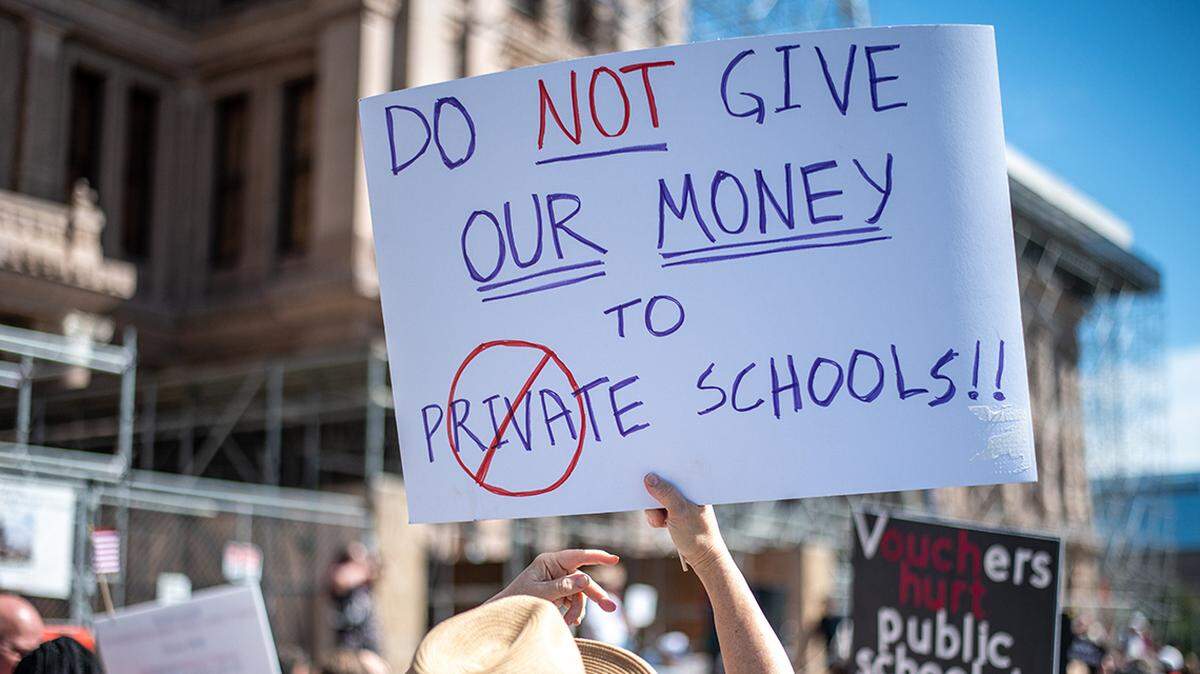
Much as it did two years ago, the fight over school vouchers is expected to be a top issue when lawmakers return to Austin this month.
But so-called education savings accounts aren’t the only education-related issue expected to come up during the legislative session that begins Jan. 14. Lawmakers are also expected to take up bills related to school funding, child care and the state’s teacher workforce.
Voucher proposal stalled in 2023, set to return in 2025
Education savings accounts are a school voucher-like plan that would give families public money to put toward private school tuition or homeschooling costs. Proponents say those policies give families more choices in their kids’ education, while skeptics say they pull money from public schools and funnel it toward private schools that don’t have the same level of accountability and oversight as school districts and public charter schools.
During the 2023 legislative session, Gov. Greg Abbott made creating an education savings account program a top priority. But he met with resistance from a coalition of Democrats and rural Republicans in the House. Democrats have traditionally opposed school vouchers because they funnel money away from public schools. Many Republican lawmakers who represent rural areas are skeptical of those programs because there are few private schools in their districts, so their constituents have little to gain.
After a voucher proposal failed to pass the House during the regular session, Abbott called lawmakers back for four special sessions. When the proposal failed to reach the governor’s desk by the end of the fourth session, Abbott vowed to campaign for primary opponents running against Republican lawmakers who had opposed the bill.
Because Abbott pledged to veto any school funding package that didn’t also include a voucher plan, the fact that the proposal didn’t pass also meant that districts didn’t get new money they expected to keep up with rising costs or give teachers a pay raise. Many districts adopted deficit budgets expecting state officials to make good on pledges to send more money to schools. When that didn’t happen, districts had to dip into their emergency reserves to cover operating costs.
Two years later, Abbott will be working with a more conservative House that may be more receptive to the idea of school vouchers. During a press conference on the morning after Election Day at Kingdom Life Academy, a private Christian school in Tyler, Abbott said there would be 79 “true, hardcore school choice proponents” in the House this year — three more votes than it generally takes to get a bill through the chamber.
Abbott noted that school choice already exists for wealthy families who can pay for private school tuition. A school voucher plan would just extend that privilege to less affluent families, he said.
“School choice improves educational opportunities for minority and low-income students, and Texas is going to make sure they have that opportunity,” Abbott said.
Critics say vouchers harm public schools
Abbott dismissed opponents who argue that a voucher plan would drain money from public schools. The voucher program would be funded from a different pot of money than public schools, he said. Any voucher plan lawmakers put forth wouldn’t interfere with the state’s ability to fully fund public schools and raise teacher pay, he said.
But critics point out that Texas funds its public schools based on average daily attendance, meaning students who move from public schools to private schools represent lost revenue for the school district they left.
Bob Popinski, senior director of policy for the education advocacy group Raise Your Hand Texas, noted that universal voucher programs have generally led to public education funding cuts in other states. In August, the Miami Herald reported that Florida’s voucher system, which was expanded in 2023 to cover families of all income levels, was beginning to affect per-pupil revenue in the state’s public school districts, affecting their ability to retain teachers and maintain school buildings.
Popinski also pointed out that, in other states, a large percentage of students who accepted vouchers were already enrolled in private schools. In a 2022 policy paper, the Grand Canyon Institute, a Phoenix-based think tank, looked at the impact of Arizona’s voucher program. Researchers found that 80% of the students who enrolled in that program weren’t enrolled in public schools the previous year, meaning that they were either just starting school, were being homeschooled, or were already enrolled in private schools. That means Arizona taxpayers are subsidizing tuition for large numbers of students who were already enrolled in private schools before the plan was implemented.
Discussion expected on teacher workforce, child care, pre-K
Although the debate around school vouchers is likely to be the biggest education-related issue this session, other matters are likely to come up, as well. Among other things, lawmakers are expected to discuss solutions to the fallout caused by a 2019 law expanding pre-K across the state. In November, a number of child care providers told the Texas Senate Committee on Natural Resources and Economic Development that the law had cost them millions of dollars as parents moved their children from private child care centers to district-run pre-K programs.
Teacher workforce issues are also expected to be a topic of concern this year. Since the pandemic, Texas has struggled to attract and retain qualified teachers, particularly in certain areas like special education and bilingual education. In September, the Texas Tribune reported that schools across the state are hiring non-certified teachers in rapidly increasing numbers. In 2024, more than a third of the new teachers hired to work in Texas schools lacked a teaching certificate.
A number of bills filed before the session began would address parts of the teacher workforce issue. House Bill 1334 would require the State Board for Educator Certification to waive certification testing fees for teachers working toward getting certified to teach special education or bilingual education. And House Bill 362 would bar districts with 5,000 or more students from placing students in grades 1-6 with a non-certified teacher for two or more years in a row.
School leaders shift focus away from voucher fight
Leaders of several North Texas school districts are acknowledging that a voucher plan is likely to become a reality in some form or other, and are shifting their efforts elsewhere. In December, the Fort Worth school board passed a slate of legislative priorities that called for increased funding, but made no mention of education savings accounts. A similar list of priorities passed by the Northwest school board called on lawmakers to meet its funding obligations to public schools before they considered a voucher plan, but stopped short of calling on them to reject any proposal outright. In November, Dallas Superintendent Stephanie Elizalde acknowledged that the fight against school vouchers is over, and said district leaders would focus this year on advocating for more school funding.
Popinski said he expects school funding to be another major issue during this year’s legislative session. Texas hasn’t adjusted the per-pupil allotment it sends to school districts since 2019, meaning districts are struggling to keep up with rising costs. Lawmakers would need to spend billions of dollars just to give schools the same purchasing power they had in 2019, he said.
But if Abbott ties increased school funding to vouchers as he did in 2023, Popinski said it’s still a bad tradeoff. There are a number of other issues lawmakers need to sort out before they establish a voucher system, he said. The state has grown increasingly reliant on unlicensed teachers because schools are struggling to retain experienced educators. Per-pupil spending on pre-K programs has declined in Texas, even as it has risen nationwide. And Texas hasn’t overhauled its special education funding system in decades.
“I think there’s a litany of public school policy issues that our legislature needs to address before even thinking about a voucher program,” Popinski said.
This story was originally published January 6, 2025 at 6:00 AM.