Advocates spar over Texas’ school voucher proposal in ‘Beyond the Headlines’ debate
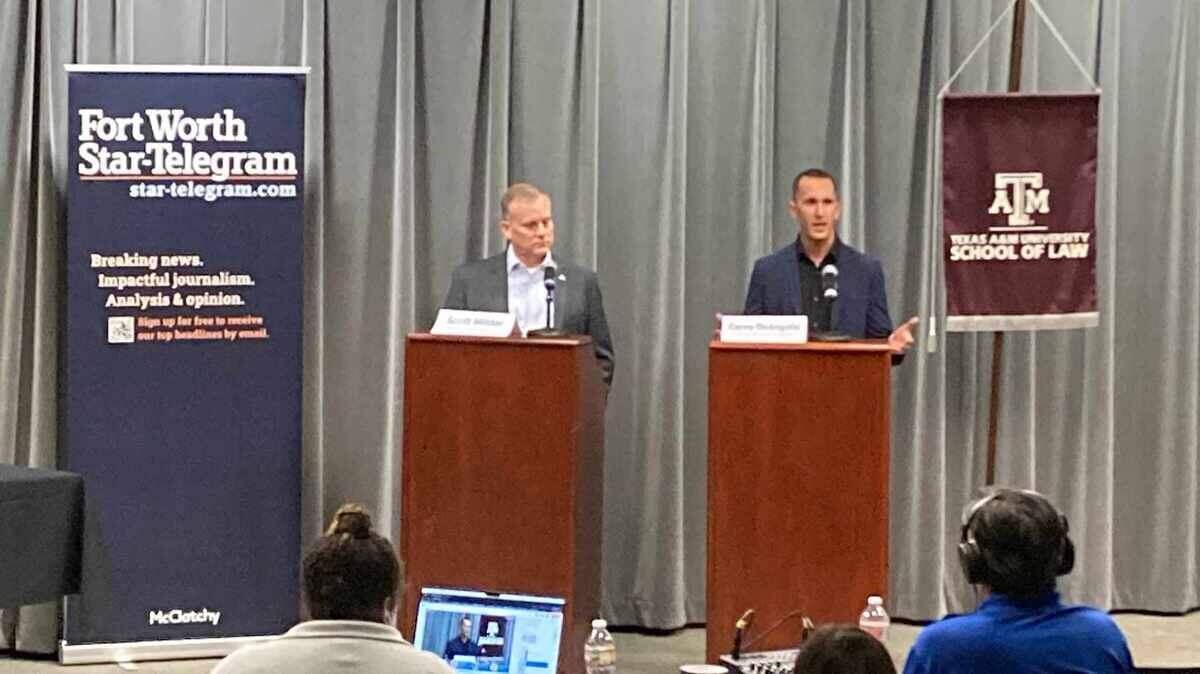
Two education policy advocates agreed Tuesday night that they want what’s best for public schools in Texas. But they differed sharply about what that is.
Corey DeAngelis, executive director of the Educational Freedom Institute, and Scott Milder, co-founder of Friends of Texas Public Schools, sparred over the issue of school vouchers at a debate at the Texas A&M University School of Law organized by the Star-Telegram.
The debate comes as Texas lawmakers are in Austin trying to hammer out a deal on education savings accounts, a school voucher-like plan that would give families taxpayer money to pay for private school tuition and other expenses. School vouchers have been a top priority for Gov. Greg Abbott and Lt. Gov. Dan Patrick, and have faced opposition in the Texas House, where Democrats and Republicans from rural areas have banded together to so far defeat voucher proposals.
DeAngelis, a self-described school choice evangelist, argued that fears that a school voucher system would harm the public school system are overblown. Competition from private schools would benefit public schools because it would force them to innovate, he said.
“We don’t want to destroy public schools. We don’t want to defund them,” he said. “We actually want to make them better, and we see this as the way to do so.”
Milder, a self-described conservative Republican, said school choice has already forced public schools to innovate. But that competition came from charter schools, he said, which are publicly funded but privately operated.
Most school districts in the state already have creative offerings like dual credit classes that in some cases allow students to graduate from high school with an associate’s degree, as well as career and technical education programs that allow students to get professional certifications while they’re still in high school, Milder said. Those programs allow students to go to work immediately after they graduate, earning enough to support families or put themselves through college or more advanced training programs.
Those innovations have been good for Texas students because they give them more options for tailoring their education toward what they need, Milder said. But those kinds of programs cost money, he said. He argued the state’s public schools are already underfunded and struggling to comply with rules the Legislature sets but doesn’t provide funding to meet. A voucher program would draw even more money away from public schools, hampering their ability to create those kinds of programs, he said.
DeAngelis responded that public school districts wouldn’t need to worry about losing funding if families are happy with the quality of education their kids get there. Giving families more school options for their kids is a higher form of accountability than anything the state has in place now, he said — if families aren’t satisfied with their schools, they can leave.
But Milder countered that there’s only so much taxpayer money to go around. If Texas’ voucher program were to see the same kind of growth that those in other states have, it could mean billions less in the state’s general fund.
“That’s less money in that pot to divvy out to the rest of the ISDs around Texas,” Milder said. “It’s just a fact there will be less money for public ed.”
School voucher proposal clears Texas Senate, heads to House
Last week, the Texas Senate passed House Bill 1, which would set aside $500 million to give qualifying students up to $8,000 in public money to use on private school tuition or other education-related expenses. The plan has the backing of Abbott, who has made a priority of passing school voucher legislation.
This week, the bill moved on to the House, where it faces stiff headwinds. House Democrats argue that vouchers drain money from public schools and give it to private schools, who don’t have to abide by the same transparency and accountability rules. Rural Republicans in the House have historically opposed school vouchers because, in most cases, no private schools exist in the communities they represent. Abbott has threatened to call lawmakers back for another special session if they don’t pass a school voucher bill during the current session. If no voucher bill reaches his desk after a fifth special session, Abbott has threatened to campaign against Republican lawmakers who didn’t back the bill.
The voucher bill was referred to the House Select Committee on Educational Opportunity and Enrichment, where it awaits a hearing.
Research into academic outcomes associated with school voucher programs in other states has been mixed. Researchers who looked at programs in Indiana and Louisiana found moderate to large academic declines among students who moved to private schools using a voucher. In most cases, those declines lasted for years. But a study looking at a program in Washington, D.C., found that voucher students saw steep declines in math for the first two years after they transferred to private schools, but then rebounded in the third year.