Charter schools are growing in Fort Worth. Is that good news?

When Keyerre Hayes’ daughter starts pre-K in August, she’ll be going to a school that isn’t only new to her.
Hayes and her husband are enrolling their daughter at Rocketship Dennis Dunkins Elementary School, a new charter school in Fort Worth’s Stop 6 neighborhood. The school opens at the start of the next school year.
Both Hayes and her husband are originally from New Orleans, where the public school district shifted to almost all charter schools after Hurricane Katrina. So before they moved to Fort Worth, she and her husband were familiar with charter schools — “The good, the bad and the ugly,” she said. They both had positive experiences going to charter high schools and liked the idea of putting their daughter in something other than a traditional public school, she said.
Hayes’ daughter goes to day care at a private school, and she was worried about how she would handle the transition to a big, open-enrollment public school. She wasn’t sure she would get the same kind of individualized, one-on-one attention that she needs, she said. So she began looking at other options in the area. Rocketship was one of the only charter schools nearby with a pre-K program, so it seems like a good fit, she said.

The new Rocketship campus is one of a growing number of charter schools operating in Fort Worth. Over the past five years, charter schools, which are publicly funded but privately operated, have seen steady enrollment growth even as the Fort Worth school district has seen steady declines. Proponents of charter schools say they give important options to parents who live in areas with low-performing traditional public schools. But critics say that difficult working conditions in charter schools often lead to high teacher turnover rates, which is ultimately bad for students academically.
Charter enrollment climbs in Fort Worth as school district numbers dip
From the 2018-19 school year to the 2021-22 school year, the enrollment at state-certified charter schools in Fort Worth has grown by about 32%, according to figures from the Fort Worth Education Partnership, a nonprofit that advocates for high-quality public schools in Fort Worth. The nonprofit has assisted national charter networks looking to move into Tarrant County.
At the same time, the Fort Worth school district’s enrollment has declined by about 9%. District officials have blamed those enrollment declines on a range of factors, including the COVID-19 pandemic and the competition from charter schools. Because schools receive state funding on a per-pupil basis, declining enrollment means tightening budgets, as well.
More than half of all pre-K-12 students in Fort Worth still go to school in the Fort Worth school district, with others going to charter schools, private schools or other school districts that operate in the city limits.
The new Rocketship elementary school is on Berry Street, about a mile northwest of Christene C. Moss Elementary School. Initially, the school will serve students in pre-K through third grade, but school leaders have plans to expand to the fifth grade within the next few years.
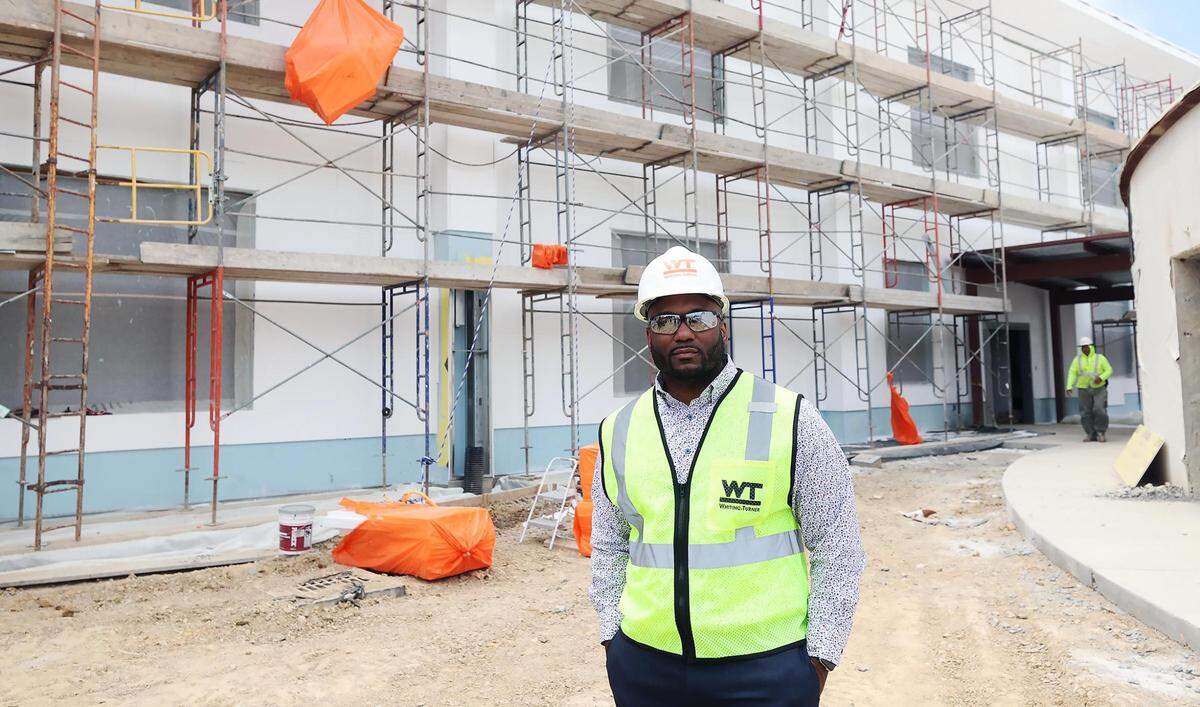
The main thing that differentiates Rocketship from a traditional public school district is “radical parent ownership,” said Rocketship Texas Superintendent SaJade Miller. Parents don’t need to drive across town to talk to school district officials, he said. The school’s leadership is all easily accessible in the neighborhood where the school operates. The school will have an open campus and a parent council that has an operating budget, Miller said.
Before going to work for Rocketship, Miller was the Fort Worth school district’s assistant superintendent for innovation. He also served as the principal of two campuses, a vice principal and a teacher. In each position, he could see the things that needed to be changed. But a district the size of Fort Worth has too many layers of bureaucracy and historical context to change quickly, he said. Students only have one shot at an education, he said, so they don’t have time to wait for that change.
Miller doesn’t think of himself as an advocate for charter schools in general, he said. He acknowledges there are great leaders and high-quality programs in the Fort Worth school district, but also says there are many underperforming schools. Likewise, he said, there are bad actors and blind spots in the charter school sector. But if Fort Worth can harness the best of both sectors, Miller says students will be better off.
“I believe that in this community at this time based off these needs, that this is right for kids and for the community,” he said. “But I won’t dare say that one is better than the other because that’s just not the case.”
Charter schools aren’t a silver bullet, education advocate says
Brent Beasley, president and CEO of the Fort Worth Education Partnership, said he thinks charter schools have a role to play alongside the traditional public school system. He doesn’t think they are any kind of silver bullet to address problems in public education. But in areas where traditional public schools are underperforming, he thinks giving students other options is critical.
Beasley pointed to a report the organization released last year breaking STAAR test scores out by City Council district. In District 5, which covers a large swathe of southeastern and eastern Fort Worth, 87% of students are economically disadvantaged. In that district, only 16% of students performed on grade level on state tests, according to the report. Those schools have struggled for years, Beasley said.
“Is it a reasonable expectation that we just kind of wait around for however many years and hope that that changes or gets better?” Beasley said.
But Beasley acknowledged that not all charter schools have been successful in improving student outcomes. He thinks the Texas Education Agency should be more aggressive in shutting down unsuccessful charter schools.
The Fort Worth school district partners with charter school operators to run several schools in the district, including the five campuses operated by Texas Wesleyan University as a part of the district’s Leadership Academy Network. In a statement, Fort Worth Superintendent Kent Scribner said the district remains open to those kinds of partnerships. But he rejected the comparison between schools in the district and charter schools, pointing out that many charter schools self-select their students.
“A more accurate ‘apples to apples’ comparison would be between charter schools and FWISD Schools of Choice,” Scribner said. “Schools like the Texas Academy of Biomedical Sciences, Young Women’s Leadership Academy, I.M. Terrell Academy for STEM and VPA, Young Men’s Leadership Academy, and several other Fort Worth ISD Schools of Choice are among the best schools in the region.”
Trinity Basin mom likes one-on-one attention from teachers
Taneesha Green’s son, Jaleel, is a third-grader at Trinity Basin Preparatory’s Panola campus, a charter school in Fort Worth’s Meadowbrook neighborhood. Green said she never wanted to put Jaleel in school in the Fort Worth school district. Friends who had kids in the district say their children’s classes are too big and they don’t get enough one-on-one attention from their teachers.
Green said she likes that Jaleel seems to get more individualized attention from his teachers at Trinity Basin. She’s also found that it’s easy for her to get in touch with his teachers at the school.
The school is also heavily involved in the surrounding community, Green said. It hosts a food pantry and offers help with Christmas and Thanksgiving dinners.
“They really do more than just simply educate your kids,” she said.
High teacher turnover could be bad for students, charter critic says
Huriya Jabbar, a professor in the College of Education at the University of Texas at Austin, said charter schools have historically had higher rates of teacher turnover than traditional schools. In a policy brief published in 2017, researchers at UT’s Education Research Center analyzed teacher retention rates in several categories of schools statewide and found that charter schools had less success keeping their teachers than any other type of school.
That’s potentially problematic, Jabbar said, because students in schools in which teachers come and go frequently tend to suffer academically because of it. She pointed to research from New York that suggested that high rates of teacher turnover have a detrimental effect on student outcomes. The harmful effects of high teacher turnover extended beyond the students of the teachers who left and those who replaced them, according to the study.
Those effects were especially pronounced in schools with large percentages of lower-performing students and Black students, according to the study. That’s especially worrisome, Jabbar said, because Black students and students in poverty make up a larger percentage of charter schools’ enrollment than they do at traditional school districts.
Jabbar and another researcher are in the middle of a five-year study looking at the academic effects of high rates of teacher turnover. The research on the consequences of turnover in schools is limited, she said, but there’s been more research on turnover in other sectors, like business.
In any organization, a certain amount of turnover can be a healthy thing, Jabbar said. New people bring in fresh perspectives and new ideas that may never have been tried before, she said. But if turnover rises above a certain level, organizations can lose institutional knowledge that they can build on from one year to the next. Jabbar said she expects to find the same thing in schools: when there are few long-tenured teachers in the classroom, schools are forced to figure out how to do everything again each year, she said.
High rates of teacher turnover can also lead to what Jabbar calls the Uberization of teaching, she said, a situation where teachers view their work less as a profession and more as a short-term job. As a part of her work, Jabbar has interviewed hundreds of charter school teachers. Many told her that a lack of transparency and unpredictability in their pay led them to move from school to school in search of better working conditions.
Many charter school teachers also said they struggled to move on to traditional schools, where union contracts generally make pay more predictable, Jabbar said. Even at a time when traditional school districts are struggling to recruit enough teachers to fill their classrooms, there are structures in place that make it difficult for teachers to move from charters into traditional schools, she said. For example, many traditional schools don’t count teachers’ years of experience in the charter sector, Jabbar said, meaning they would be at the lowest pay level if they moved to traditional schools.
When teachers leave schools in large numbers each year, it may have an effect on student-teacher relationships, Jabbar said. Those relationships are important for students’ academic outlooks after high school, she said. College-bound students need teachers to write letters of recommendation. First-generation college students often need help navigating the college application process, because the process is complicated and no one in their families has handled it before. In schools with few long-tenured teachers, students may have nowhere to turn for those things, she said.
Last year, IDEA Public Schools, one of Fort Worth’s largest charter school operators, attracted scrutiny after a financial investigation uncovered evidence that school officials had used school money for personal benefit, according to The Dallas Morning News. Following the investigation, the network’s board fired its CEO and superintendent, JoAnn Gama, and its chief operating officer, Irma Munoz.
On May 10, the network announced it was hiring Jeff Cottrill as its next superintendent. Cottrill previously headed up TEA’s investigative division at the time when it was reviewing IDEA’s finances.
IDEA has more than 60 campuses across Texas, including four in Tarrant County. Its newest campus, IDEA Southeast, opened on East Seminary Drive in Southeastern Fort Worth last year. IDEA officials hope to have 14 campuses in Tarrant County by the 2023-24 school year, according to the network’s growth plan.
Charter network looks to shore up teacher retention
Remy Washington, president of Uplift Education, a charter network that operates campuses across the Dallas-Fort Worth area, said teacher turnover was a problem in the network’s early days. When she came on board in 2013, the annual teacher turnover rate was about 30%, she said. But as the network has gotten more established, its teacher base has become more solidified, she said. Now, about 10-20% of its teachers leave their schools in any given year, she said.
Uplift works hard to keep a pulse on employee satisfaction with their jobs, Washington said. The network uses employee satisfaction surveys and holds quarterly town hall meetings where teachers can discuss challenges and problems with the network’s leaders. The network’s chief people officer holds focus groups on each campus where employees can talk about their concerns. Those discussions help inform decisions about the network’s direction, Washington said.
Compensation and benefits aren’t the top factor in keeping teachers, Washington said, but they’re big factors. The network tries to stay competitive with salary and benefits, she said, and because Uplift is a designated district in the state’s Teacher Incentive Allotment program, teachers are eligible for stipends of up to $25,000 for working in areas of high need.
Fort Worth is a competitive market in terms of attracting and keeping teachers, Washington said. That’s due in part to new charter networks moving into the city and competing for teachers. But also, the Fort Worth school district has improved its programming over the past few years, making itself a more attractive destination for teachers, she said. Another big factor is the large number of smaller school districts in the immediate area around Fort Worth, she said.
Washington came to Uplift from Chicago Public Schools, the nation’s third-largest school district. In moving from a large urban district to a charter network, the biggest difference Washington has noticed is in the organizations’ hierarchies. In Chicago, major decisions were made by the district’s CEO. It could be hard for lower-level employees to reach the CEO with their concerns, she said. Uplift is a much smaller organization, meaning most employees have better access to the people at the top, she said. That enables the network to make changes more quickly, she said, something that was critical during the early days of the pandemic.
“I think you definitely have a lot more flexibility in a charter school,” Washington said.
This story was originally published May 24, 2022 at 5:00 AM.