On Wednesday morning, LaShun Cabness and Anabel Montes stood in front of a two-story house on Riverside Drive, waiting for someone to come to the door.
The house was their third stop of the morning. They’d struck out on their first two, and at first, it looked like they’d strike out here, as well. Cabness knocked. When no one answered, she waited a few moments, then knocked again. Hearing no answer, she used her cell phone to call the woman she hoped was inside.
Finally, a second-story window opened, and Roberneshia Johnson and her daughter poked their faces outside. Johnson called down that she’d be there in a minute, then disappeared inside. A moment later, she opened the front door and stepped outside.
Johnson said her family moved to Fort Worth from Nacodoches a few months ago. Her daughters are enrolled in online learning at Oakhurst Elementary School, but Cabness said they haven’t participated regularly. School leaders worry they could fall through the cracks. Johnson explained that she and her husband work with the girls on their remote classes, but it’s been a struggle. She’s considered sending at least one of the girls back to school in person.
Cabness, a family and community partnership manager at Oakhurst, encouraged Johnson not to wait to send her daughters back to school in person. They could come back to school the next day, she said. She told Johnson not to worry if the girls didn’t have school uniforms. Many families didn’t get a chance to shop for uniforms this year, she said.
Before they left, Cabness pulled up Google Classroom on her phone and showed Johnson where to see what assignments her daughters had due and whether they’d missed anything. Montes, a service coordinator with MHMR Tarrant County, told her what family support resources were available and handed her bags of supplies for at-home learning.
Cabness and Montes are part of an effort by the Fort Worth school district and a coalition of community groups to connect with students who haven’t attended school regularly since the beginning of the pandemic. With about half the students in the district still learning remotely, teachers, district officials and outreach workers worry about the risk of chronic absence and the effect it could have on those students’ academic futures. Many Fort Worth teachers say they have students they’ve seen rarely, if at all, since the school year began.
Tahiry Green, 6, peeks out the window as LaShun Cabness, a family and community partnership manager at Oakhurst Elementary School, and Anabel Montes, a service coordinator with MHMR Tarrant County, wait at the front door Wednesday, March 24, 2021, in Fort Worth. MHMR and Fort Worth ISD teamed up to do visits in an effort to reach students who are disengaged from school during the pandemic. Yffy Yossifor yyossifor@star-telegram.com
Fort Worth school officials wouldn’t provide the number of students who haven’t participated in school regularly, nor would they say how many students have re-engaged with school as a result of the district’s efforts to find them. It’s a problem many districts are dealing with this year: officials in the Dallas school district reported last month that an estimated one in five students had stopped attending class regularly.
Obstacles keep families from sending students to school
Six months after the beginning of the school year, Fort Worth district officials still struggle to find some students who never returned after summer break. Cherie Washington, a chief of student and school support for the district, said a wide range of barriers prevent families from sending their students to school in person or keeping them engaged through remote learning.
Often, the biggest barrier is a lack of information, she said. Last October, about a month after the school year began, Washington participated in a community walk in the neighborhoods around Eastern Hills and Dunbar high schools. During the walk, Washington learned that many families in the neighborhood hadn’t gotten any information from the district about remote learning, even after extensive messaging at the beginning of the school year.
Most of those families could tell school staff what barriers kept their children out of school, Washington said. In many cases, the only issue was that families didn’t have a device or broadband access at home and hadn’t heard they could get tablets and mobile wifi hotspots from the district. School staff members took down contact information for those families and followed up with them later, Washington said.
It’s a challenge for the district to locate missing students and re-engage them in school, particularly at the high school level, Washington said. Many of those students have to work to help support their families, she said. A group of families in one of the district’s attendance zones contacted the district to say they hadn’t had water or electricity after the winter storms. In cases like that, those families are most worried about basic necessities, and school becomes a secondary priority, she said.
Raul Pena, another of Fort Worth’s chiefs of student and school support, said the district started its outreach efforts in the areas around Eastern Hills and Oakhurst elementary schools, which had the lowest attendance rates in the district. Those efforts have broadened since then, he said.
This year has been difficult for students, and not only because of the pandemic, Pena said. Social injustice over the past year, including the deaths of George Floyd and Brianna Taylor at the hands of police, have deeply affected many students, he said. And many families were left without power or water for days during last month’s winter storm.
“Our kids have experienced more in their brief lifespan than we have as adults,” Pena said.
LaShun Cabness, a family and community partnership manager at Oakhurst Elementary School, right, shows Roberneshia Johnson and her children how to find their assignments Wednesday, March 24, 2021, in Fort Worth. Yffy Yossifor yyossifor@star-telegram.com
Home visits can help build relationships
Contacting families of missing students and visiting them at home is a good strategy to re-engage those students, said Hedy Chang, executive director of Attendance Works, a national education advocacy group. But it matters what shape those visits take, she said.
The primary goal of home visits should be not to warn families of the legal implications of truancy, but to find barriers that keep the family from sending their children to school, Chang said. Families generally want their children to be in school, but many need help, she said.
That’s especially true this year, when the pandemic has thrown some families’ lives into chaos and others struggle to navigate remote learning. Some families may struggle with connectivity, she said. Others may have no one at home to supervise their children. In other cases, students may withdraw after being bullied. If teachers or other school workers can help families deal with those problems, they can get students back into school, and everyone is better off, she said.
When those visits are done thoughtfully, they can help build lasting partnerships between teachers and parents, Chang said. In districts that worked to build those relationships before the pandemic began, many families went from treating every phone call from their children’s schools with suspicion to keeping regular contact with their children’s teachers, she said.
“It forges this really important, meaningful relationship between the teacher and the family,” she said.
Home visits can be helpful for teachers, as well, Chang said. Teachers who don’t come from low-income backgrounds might not understand the challenges their economically disadvantaged students face, she said. But when they visit their homes and talk to their parents, they get a better appreciation for what those roadblocks are and how to help students overcome them, she said.
In evaluations of the impact of home visits on school attendance, Chang’s group learned that attendance improved even among students who didn’t receive a visit, she said. Chang said that’s because once teachers get a better understanding of the challenges students face, they’re less likely to judge missing students and their families harshly and are more likely to keep an open mind, she said. That new understanding can help teachers build stronger relationships with students and their families, which can lead to better attendance overall, she said.
That softer approach to attendance issues also works for written truancy notices, Chang said. In 2015 and 2016, Chang’s organization collaborated with researchers at Harvard University to revamp notice of truancy letters in the Los Angeles Unified School District. California’s standard truancy notice opened with a warning that the district could take parents to court if students didn’t return to school. The problem with that language, Chang said, is that it makes families feel threatened and doesn’t leave them with the impression that they can explain the problem to the district and work together to find a solution.
Researchers developed a new truancy notice that placed the same warning near the bottom, in smaller print. At the top, the form included a request for the family’s help and partnership in ensuring students attended school and a warning that excessive absences can lead students to fall behind. From February 2016 to February 2017, the district sent its standard notice to half the families of truant children and the new notice to the other half. At the end of the experiment, researchers found that the results of the new notice were 40% better than those of the standard notice.
Washington, the Fort Worth schools chief, said the Tarrant County truancy court could become involved in cases where students disengage from school and never come back. But before the district prosecutes a student for truancy, it’s critical that officials understand what’s keeping that student out of school and find a solution, she said.
Communication is still an issue for schools, parents
Cabness, the Oakhurst family coordinator, said that more than halfway into the school year, there are still communication breakdowns between schools and parents. Some parents don’t use email regularly, so they don’t get correspondence from the district. She’s also noticed that many parents around Oakhurst use prepaid cellphones, so their phone numbers change frequently. Unless those parents update school leaders every time their phone number changes, it can be difficult to reach them, she said.
In a typical year, many of those harder-to-reach parents would get their information about what’s going on at their children’s school by walking into the school building and talking to front office staff, reading what’s posted on the sign in front of the school and talking to other parents. But this year, parents whose children are in remote learning rarely go to their schools in person, she said, meaning those opportunities for communication are lost.
In most cases in which students have disengaged from school, some underlying issue is to blame, Cabness said. Sometimes it’s a technology issue. Although the district distributed thousands of mobile wifi hotspots and internet-enabled devices to students who didn’t have internet access at home, there were weeks when demand for those devices outstripped supply, she said.
Another issue is access to basic needs, said Montes, the MHMR service coordinator. For families that struggle to pay rent and utilities and still have money to buy groceries, wifi service isn’t a high priority, she said. So she and Cabness try to connect those families with food banks and rent and utility assistance.
Cabness said she and other outreach workers try to meet families where they are. Many parents don’t want to come into a school building, either because they find it intimidating or they worry about exposure to COVID-19, she said. Many are more comfortable with a conversation on their own front porches, she said. In many cases, their efforts pay off, she said. She knows of about 14 cases in which Oakhurst families sent their children back to school in person after getting a visit from outreach workers from the school.
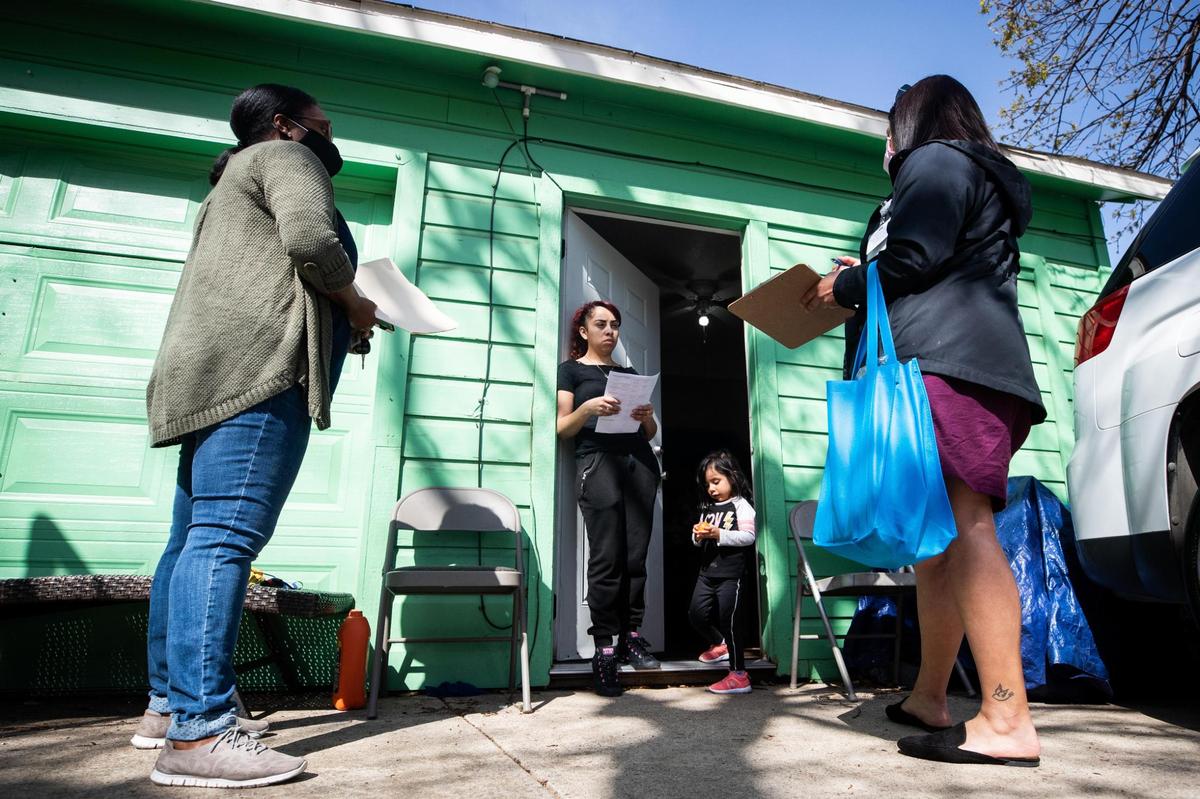
LaShun Cabness, left, a family and community partnership manager at Oakhurst Elementary School, and Anabel Montes, a service coordinator with MHMR Tarrant County, chat with Viridiana Meza and her daughter Madelyn Sanchez, 3, about her son who attends Oakhurst on Wednesday, March 24, 2021, in Fort Worth. MHMR and Fort Worth ISD teamed up to do visits in an effort to reach students who are disengaged from school during the pandemic. Yffy Yossifor yyossifor@star-telegram.com
Pandemic leads to uptick in Fort Worth’s failure rate
Fort Worth schools saw a spike in the number of students who had one or more Fs on their report cards during the first two grading periods of the school year. During the first grading period, the number of middle and high school students failing a class was up 57% over the same period last school year. The number of students failing a class during the second grading period was up 30% over last year. The raw number of students failing a class went up from the first grading period to the second, from 18,022 to 18,539, according to the statistics.
Teachers have attributed the uptick in the district’s failure rate to the shift to online learning. Some have said the district’s format doesn’t allow teachers to hold students accountable when they don’t show up for online class.
This month, a teacher at Riverside Middle School said about 16% of her students don’t regularly show up for class or open assignments in Google Classroom. Those same students have been disconnected all year, she said. Administrators at Riverside began a mentoring program that connected teachers with disengaged students. The teacher said she was assigned two students through that program. The parents of one of those students have stopped responding to her, the teacher said, and the other student “won’t do anything to pass.”
Adam Desmond, a theater teacher at Jean McClung Middle School, said he still has students on his roster he’s never seen. By itself, that isn’t unusual, he said — at the beginning of every year, he usually has a small number of students who never show up for school. In a typical year, three or four of his 160-180 students might fall into that category, he said. But this year, that total was closer to 20.
Most of the time, students who are missing at the beginning of the year have transferred to another school but were never dropped from the rolls at his school, he said. Students’ families come and go frequently, usually for work, he said. Generally, when a student on his roster has left, Desmond finds out, usually through those students’ friends.
This year, it’s hard to know which missing students have enrolled somewhere else and which have disengaged from school completely. So it makes sense, he said, that the district would want to exhaust every avenue for reconnecting with students who are still on the district’s rosters but haven’t shown up to class.
Desmond said it’s important for parents to understand that schools will continue trying to contact absent students’ families as long as they’re on class rolls. If families move to another town or parents decide to send their children to another school or home school, they need to let the district know, he said.
“Don’t just leave and assume that we’re going to let your child fall off the roster,” he said.
Fort Worth is hardly the only school district where more students are disengaged this year. As many as 3 million students may have gone missing from the nation’s schools since the beginning of the pandemic, according to a recent study by the nonprofit Bellwether Education Partners. Student populations that were already the most vulnerable, including homeless students, English language learners and students in foster care, were hit hardest, according to the study.
In the Dallas school district, officials reported last month that about 9,000 students, or roughly one in five students in the district, had stopped attending class regularly, The Dallas Morning News reported. District officials mailed postcards with information about returning to class to every missing high school student. After a week, only 12 students responded.
Anabel Montes, a service coordinator with MHMR Tarrant County, looks over paperwork before heading to visit a family Wednesday, March 24, 2021, in Fort Worth. MHMR and Fort Worth ISD teamed up to do visits in an effort to reach students who are disengaged from school during the pandemic. Yffy Yossifor yyossifor@star-telegram.com
In Chicago, public school officials are trying to locate thousands of students who either signed up for in-person learning when the district reopened many of its classrooms this month, or never responded to the district’s reopening survey, the education news site Chalkbeat reported. Most of the students whose families never filled out the survey hadn’t been actively engaged in remote learning.
Some Fort Worth families may take time to recover
Later Wednesday morning, Cabness and Montes visited another house a short drive from Oakhurst, where they met with Viridiana Meza, whose son goes to Oakhurst. As Meza’s 3-year-old daughter, Madelyn, danced around the driveway and peeled a tangerine, Cabness and Montes talked to Meza about how her older son was doing in school, as well as Meza’s own classes. Meza explained that she’d just completed a GED program through the district, and she asked about enrolling in a second-level English language course.
Montes explained in Spanish the resources they could offer, including help with utilities, clothes and food. She and Cabness congratulated Meza on passing her GED course, encouraged her to get in touch about enrolling in classes at Tarrant County College and left her with bags of at-home learning supplies.
Even though students who come back to school in person tend to do better, Cabness said there’s a catch-up period after they return. Oakhurst has a team of community volunteers who read virtually with students a few times a week. School leaders hope that program will help students catch up in reading, she said.
Cabness said she expects there will be a similar catch-up period for some families once all students go back to school in person.
“There will be some that will be able to bounce back and get back to normal,” Cabness said. “And then there will be some that will continue to struggle, that are just not able to climb out of the rut that they’ve gotten into.”
This story was originally published March 26, 2021 at 5:00 AM.