Fort Worth group will address maternal health. Black advocates ask why they were left out
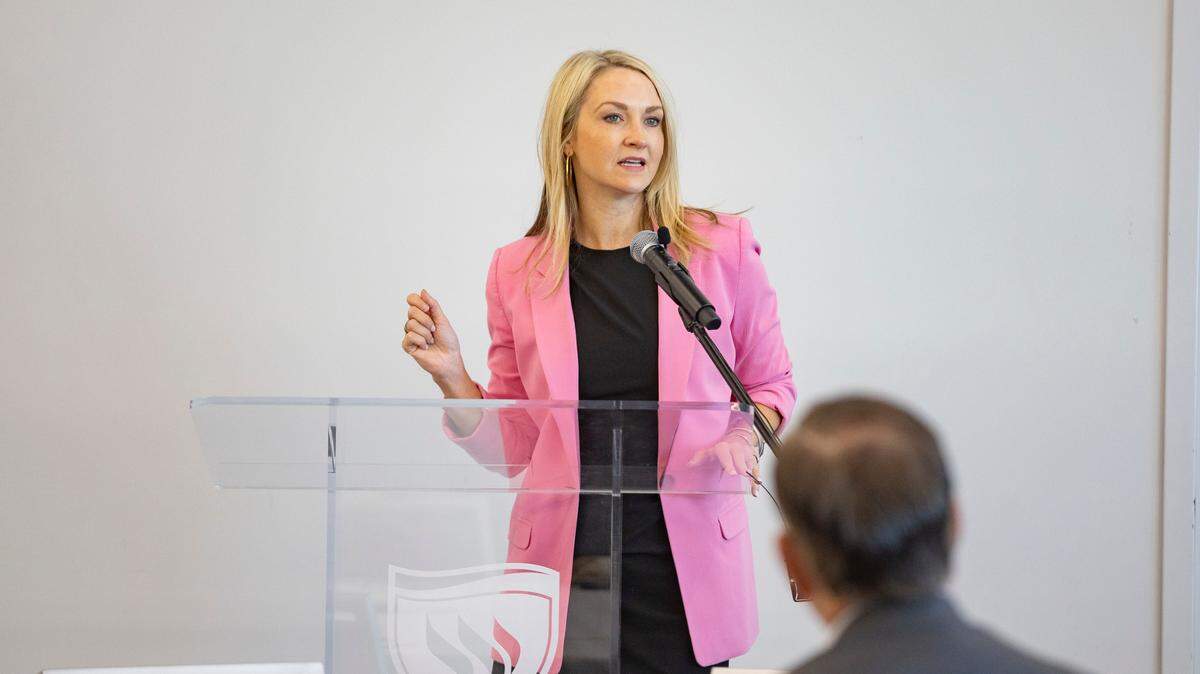
In September, Fort Worth Mayor Mattie Parker convened a group of 15 leaders in the Fort Worth community to address maternal and infant health.
But maternal and child health advocates who have worked in Fort Worth for decades are asking why they weren’t invited to join the working group, and why the group didn’t do more to reach out to Black-led, grassroots organizations that support moms and babies. Black mothers and infants face disproportionate risk during pregnancy, childbirth, and the postpartum period compared to other demographic groups.
“I think it’s great that there is a task force forming citywide,” said Kyrah Brown, an assistant professor at UT Arlington. “What I would hope to see is that there is community-based involvement.”
The open letter announcing the initiative is signed by 11 CEOs or president-CEOs, two presidents, a dean and the mayor. Although the working group does include Black women, there are no organizations that specifically work in and for Black communities, said Misty Wilder, the former chair of the Health Equity Alliance of Tarrant County.
“When you don’t have leaders of programs that offer direct services to families at the table; In situations like these, it’s always best practice to ask yourself questions like ‘Where are you getting your perspective from? Whose voices aren’t being heard but need to be?” Wilder asked.
Parker, who was elected to office in 2021, said the group started as a conversation about six months ago among leaders of local hospitals and service providers. Parker decided to use the mayor’s office to convene the working group, which announced its existence Sept. 1. Fort Worth’s City Council passed a resolution supporting the group on Sept. 27. The leaders of institutions like JPS Health Network, the University of North Texas Health Science Center, and Child Care Associates are included in the working group.
Parker said the working group invited anyone interested in addressing maternal and child health to reach out.
“The press release is just one document,” Parker said. “We were very clear: Please come to us if you have interest in doing this work.”
Parker said that, eventually, she hopes one institution will become the permanent home or leader for the working group.
Initially, she said, the working group will tackle what policy reforms are deemed most urgent in the upcoming Texas legislative session, like access to health insurance and health care and accessible child care. The working group will also likely partner with a third party to conduct a review of the maternal health ecosystem in Fort Worth, and will likely use federal funding to address any gaps identified by that review, Parker said.
Parker said centering Black moms and babies was vital to the group’s work.
“The data speaks for itself how African American women specifically are experiencing negative health outcomes, or difficulty in childbirth in the first place,” Parker said. “And I think there’s no one better to carry that water than Dr. Sylvia Trent-Adams.”
Trent-Adams, who is Black, is the new president of the University of North Texas Health Science Center.
The history of infant mortality activism in Tarrant County
In 2015, 18.3 women died during pregnancy or within 42 days of birth for every 100,000 births in Texas, according to the state’s maternal mortality review committee. (More recent statewide data on maternal mortality data was scheduled to be released in 2022, but will instead be published in 2023.) Black women face a higher risk of dying during or shortly after pregnancy, both in Texas and nationwide.
Comparable disparities exist among infants: In some parts of Fort Worth, the infant mortality rate is six times higher than in nearby neighborhoods, a difference of about 12 deaths per 1,000 births and 2 deaths per 1,000 births, according to a report from the University of Texas System.
Some of the earliest work to address maternal and infant health in Fort Worth was started by the Health Equity Alliance, or HEAL. HEAL formed 21 years ago as the Tarrant County Infant Mortality Network in response to growing concern about Fort Worth’s unusually high rate of moms and infants dying during pregnancy, childbirth, or immediately after.
The group’s early work inspired U.S. Rep. Michael Burgess to lobby for the nationwide Infant Mortality Awareness Month.
Given HEAL’s long history of addressing maternal mortality disparities in Fort Worth, its members and other people in the community said they wished the group had been invited to join the table.
“These are great organizations,” said Barbara Dunlap, the chair of HEAL and a United Methodist Church pastor. “We don’t think that there’s anything wrong with the group. It’s just we don’t think that there are enough people at the table.”
Parker said that Trent-Adams could work with HEAL and advocate for many of the group’s interests. But although HEAL partners with UNT HSC, it is an independent nonprofit organization separate from the Health Science Center, Dunlap said.
In an interview discussing the working group, Parker said the structure of the working group allowed leaders of big organizations to sit on the working group while working within their own organizations.
“My goal really is to try to make change where it’s needed,” Parker said. “Whether it’s a CEO or a head of a hospital, whoever it may be, you can’t make change until those leaders are really recognizing there’s a significant problem.”
Brown, who is also the director of the Maternal and Child Health Equity Lab, added that some of the communities with the greatest success at tackling maternal and child health disparities did so through community work.
Hamilton County, Ohio, used to have one of the nation’s highest rates of infant mortality, with the worst outcomes for Black infants. A local nonprofit created “sacred spaces” to listen to Black moms’ experiences during pregnancy and childbirth, a step that has helped the county reach its lowest infant mortality rate on record in 2020.
Get involved
To get involved with the working group to address maternal and infant health, you can contact the mayor’s office online or at 817-392-6118.