If you’re the parent of a Fort Worth ISD elementary student, here’s some good news
Fort Worth schools have made significant progress in accountability scores since the last time the state letter grades were given in 2019, according to predictions made by school officials at a recent Fort Worth ISD board meeting.
Based on preliminary data from the Texas Education Agency, the district predicts that it will slash the rate of failing schools from 18 to only two. In many subject areas, including third- and fourth-grade reading, the numbers signal a return to progress being made prior to the pandemic — a feat many predicted would take years.
“While we have the state and the nation telling us that it may take several years, and that is true, we have areas where we’re already seeing students make that recovery because of the hard work of our educators in our schools,” Associate Superintendent Sara Arispe said at the July 26 board meeting. “So really something to celebrate. And I don’t want to say that that means we’re where we need to be. We know we have areas where we need to grow even more than where we were in 2019.”
Experts echoed that sentiment, cautioning that existing inequities apparent in test scores prior to the COVID-19 pandemic could be widened, requiring even more ground to be made up to avoid prolonged learning loss.
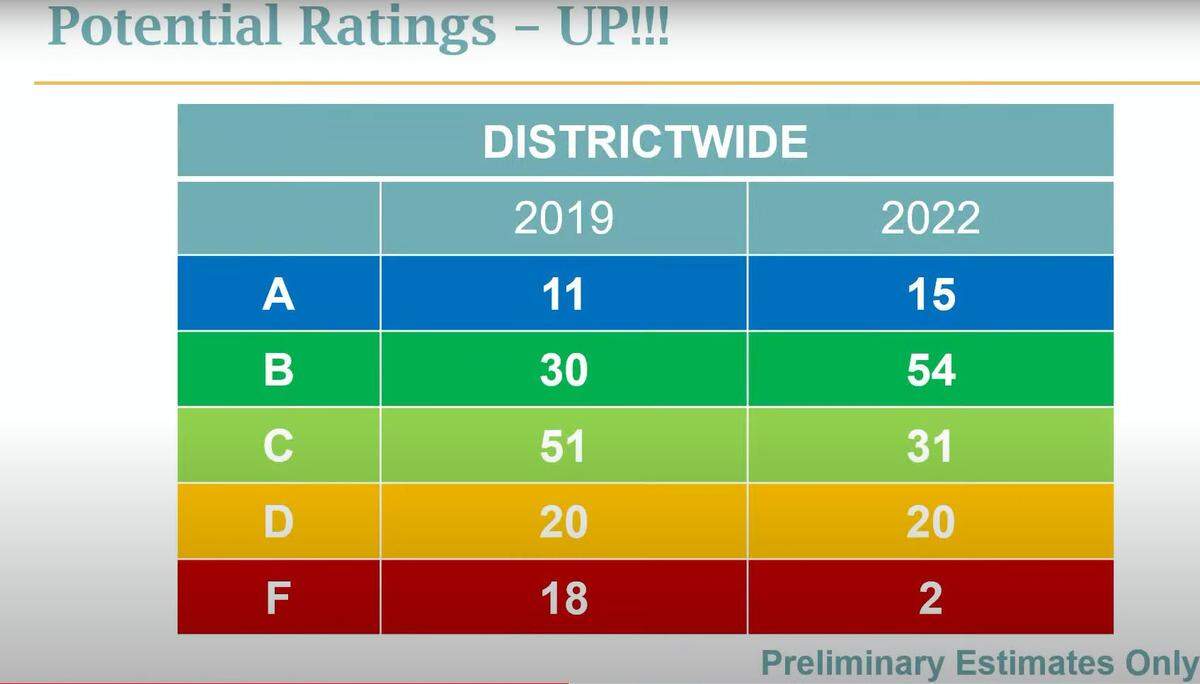
Officials pointed to a shift in teaching approaches, reading academies as well as tutoring and extra learning opportunities like Saturday Learning Quest for driving the improvements that occurred over the course of the last three years. Arispe noted the added complications of COVID-19, pointing to two surges that happened during the school year.
“Last year, we did have a higher number of absences, both of students and teachers as you’ll remember due to quarantines,” Arispe said. “We had some unfinished and lost learning time coming out of the pandemic.”
Elementary schools showed highest gains in accountability scores
According to the potential ratings presented at the board meeting, elementary schools are expected to see the greatest improvements in accountability grades, which will be released in August.
The number of failing schools, which prior to the pandemic would have been required to improve on a state-mandated timeline or face state intervention, fell from eight to zero, with D-rated schools halved from 14 to seven.
A pandemic-era law exempts districts from those intervention requirements.
The number of A-rated elementary schools in the district doubled from five to 10, officials said.

Arispe did not share which schools were expected to improve, telling board members that the full details would be shared when the state releases final letter grades.
Texas’ A-F Accountability Rating System, which applies to all public and charter schools, takes into account a number of factors when assigning campuses and districts letter grades, according to the Texas Education Agency, including performance on state standardized tests, graduation rates and college, career, and military readiness outcomes.
Ratings also examine student achievement, school progress and whether districts and campuses are closing achievement gaps among various student groups, according to the agency.
Fort Worth students improved in both math and reading in the most recent State of Texas Assessments of Academic Readiness.
About 38% of third-graders met grade level in reading, according to the report, up from just 26% who met grade level the previous school year.
Policy makers and researchers say third-grade reading proficiency is a key predictor of how students will do for the rest of their academic careers.
Education researchers say more work still needs to be done
The improvement over 2019 levels is a positive sign after fears of academic stagnation, but a return to prior progress is not enough, experts say.
Thomas Kane, the faculty director of the Center for Education Policy Research at Harvard, compared the progress to a conveyor belt while speaking on a panel at the Education Writers Association conference in Orlando last week.
“Think of it as like a conveyor belt, the conveyor belts stopped in a lot of districts during the 2021 school year,” he said. “And then it resumed at the same pace that it had been at prior to the pandemic. But that’s not a catch-up, that’s, ‘OK, things are looking like they’re getting closer to normal.’ But normal is not enough.”
Karyn Lewis, director of the Center for School and Student Progress at Northwest Evaluation Association, said that is being seen in data across the country.
The nonprofit provides a series of tests designed to measure how students are performing and how much they are growing over a period of time.
“We do see evidence that learning gains in this most recent school year have returned to mimic average levels. So students are making gains at rates that are consistent with pre-pandemic trends,” Lewis said. “But the bad news with that same exact statement is if students are only making the kind of an average pace, then that doesn’t do much to get us out of a hole that we’re in; we still have significant levels of unfinished learning by the end of the school year.”
Another concern is how the pandemic impacted achievement gaps, notably with African-American and Hispanic students learning from home at a higher rate than their white and Asian peers.
That is a key predictor for learning loss, according to Kane.
District looks to close gaps between student groups
One of the measures the TEA uses in determining a district’s letter grade is closing the gaps, which uses disaggregated data to identify gaps among racial/ethnic groups, socioeconomic backgrounds and other factors.
Fort Worth previously received a C rating in the category, meeting only one out of 27 indicators for English, language arts, reading and mathematics, and 4% of targets overall.
This year, Arispe pointed to significant gains by African-American students during the July board meeting, with the number of African-American students who approach grade level in reading increasing 14% for third-graders and 24% for fourth-graders. The number of students on grade level also increased by 7%, to just over 10% of students reading on grade level.
“Board, I’ve been in front of you many times talking about our scores,” Arispe said. “We see district-wide our African-American scores tend to lag behind our other student groups. These data are particularly encouraging. Not where we need to be, (but) on the right path. We need to continue that work.”
In middle school, however, the number of African-American students scoring on grade level for both reading and math remains below 10% — a number questioned by Trustee Michael Ryan.
“To the teachers that did the work, the students that did the work to bring things up, great,” he said. “But when I’m looking at seventh-grade African-American math and we’re at below 10%, you all know the work we got to do. Double that gain to 14% is still not any good. In the end we got to do better.”
Chief Academic Officer Marcey Sorensen said the district is introducing a new math curriculum and revamping the way it teaches math to be more conceptual and applied, in line with changes to the standardized test, in order to improve the scores. Math was a subject that was hit particularly hard during the pandemic learning loss.
Lewis said that as districts across the country set goals for the coming years and budget the remaining federal dollars given to schools to assist in learning recovery, they should consider what goals they want to achieve.
“I think we just kind of assumed that recovery means getting kids back to where they would have been had there not been a pandemic,” she said. “My fear with that definition of recovery is that it would be going back to the status quo that already had stark inequity between groups of students.”
“My greatest hope at this moment is that we’re learning some better best practices about how to support students and how to accelerate learning so we can start to gain some traction against those inequities that have been there prior to the pandemic and have only widened across the two years.”
This story was originally published August 1, 2022 at 5:00 AM.