Tarrant County has high child drowning rates. Here’s how kids learn to save themselves
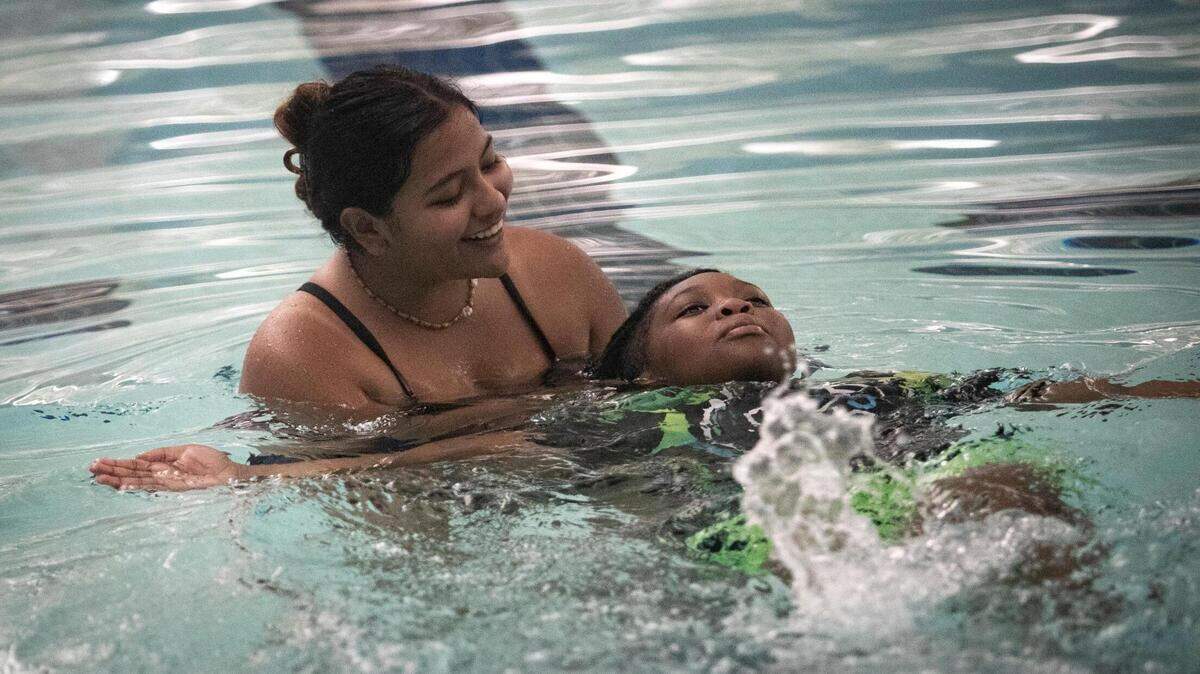
A round of cheers broke out at the Wilkerson-Greines Activities Center pool on a mid-July afternoon. As kids of all ages splashed, kicked and laughed with their swimming instructors near the end of the center’s Olympic-style pool, one young child at the corner of the pool made a major breakthrough: she finally put her face in the water.
The kids at the center in south Fort Worth are part of a free three-week swim program designed to increase access to swimming lessons for low-income, elementary-age children.
As the small celebration for the young girl ensued, each lane of the pool contained kids learning to kick on a kickboard, tread water, float on their backs and much more. Older kids at the other end of the pool calmly backstroked 25 meters as their instructor drifted in front of them.
The smiles and the laughs attest to the pure fun of this summertime activity, but to Coach Richard Sybesma, this program is about teaching these kids life-saving skills that they may otherwise never get the chance to learn.
Tarrant County has historically seen some of the highest rates of pediatric drownings in the state, and Texas ranks high nationally in child drownings.
As of June, Cook Children’s Medical Center reported it has seen at least 54 children for water-related injuries, with eight being fatal. Last year, Tarrant County reported six drownings for the entire year.
Black, Hispanic children more likely to lack swimming ability
Data suggests that swimming deaths disproportionately affect children of color. CDC data suggests that Black children in the United States aged 10 to 14 die in swimming pools at 7.6 times higher rates than white children. A 2017 USA Swimming Foundation study shows that 64% of Black children, 45% of Hispanic children and 40% of white children have no or low swimming ability.
Cost and access to swimming areas, as well as generational fear of water, have contributed to Black and brown children being more likely to die in swimming pools than white children.
That fear and lack of swimming instruction is exactly what a program like the one at the Wilkerson-Greines Activities Center is trying to combat.
The program, which began in 2013, is a partnership between the Rainwater Charitable Foundation, Near Southside Inc., the City of Fort Worth Mobile Recreation program and the Fort Worth school district.
The lessons consist of two three-week sessions serving two separate cohorts. Students as young as 4 years old receive 30-minute lessons each weekday in a small group setting with lessons tailored to students’ age and experience.
Goal: water safety
Sarah Geer, program officer of the Rainwater Charitable Foundation, said the main goal is for students to learn water safety, including entering and exiting the pool safely and basic breathing and swimming techniques.
The program is offered to children who are either enrolled in the city’s mobile rec program or enrolled as students at one of the Fort Worth school district’s partnering campuses.
Since 2015, the program has averaged 500 to 550 children each summer, Sybesma said.
He said that over the years, they’ve seen kids who are getting in a pool for the first time and some who have never put their faces in water.
Instructor Aaron Santos, who learned to swim as a part of the program for several years before becoming an instructor, said seeing the kids grow in skill and confidence is one of the most rewarding things.
He said he remembers teaching a young boy to do the backstroke the entire length of the pool while the boy’s mom watched from the stands.
“That made me pretty happy because I remember when I was a kid, and the teacher was pretty happy with me,” he said.
Sybesma said that if it wasn’t for this opportunity, some of these kids may not have had access to swimming.
Lack of pool access
Most of Fort Worth’s predominantly Black and Hispanic neighborhoods don’t have nearby access to a public pool, with only two public city pools serving over 900,000 people, not including splash pads, play pools or water parks without deep water.
“So where are they gonna swim?” he said. “… And more importantly, where are they going to learn to swim?”
Other organizations such as the YMCA of Metropolitan Fort Worth and the Fort Worth Drowning Prevention Coalition also lead drowning prevention training in an attempt to reduce Tarrant County’s drowning rate.
The William M. McDonald YMCA pool in southeast Fort Worth provides public access for people even if they aren’t members, and YMCA staff provide swimming lessons at several low-income apartment complexes with pools.
Pool construction hasn’t been prioritized in Fort Worth’s bond packages. The city’s 2012 Aquatic Master Plan had a timeline of five to 10 years to build five new public pools. One has been built so far.
Following the approval of the city’s recent bond election, Forest Park Pool is set for renovations, and a new aquatics complex is set for construction in Stop Six.
In the meantime, Sybesma and everyone involved with the swim lessons program hope to continue to provide what they see as an important life skill.
And through all the laughs and small celebrations, Sybesma and his instructors’ goals are the same.
“Most of them will leave here knowing how to save themselves,” he said.
This story includes information from the Star-Telegram’s archives.
Editor’s note: The Rainwater Charitable Foundation provides funding for the Fort Worth Star-Telegram’s Crossroads Lab.