
Fort Worth teachers exhausted by schools’ scattered approach to bilingual learning
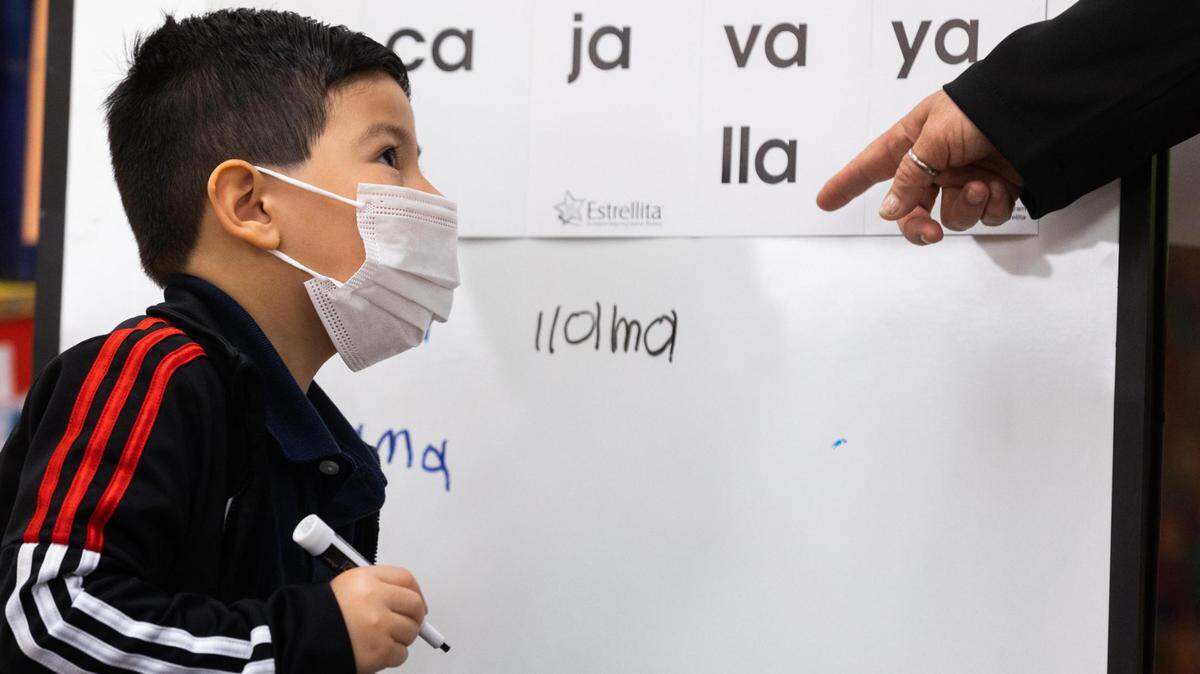
Janette Chairez, a first grade dual language teacher in Fort Worth, said she was excited to learn about a new research-based reading program for struggling students at her school about two years ago.
But her excitement faded when she learned it was only available in English.
Chairez gathered with other teachers at Mary Louise Phillips Elementary to translate the entire program. They spent hours searching the internet for authentic Spanish poems, verses or stories that matched what the English version was trying to teach in content and structure.
“That was really hard because it’s a lot of work on the teacher’s end,” she said.
Chairez said she hoped to find texts that were written in Spanish originally. Translations don’t always reflect original ideas or word structure, which can muddle the learning process for students trying to advance in both languages. Translated texts also often lack cultural relevance to Hispanic students, Chairez said.
For that reason, Chairez said, she also worried about the effectiveness of the targeted reading program.
“It’s really hard to get the exact same quality in Spanish when you’re trying to get resources from all over the school or wherever you can find them,” Chairez said.
The situation Chairez described is common for dual language teachers.
Interviews with teachers, experts and advocates confirmed concerns are widespread in the Fort Worth school district over a lack of equitable resources in Spanish, unclear expectations on how to structure dual language teaching, shifting reading approaches and languishing student outcomes. Experts, teachers and administrators also shared concerns over a lack of consistency in bilingual instruction methods from school to school and even classroom to classroom, making results on student progress across the district hard to measure.
Administrators hope an effort to standardize lessons at schools across the district will answer teachers’ concerns and lead to better student achievement.
But teachers who have gone through numerous efforts to overhaul bilingual learning in the past are skeptical.
That story isn’t new, and it isn’t unique to Fort Worth, said Andy Canales, the executive director of the advocacy organization Latinos for Education Texas.
“This is a problem that has persisted for a long time, and it continues to get worse, because change is a constant in education,” he said. “There are changes occurring at the state, and sometimes federal, level that impact how teachers teach.”
The updates in books, curricula and teaching guides that accompany those changes lag behind for bilingual versions.
“It’s been a persistent challenge,” he said.
‘Emergent’ bilingual students lag behind
Students learning English as a second language, also referred to as emergent bilinguals, make up nearly 35% of the Fort Worth school district. Many are in dual language programs where students learn their native language, Spanish, in an effort to eventually transition them to English.
In 2019, the district got a C in a state accountability rating for closing the gaps, a rating that looks at English language proficiency, academic achievement and graduation rates among racial and ethnic groups and socioeconomic backgrounds. That year, only 22% of emergent bilingual students were reading on grade level by third grade, compared to 61% of white students. That number fell to 20% in 2021 for emergent bilingual students, with white students’ scores falling to 58% reading on grade level.
Campuses district-wide have historically had different approaches to dual language instruction, Chief Academic Officer Marcey Sorensen said. Some wouldn’t introduce English until the second grade, others taught English at the start of the program.
Next year, the district will align campuses across the district under a standardized “biliteracy model,” which will require all campuses to start English in pre-kindergarten, gradually implementing more class time in English as students get older.
There will be “simultaneous instruction happening where students learn to read in language one and language two, and continue to develop literacy in both languages,” Sorensen said.
The district is also expanding a curriculum that was piloted at some schools this year to all but two campuses, which will add the curriculum later.
But with the district’s history of shifting approaches at least three times in nine years, some teachers are skeptical about how it will be implemented. Others worry this won’t address the district’s problem of providing equitable resources in Spanish.
Many teachers are left burnt out and wondering how effective their reading instruction can be when tactics change so often.
Teachers lack materials in Spanish
Teachers are often frustrated over a lack of authentic Spanish books on library shelves or the newest research-driven curricula not being provided in Spanish.
Teachers have expressed concerns about having to print culturally-relevant Spanish stories from the internet because school libraries and classrooms have few books in Spanish. Or in many cases, books provided for bilingual classrooms are English translations, meaning they might not share cultural relevance with Hispanic bilingual students or are even mistranslated, teachers told the Star-Telegram.

“Teachers are left to find the resources ourselves, pay for the resources ourselves, and still give the same academic expectations that they want for English,” Marisol Martin, a first grade dual language teacher at West Handley Elementary, said. “Only ... they have the books in English, and we didn’t.”
Lizdelia Piñón, education advocate for the San Antonio nonprofit Intercultural Development Research Association, said publishing houses should hire native-Spanish speaking authors to share English ideas with sensitivity to the Spanish language and Hispanic culture.
When translated directly, books can have errors, or instances where the words used are too complex for students at their grade level.
That has been the case with some units of Amplify, the new curriculum that was piloted at schools across Fort Worth this year. A portion of the program was provided in Spanish.
Teachers have said that Amplify’s lessons are better than the ones they’ve had in the past, but confusion over the roll-out has left others doing the same extra labor that has become second nature in the field of bilingual education.
“Sometimes there would be a text that I would read and I would say, ‘OK, I need to go home and study that,’” Samantha Korn, a dual language teacher at Oakhurst Elementary school, said. “Because there is a lot of vocabulary I’ve never heard.”
Other campuses that have received the Amplify curriculum weren’t given lesson plans until after the lessons were supposed to be taught or not given lesson plans at all, according to teachers. Amplify also doesn’t have a Spanish phonics section, one teacher said, leaving some dual language teachers to supplement with materials they have on hand.
Another Fort Worth dual language teacher shared photos of passages from a Spanish science textbook that contained illogical wording and vocabulary that was more advanced than her students’ grade level. The teachers said the errors were pointed out to them by students.
Administrators said they hadn’t heard concerns about mistranslated texts and that advanced vocabulary could actually be a benefit to students.
“We should have high expectations of all kids at all grade levels. So I’m actually excited to hear that … we’ve got high level vocabulary at all grade levels for all kids in all languages,” Sorensen, the chief academic officer, said.
Piñón, of the Intercultural Development Research Association, remembers her own struggles as a teacher dealing with some publishing houses that missed the nuance of Spanish translation. When trying to teach syllables to her classroom, for example, her curriculum’s recommended word was “juguete,” correctly translated from the English word “toy.” A significantly longer word with more vowels, syllables and trickier pronunciation was recommended to teach the same concept that the three-letter sight word, “toy,” would.
You can’t expect a kindergarten student to understand that, Piñón said.
Despite years without clear guidance, the district is attempting to fill its libraries with an adequate amount of Spanish materials, in addition to standardizing the curriculum and style of teaching.
For the first time, the district this year is advising campus libraries on the number of Spanish library books they should have, Carter Cook, the district’s library and media services director, told the Star-Telegram.
He said the local guidelines are necessary, because none are provided by the state.
The guidelines recommend that libraries stock shelves with books in different languages based on how many of those books are checked out per year, Cook said.
But the recommendations are not mandatory, and similar guidelines for per-student library spending and age of publication haven’t been followed by all campuses in the district in the past.
Turnover leaves a constant learning curve
Teachers and advocates pointed to high turnover for both teachers and administrators as a key cause of inconsistent strategies at Fort Worth and other districts.
Piñón said without administrators there to see changes through to the end, campus staff are left on their own.
“You can’t just say you’re going to do a program this year and then all the administrators leave,” Piñón said. “That leaves the principals to do whatever they want with the program.”

Teachers recall using many different programs over the last decade, including I-Station, MyView, Achieve3000 and Reading Street, all with varying levels of dual language support, and rarely with cohesive guidance on how they fit in with the broader curricula.
Korn, the dual language teacher who joined the district nine years ago, said she has seen rapid and choppy change in the programs, tools and curricula in the time she has been with the district.
“I have never used a program more than three to four years. That’s probably the most that I have used a particular text,” she said. “In terms of computer programs, whether it’s an I-Station or Achieve 3000, or now Lexia, there does tend to be a lot of turnover in those curricula.”
The result, she and other teachers said, is a constant learning curve for students and teachers, without ever fully implementing a program before the next one is rolled out.
Chairez, the Mary Louise Phillips Elementary dual language teacher, said that in the six years she’s taught in Fort Worth she’s seen at least three different curricula being used and three or four reading intervention programs.
“It’s really hard to gauge what’s working for them truly and what isn’t because we don’t have enough data,” Chairez said.
Chairez said she sometimes gets drained from all the change. After completing what seems like annual week-long trainings for an incoming program, she has to rework her PowerPoints and other supplements to teach it.
“You have to start your toolbox all over again,” Chairez said.
Teachers want interactive software
A key tool that teachers have used to bolster reading scores in English has been interactive software called Lexia that kids can use to learn to read, while also giving teachers real-time insight into where students are struggling.
According to school board documents, 27% of all elementary and middle school students using the program advanced one or more grade levels in a school year. The district expanded the usage to 42 schools in June, 2021, for more than $700,000 the first year.
But the program isn’t available in Spanish. Teachers and principals said the difference was clear, pointing to the gaps within classrooms where they noticed success in English, while Spanish lagged.
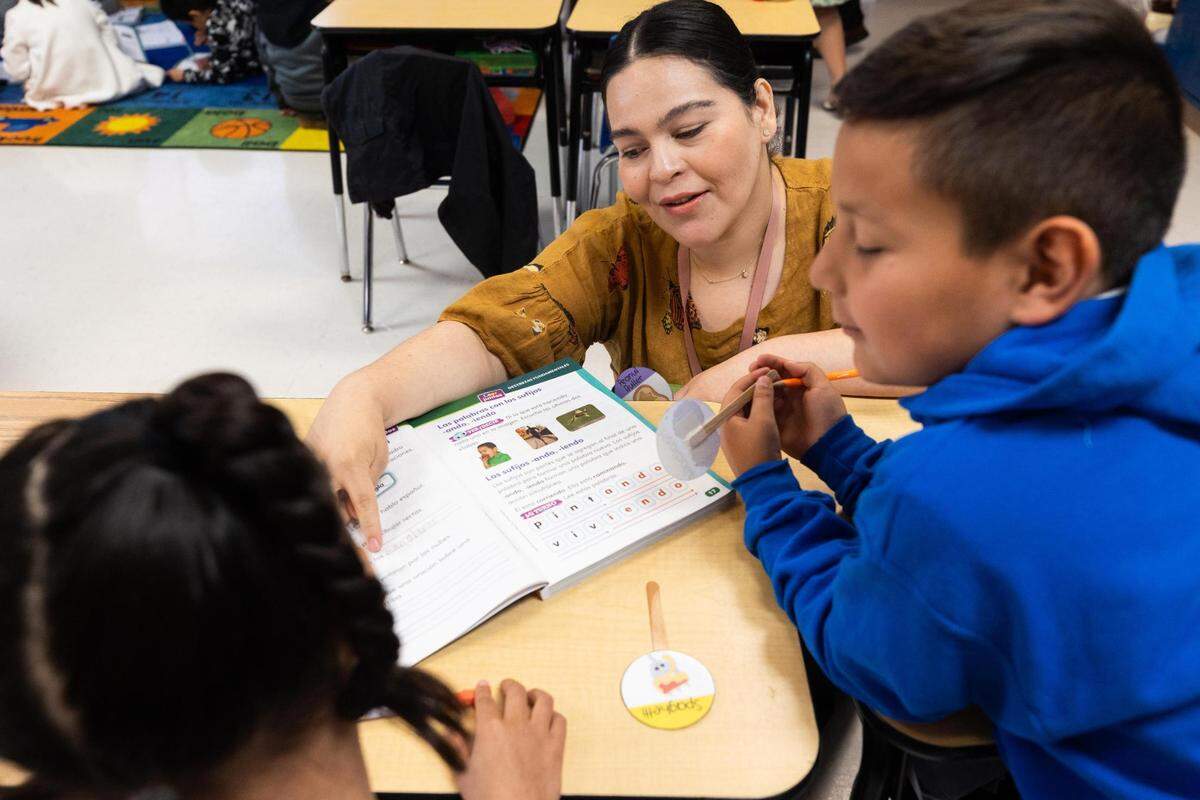
Fort Worth does provide a suite of Spanish workbook based phonics instruction from a company called Estrellita, which is also used by districts in Dallas, El Paso and Spring.
But teachers say the lack of interactive options is stark.
“For interventions, in the past we have Esperanza which is a published kind of scripted intervention and then there’s Estrellita, which is a phonics supplement and that goes from pre-K all the way to fifth,” Deborah Baez, the principal of Turner Elementary School, said. “What is still lacking is software that really helps our Spanish-speaking students to practice those skills, the phonics skills, reading comprehension skills in a fun way.”
Sorensen, the chief academic officer, said the district doesn’t see that difference as an equity issue.
“No, we don’t have an equity issue, because students are still getting the explicit instruction,” she said. “If we weren’t providing the resources, I would say there is an equity issue. It is not about how it is delivered … [but] is it delivered.”
Teachers and campus administrators who have used the interventions say there is a difference.
Baez pointed to Lexia, the popular research-backed literacy program, which she compared to a video game.
“You can level up, you complete little missions,” Baez said. “The kids love to do Lexia, but it is all in English. So we don’t have the Spanish equivalent to that.”
Cloris Rangel, the director of the Fort Worth ISD’s multilingual department, said the district considered the best options for both languages when choosing teaching materials for bilingual classrooms.
“Sometimes equity means we’re getting the right resource for the language in which it’s being taught, not necessarily the same resource that’s just a translation,” Rangel said. “There are computer programs out there, such as Imagine learning (and) I-Station, but their Spanish is not as high caliber. So we have to be very careful.”
Both the curriculum and the interventions that were chosen came after an exhaustive search, Rangel said, with the goal of authenticity and quality in mind.
Korn and other teachers are looking forward to the next chapter of dual language at the Fort Worth school district, as district leaders prepare to release more details in the coming weeks.
“I’m very hopeful that next year, there will be some good direction from the district as to how they want these resources implemented in the dual language classroom,” she said.
The hope from all teachers interviewed is that the district can provide equitable resources to all students.
“This is important because if we really truly want equity in our education, we have to think about our bilingual students,” Martin, the dual language teacher at West Handley Elementary, said.