‘Everybody is losing’: Teacher shortage strains Fort Worth area bilingual classrooms
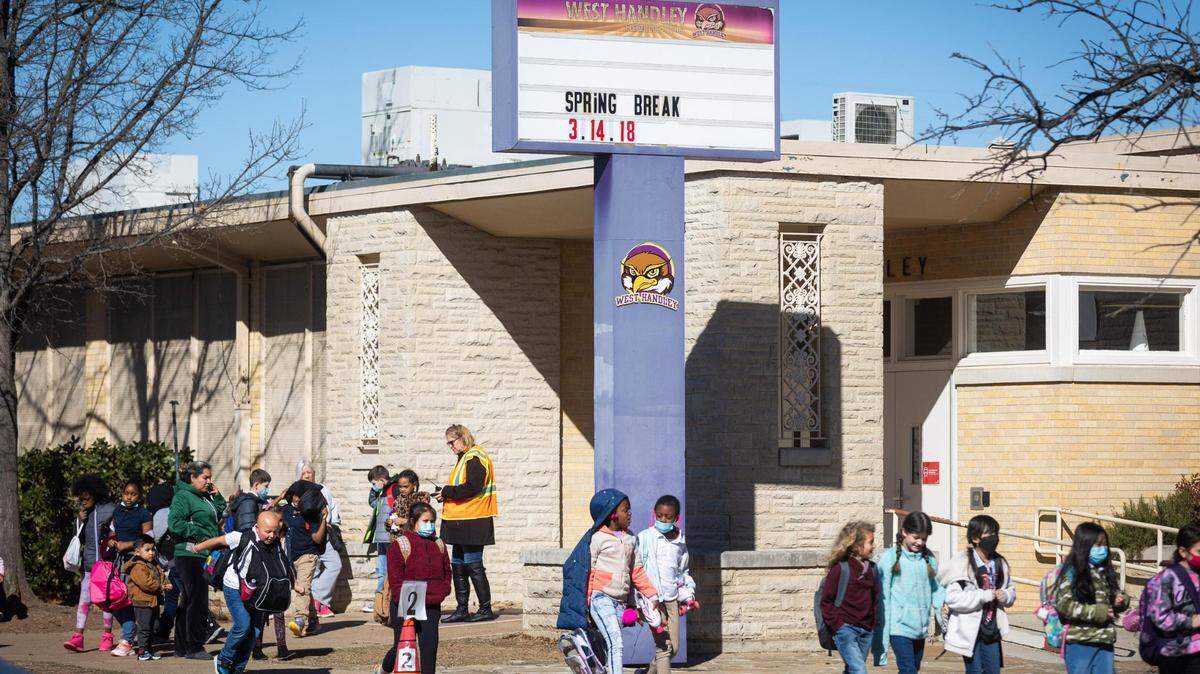
Bilingual teachers in the Fort Worth school district were already stretched thin before the pandemic, with classes twice the recommended size.
But a wave of departures have left them with little resources to serve the district’s 28,000 Spanish-speaking students, who make up one-third of the enrollment.
“I have never seen it this bad,” said Marisol Martin, one of the district’s 757 dual language teachers.
Since the beginning of the pandemic, school districts have struggled to manage substitute and teacher shortages. During the most recent outbreak, librarians and administrators substituted to cover as 5,000 students and teachers were out with positive cases.
These pressures have been especially felt by bilingual teachers, who told the Star-Telegram they feel guilty for missing school because of mandated quarantines, knowing their students will likely go weeks without being taught in the language they understand.
Martin tested positive for COVID the first week of the year, when the district could not find a bilingual substitute teacher. During the eight days she was out, her first-graders at West Handley Elementary were sent to other classrooms and were taught by substitutes who spoke only English.
“It’s difficult because whether you’re the one being absent or not everybody is losing,” Martin said.
Teachers taking on additional responsibilities lose their consistency in their own classroom, and students in both classrooms are rocked out of their routine, Martin said. And for bilingual students who have less access to teachers who speak their language, it can be challenging.
“When there’s English-only teachers going into a bilingual classroom, some of the kids really have no idea what’s going on,” Martin said. Sometimes students have to ask their 6-year-old peers for translations, she said.
Bilingual education became federal law in the 1960s after data showed that students whose first language wasn’t English weren’t performing as well as native English speakers. All public schools have to accommodate these students usually by way of English as a Second Language, in which all non-native English speaking students are taught together.
Texas takes this requirement one step further and is one of four states that require schools that have a high percentage of native Spanish speakers to be in bilingual programs. Texas’ extensive dual language program caters specifically to the large and growing population of Spanish-speaking Texans. Dual language emphasizes becoming equally proficient in both languages, starting out with Spanish and gradually introducing English over several grade levels. Bilingual teachers are specifically trained to manage Spanish’s unique instructional needs, particularly when it comes to reading and writing.
Filling the Vacancies
About 80 of Fort Worth’s 150 schools have dual language programs.
School districts across the state have struggled for years to fill their bilingual positions.
Districts offer $3,000 to $6,000 stipends and teaching assistant programs to entice certified bilingual teachers. And Fort Worth has taken its recruiting efforts across the border. Last month it hosted a virtual job fair for Mexico City’s certified teachers.
Cloris Rangel, executive director of the Bilingual and English as a Second Language Department, said the district has always had a shortage of bilingual teachers, but the pandemic has made the need more apparent. The district saw a higher number of bilingual retirees when classes went virtual, Rangel said.
“There’s just not a lot of teachers coming out of college,” Rangel said. “We’re looking at putting in some big incentive to recruit teachers and then also to support the teachers that we do have.”
At West Handley Elementary there are four vacancies. In second grade, one teacher teaches two bilingual classrooms totaling almost 40 students, and in fourth grade, there’s no bilingual teacher at all. Fourth grade bilingual students are split among English-only classrooms.
Symptoms of burnout
Bilingual teachers usually have additional training alongside their general district-required hours. They’re sometimes asked to translate curriculum materials and messages for families. Some give out their phone numbers to make sure parents are informed of news at their school.
At the Crowley school district, Hjamil Martinez-Vazquez, who teaches third, fourth and fifth grades, has been asked several times in the middle of a school day to translate for families.
“You have a school which has a bilingual program but none of their administration speak Spanish,” Martinez-Vazquez said.
Talhia Enriquez, a kindergarten dual language teacher at West Handley, said she feels the pressure and experiences burnout symptoms. She started the year with almost 40 students in her kindergarten classroom.
“It’s just too much. I just feel that’s why there’s so many vacancies right now,” Enriquez said.
Enriquez said she thinks several of her colleagues have left the profession because of burnout and the added expectations that bilingual teachers often face.
Enriquez said she manages by limiting the amount of work she brings home and by reaching out to other teachers for support.
Janette Chairez, first grade dual language teacher at Mary Louise Phillips Elementary, said her and her colleagues are drowning because of all the additional challenges the pandemic has brought. She experienced it first hand when she had to take time off at the beginning of the year after contracting COVID.
“It takes a toll on you because you can’t help but feel bad for it, even though it’s your health and your health should come first,” Chairez said. “You can’t help but feel guilty because you know that your kids they’re missing a lot of instruction.”
Very rarely are bilingual students placed with a bilingual substitute when teachers are absent, Chairez said. And because of a general lack of substitute teachers the past several months, students are more often divided among other classrooms in the school, many of whom aren’t bilingual.
Chairez and other teachers said they worry their students won’t be able to make progress without learning in their language. Teachers typically leave them with packets of busy work that they might be able to handle on their own.
Consistency is extremely important for students’ learning and retention, Chairez said. She said she noticed a change in her students’ attitudes when she returned from her quarantine.
“My kids are all over the place,” she said. “We have to stop, and we have to talk about our class rules, our routine, how we do everything. We need to review the schedule, and all that takes up instructional time.”
But Chairez said that not every moment is bad. She said she’s reminded of why she teaches in those rare moments when students start to get back into a routine.
“Teachers do care and we’re doing what we can,” Chairez said. “I think it’s something I’ve learned this year or these past couple years is that for us to serve our students you got to be able to serve ourselves first, you know, take care of our own health.”
This story was originally published February 21, 2022 at 5:00 AM.