Texas teachers burning out after a hellish month. Here’s what a trustee saw in classrooms
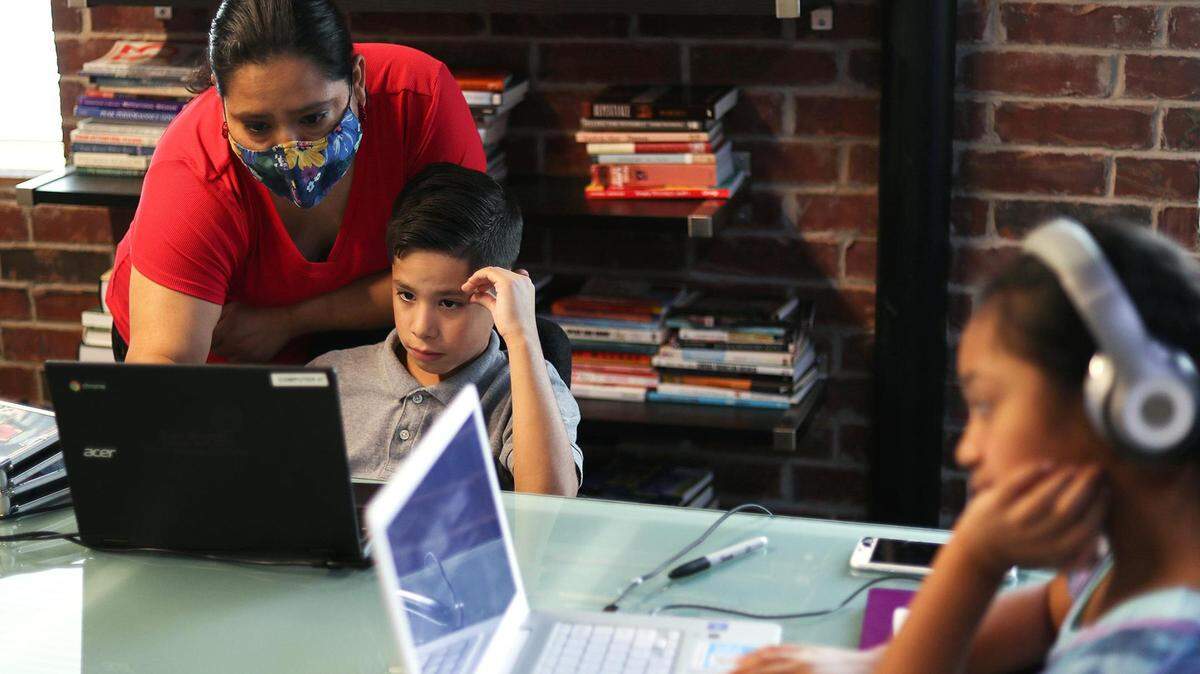
As teachers return to the classroom after weeks of quarantine amid the latest surge of COVID-19 cases in January, school districts are left grappling with a staffing shortage that could be made worse by the conditions caused by the enduring pandemic.
Raúl Peña, the chief talent officer for the Fort Worth school district, said last week that the district was continuing to ramp up efforts to hire more teachers, substitutes and staff in order to fill vacancies and help prevent another short-term staffing crisis like the one seen in January.
“We are trying every strategy to hire teachers,” Peña said. “We are seeing a lot higher number of teachers and a lot more professionals just not wanting to come into the profession.”
Hiring efforts have included multiple hiring fairs, including one that was held virtually for teachers in Mexico City. But the shortage in teachers, which some experts call a crisis, did not start amid the pandemic.
As teachers leave workforce, enrollment in preparation programs declines
David Steiner, the executive director of the Institute for Education Policy at John Hopkins University, pointed to data about the number of teachers being trained to enter the workforce.
“We have inherited, even before COVID, a major decline in new teacher preparation,” he said. “From 2010 to 2018, which is the last good data, enrollment in teacher preparation programs declined ... over a third.”
At the same time, teachers already in the workforce are not staying, Steiner said.
“Particularly in urban districts, and districts that are economically challenged, we’re seeing much higher rates of leaving the profession, either to switch careers or to retire early,” he added.
The Bureau of Labor Statistics projects that more than 270,000 elementary and kindergarten workers are expected to leave their occupation each year, on average, from 2016 to 2026 – with about half of those leaving for other careers.
“I think that what this crisis has shown is that the whole profession is very fragile,” Steiner said.
Board member saw burnout when she subbed in Fort Worth school
Roxanne Martinez, the Fort Worth school board trustee for District 9, said she saw how burnout affects campuses first hand when she stepped in as a substitute teacher as COVID cases surged last month.
“I saw teachers going all day with no break, no planning period, covering multiple classes, just jumping in,” said Martinez, who subbed in a math class at Diamond Hill-Jarvis High School. “I talked to a lot of teachers today, while I was there, and you know, they were just all expressing how hard it’s been.”
“I think the impact of teacher shortages and just COVID in general. They’re weighing heavy on everyone,” she said.
Martinez said that the ongoing teacher shortages seen in Texas and across the country are one of the most pressing issues in public education.
“We are working on recruitment and hiring strategies to help fill those gaps and it started before COVID,” she said. “But the pandemic has just really made up for a perfect storm.”
Martinez said that the burnout she has heard about from employees across the district has her concerned for what the district will face even after the pandemic subsides.
“Even if we do even get out of this pandemic, will those numbers bounce back to what they once were?” she asked. “I’ve been hearing, not just today, but over the last two years the effects that teachers have felt, the burnout, the stress and this was all before the pandemic.”
The impacts are not limited to teachers in the classroom.
As the Star-Telegram previously reported, a Fort Worth district librarian quit at the end of last year citing her use as a de-facto substitute.
Carter Cook, the Fort Worth school district’s director of library media services, said the librarian was the third the district has lost this school year, which began as the first year that all campuses started with their own librarians.
“She was willing to sub but didn’t feel that the duty was equally assigned among the available staff members,” he said.
Another librarian resigned for personal reasons and the third died from COVID-19 last year.
“The word I hear most often from librarians and other campus staff is ‘fatigued,’” Cook said. “They are just tired of every day having a different set of challenges that detract from what they planned to accomplish that day.”
Accountability scores put added pressure on Texas teachers
In Texas, teachers have also shared concerns about being evaluated based on standardized test scores.
Zeph Capo, the president of the Texas chapter of the American Federation of Teachers, said that the accountability regime in Texas over the years has chipped away at the teaching workforce.
“We spent all of our time on tying pay raises to test scores, and being told that that’s what teachers want, or that that’s what’s going to keep the best in the classroom,” Capo said. “When the fact is, for all of those efforts, we actually have far fewer certified, licensed capable people in the classroom today than we did 10 years ago.”
Martinez said she has spoken with educators across the district who share concerns about the state accountability assessments — which have highlighted stark learning loss since the outset of the pandemic.
“When you add on the testing and accountability piece, the state accountability piece, it’s no wonder that teachers are exiting the field,” she said.
Concerns about another year of disrupted learning and low scores led Sen. Jose Menendez, a San Antonio Democrat, to call for STAAR exams to be suspended this year.
But the Texas Education Agency, in a statement to the Star-Telegram on Tuesday, said the agency would not be canceling the test this year.
“STAAR results allow parents, teachers, and schools to see how individual students are performing so they can better support those students moving forward,” the statement read. “Results also give education leaders and policymakers across Texas a comprehensive picture of how we are recovering, academically, from the pandemic.”
Capo and Menendez said they fear the added stress of the tests along with the continuing pandemic could lead to even more burnout, especially after last month.
Lack of professional mobility is pushing teachers to leave schools
While burnout and low pay have been cited as reasons for teachers leaving the profession, educators and experts also point to a lack of options for career advancement and the removal of basic job requirements like planning periods.
Martinez, the Fort Worth school board trustee representing District 9, said that providing teachers with the planning time needed and figuring out what they need to stay is a priority for her.
“I’ve been trying different ways to let our teachers and our staff know that they’re appreciated,” she said. “I’m hearing from educators that it’s a stress level that’s associated with teaching right now.”
Much of that stress comes from students requiring greater intervention, at the same time there are less professionals available to help them.
“Teachers are dealing with a lot more than just academics,” Martinez said. “They’re being asked to do more than just teach, they’re counseling, they’re meeting all these other student needs, on top of just teaching. It’s enough to really burn anyone out.”
The district has also employed a variety of sign-on bonuses and stipends to attract new teachers, something former teacher Laurie George said could push longtime employees out if not paired with incentives to stay.
“As a former teacher, it feels really insulting to those professionals who have advanced degrees, they got their master’s in education or their undergraduate degrees in early childhood, or English or math or whatever, and they they’ve intentionally gone out to pursue this career path, and they are kind of being glossed over in terms of … not getting rewards and incentives,” she said. “And then when they stick around, there’s no real reward, so why bother?”
The other option, George said, is to move into an administrative role.
“The only way to do it is you get catapulted into a job in order to make more money and feel like you’re advancing,” she said. “You get catapulted into a job that maybe you’re not that great at like being a principal, which is not the same skill set as being a classroom teacher, or delivering lessons, it’s different.”
Steiner said this lack of professionalization is one of the defining roadblocks keeping teachers out of the profession, or driving them out once they are there.
“We have to rethink the whole profession,” he said. “We have to professionalize it. That is, it can’t just be a choice between being a teacher and then being an administrator. We need real career tracks that recognize mentoring and curriculum expertise, and so forth and so on.”
This story was originally published February 2, 2022 at 5:00 AM.