Murder charge unresolved, but Fort Worth road rage defendant gets prison time
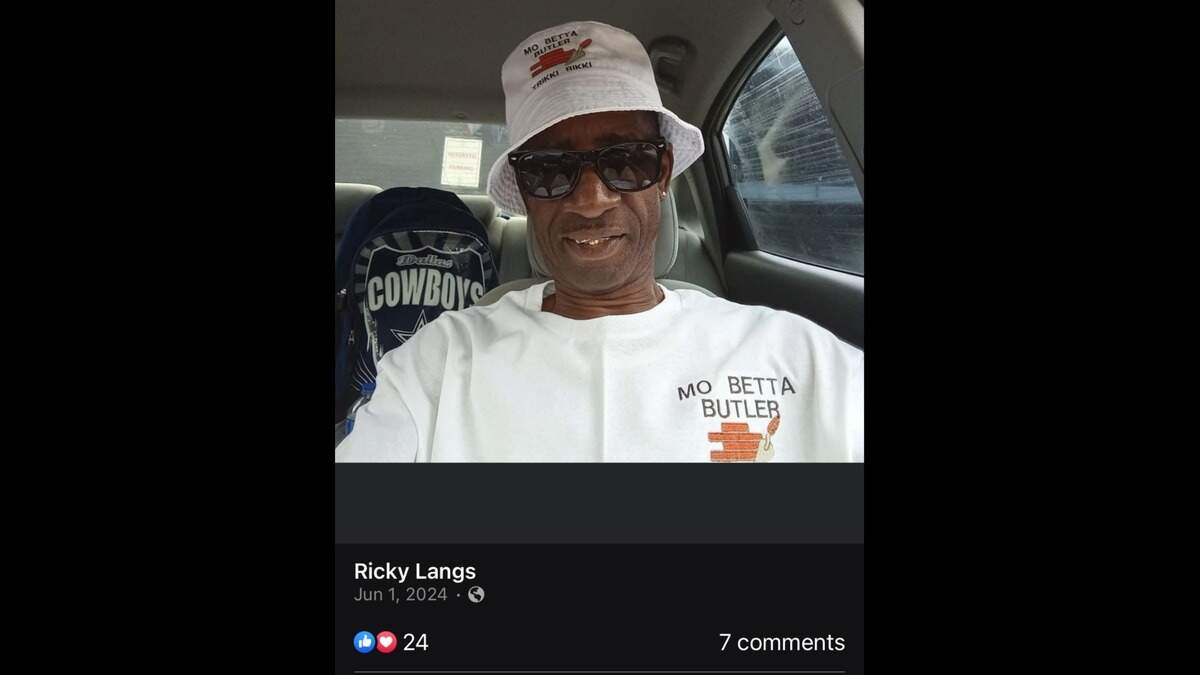
At a trial last month, a state district court jury in Tarrant County could not agree on whether Koby Burkhart was guilty or innocent of murder in a killing at a traffic light in southeast Fort Worth.
After a full day of deliberation on a Friday and a return to the jury room for a couple of hours on the Monday that followed, the panel hung on the indictment’s top count in the January 2025 death of Ricky Langs in Stop Six. Judge George Gallagher declared a mistrial.
Police concluded that in rage, Burkhart, then 22, shot to death Langs, who was 62, for honking a car’s horn at him.
In an interview with homicide detectives, Burkhart said that Langs pointed a gun at him when Burkhart stopped beside the elder man’s sedan. Burkhart could not describe the gun beyond that it was “probably black.” Police did not find a gun in Langs’ car, a Hyundai Elantra.
Burkhart believed wholeheartedly that there was a gun in Langs’ car, defense attorney Kathy Lowthorp argued. In the period that elapsed between the shooting and when police officers searched Langs’ car, there was time for a gun to disappear, Lowthorp asserted.
Burkhart was justified by self-defense and defense of Burkhart’s girlfriend, who was a passenger in Burkhart’s Chevrolet Equinox, Lowthorp argued. Judge Gallagher included an advisory on those defenses in the jury’s instructions at Lowthorp’s request.
The jury also considered Burkhart’s indictment on three counts of tampering with evidence in what prosecutors Lucas Allan and Devon Mann argued was an attempt to cover up a criminal killing. Burkhart hid his gun, an AR pistol, in crawl space under the house where he was living, covered the Equinox with a tarp and removed its license plate, the jury found as it returned a guilty verdict on the tampering counts.
The Tarrant County Criminal District Attorney’s Office has not publicly announced whether it intends to retry Burkhart on murder.
Burkhart elected to have a judge, rather than the jury, assess punishment on the tampering with evidence counts.
At the end of a hearing on Thursday, Judge Gallagher sentenced Burkhart to 10 years in prison on each of the three tampering counts. Burkhart, who is 24, will serve the terms concurrently and become eligible for parole after he serves five years. The range of punishment for the offense is two to 10 years in prison.
Gallagher heard evidence presented by the state that Burkhart had run afoul of jail rules since his arrest in the homicide, has misdemeanor marijuana possession and vehicle burglary convictions and, as a juvenile, a delinquency finding in a sexual assault case in which the victim was the 12-year-old sister of Burkhart’s girlfriend. Burkhart was 15.
Because Burkhart had no felony conviction in his history, he was eligible for probation.
“Removing the murder for one minute,” Lowthorp began her discussion of Burkhart jail policy skirmishes, referencing instances in which he reached near the body of a detention sergeant for a tablet, was jubilant as he jumped in a jail day room and attempted to stick paper clips or razor blades in a tablet charging station.
Lowthorp argued that her client was a strong candidate for probation on the tampering with evidence counts. He successfully completed, in his juvenile case, sex offense probation terms, including counseling and polygraph testing.
Burkhart’s mother, Kristy Lambert, testified that her son had been diagnosed with ADHD and left Mansfield Legacy High School in 10th grade during his time on sex offense probation. Flyers with Burkhart’s photo and the term alleged rapist were posted at the school and in neighborhoods.
Defense attorney Shelby Barrett also was retained to represent Burkhart.
Prosecutor Allan argued that Burkhart has a history of assigning blame for his conduct to others and does not absorb responsibility when he should.
“This is a dead body-involved tampering with evidence,” Allan observed in his argument. Burkhart merited 10-year terms, Allan said.
Video recordings from Langs’ dashboard camera and surveillance cameras and license plate readers led Fort Worth police homicide detectives to connect Burkhart to the killing, according to an arrest warrant affidavit.
At the roundabout at East Rosedale Street and South Ayers Avenue, Langs stopped his car and honked at Burkhart, who was in front of him.
After that, the videos showed Burkhart’s Equinox following Langs’ Elantra, a detective wrote in the affidavit. Both vehicles stopped at the traffic light at 6000 East Rosedale, with Langs’ car in the left lane and Burkhart’s SUV in the right lane.
The detective noted that Burkhart left more than an entire car length of space in front of him. After the traffic light turned green, as Burkhart slowed down to stay next to Langs’ car, two gunshots can be heard on Langs’ dashboard camera video, the detective wrote in the affidavit.
Langs lost control of his car and ended up in the median between East Loop 820 and its service road. The videos show that Burkhart drove away, according to the affidavit.
Burkhart told detectives that he took a pistol from the floorboard behind his seat because he was afraid that Langs would shoot him, and Burkhart fired two shots and drove away, according to the affidavit.
Burkhart chose not to testify in the guilt-innocence trial phase or at the punishment hearing. Judge Gallagher was sitting by assignment in the 371st District Court.
This story was originally published July 10, 2026 at 6:19 PM.