
Blind woman from North Texas bringing Braille displays, laptops to Ukrainian refugees
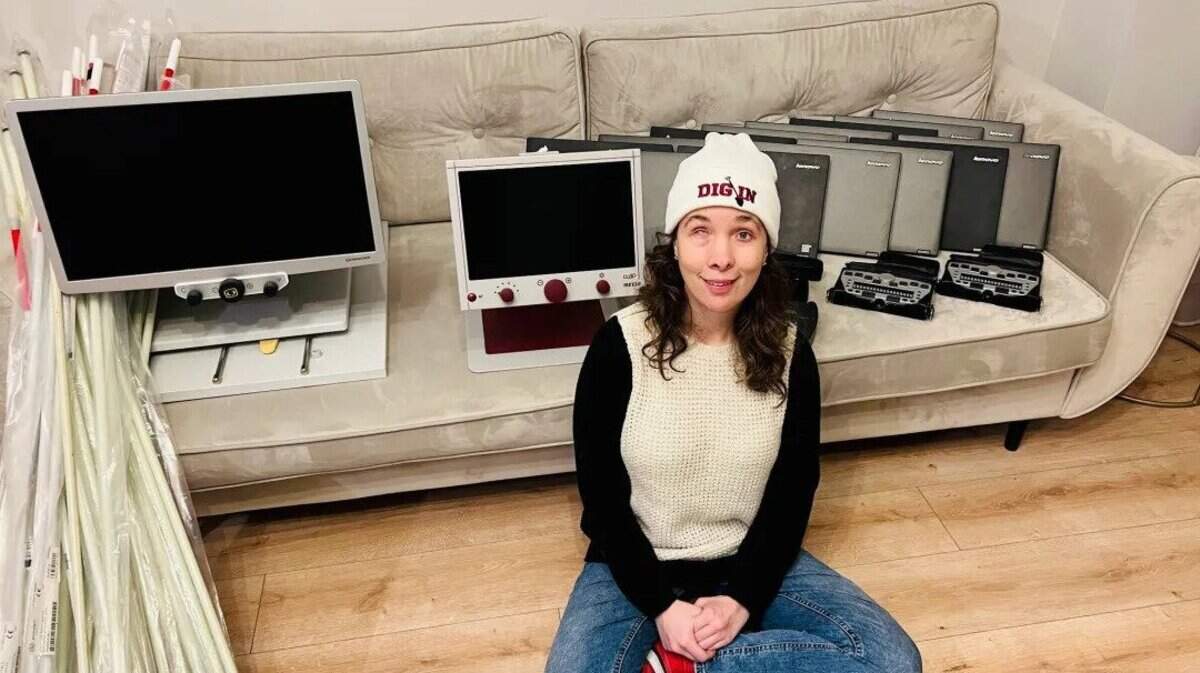
When Laurel Wheeler got word that blind people fleeing the war in Ukraine needed white canes, laptop computers and smart phones, she marshaled volunteers to help gather donations and equipment and flew to Poland on short notice.
Wheeler, who is also blind, is originally from North Richland Hills and now lives in Helsinki, Finland, where she is pursuing a master’s degree in Russian studies.
Wheeler took a leap of faith and flew to Warsaw last week, bringing around $25,000 worth of laptops, smart phones and canes for refugees staying in Warsaw and at schools for the blind throughout Poland.
She met blind refugees who got out of Ukraine by either making their way to train stations, where strangers helped them board trains bound for Poland, or through volunteers who drove them to Warsaw.
She said there are people with disabilities who are too afraid to leave because they think they might be killed trying, she said.
“The ones who make it are the bravest ones. They are the ones that have the best social media skills and the best travel skills,” Wheeler said.
Wheeler knows and understands the struggles that blind people throughout the world face when getting technology such as laptops, and Braille displays to move forward with school and work. She started the Laurel Wheeler Foundation in 2017 to provide a wide range of items such as slates and styluses, (used to write Braille) white canes and computers.
“As a blind person, I understand how important these tools are,” she said. “You would ask, Why give a refugee a laptop? For a blind person, it’s crucial because they have to get information and fill out paperwork for countries to get services where they are going. I understand how much an immediate difference this technology makes.”
Living in Finland
Wheeler’s interest in international affairs began when she was a child. Wheeler was 12, and her family hosted a Ukrainian exchange student, Olga Mahler, who is also blind. They became like sisters, Wheeler said, and they worked together through Wheeler’s foundation to help blind people in Russia and other countries.
She graduated from the University of Oklahoma with a degree in Russian and decided to sell everything and move to Helsinki to start the master’s program.
Then, the pandemic hit, and she put her plans on hold. When countries started lifting COVID-19 restrictions, Wheeler was ready to expand her foundation work to Uganda and other countries. Then, the war started in Ukraine.
Her longtime friend said she needed help getting supplies for blind refugees.
Wheeler said she put out the call for donations, and got equipment from a Finnish company.
She still wasn’t sure how she was going to get to the airport with over 100 pounds of equipment. So, she put the word out on social media and got a ride to the Helsinki airport.
Wheeler said she is concerned that nongovernmental organizations that provide food, clothing and other assistance for refugees don’t understand that the disabled have specific needs.
“We need NGO’s to be flexible. We need them to provide things that are valid that may not be necessary for able-bodied refugees,” she said. “In a society where you’ve made so many adjustments for COVID, why can’t you make adjustments to serve disabled refugees.”
Meeting blind refugees
Wheeler posted videos on her blog describing what it was like meeting people, including Antonina, a mom who fled with her two children to the Laski Center for the Blind in Poland.
Antonina explained that one of her sons is “severely” visually impaired and was doing well at the school for the blind in Kharkiv, but then the bombing started.
Antonina said she hid in a church before escaping to Poland.
Antonina hopes her son will do well in Laski.
In Warsaw, Wheeler also met a couple from Kyiv, Olga and Denys. She gave them an iPhone and a Braille display.
Olga teaches English and Denys is a translator and proof reader. The equipment means they can continue doing their work and keep up with critical information.
Wheeler also got a Braille printer for a blind journalist working in western Ukraine.
Wheeler said she is planning another trip to Poland next month to bring more equipment to refugees.
“When I moved to Finland from the U.S., I sold everything and started over without knowing anyone in Finland,” she said. “I did all of that in peace time, and it was hard. I can’t imagine doing that in war time. These people didn’t have that option. I knew my destination. They had no time to plan and don’t know their final country where they will be.”