
Bedford girl’s fossil flies on maiden voyage of NASA craft
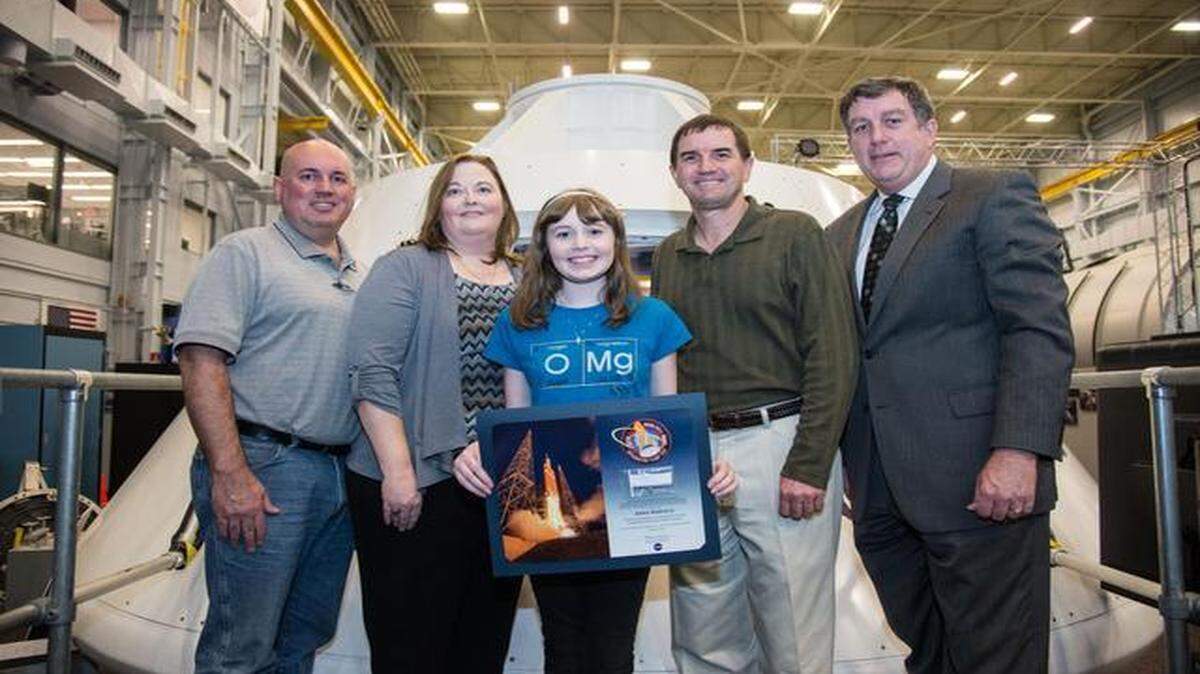
Seventh-grade student Anna Marceca is a self-described fossil hunter who owns a relic from the past that was included in Orion’s first flight test.
When Anna was 9, she found a dime-sized fossil called a Crinoid Stem at Mineral Wells Fossil Park. She decided to ask NASA to take her finding into space.
NASA listened.
Anna, now 12, found out in February that her fossil was included in the December unmanned mission Orion’s Exploration Flight Test-1, Orion EFT-1. The Orion is a new spacecraft designed to carry humans farther into space than ever before, according to NASA. Space journeys could include visits to Mars or an asteroid.
“That’s the highest, I think, a fossil has left Earth,” Anna said. “I think that’s really cool.”
Anna, a student at Bedford Junior High School, caught the attention of NASA officials in early 2012 during a public viewing of an Orion test prototype at American Airlines Center, said Barbara Zelon, communications manager for the Orion program.
Zelon said NASA officials noticed Anna because she wore a homemade space helmet.
“She looked adorable in it,” Zelon said. “It got our attention.”
‘A neat surprise’
Back in 2012, Anna was prepared to petition NASA.
Anna had her dime-size fossil and an explanation for NASA: “Crinoids are fossilized marine life from the Pennsylvanian Age, about 300 million years ago. I think it would be awesome if this fossil went into space because fossils are so old we can only imagine what life was like then, and space exploration is so new we can only imagine what will be discovered.”
Time passed and in December Anna’s fossil went into space. The Marcecas learned about it after the fossil returned to Earth, Anna’s mom, Robin Marceca, said.
“That was a neat surprise for her,” she said.
The flight, Orion’s first trip in space, is described as a major step in the return to human deep-space exploration. The trip included mementos and keepsakes — more than 7,400 items, according to Lockheed Martin and NASA. The two entities worked together to manage the ancillary items manifest.
Several storage lockers on the Orion were packed with interesting items. Anna’s fossil traveled among flags, coins, pins and a Tyrannosaurus rex tooth from the Denver Museum of Nature & Science. Twenty-four hours and 40 minutes of the Pharrell Williams song Happy was included to represent the equivalent of a Martian day.
A love for science
In February, the Marcecas were treated to a behind-the-scenes tour at NASA’s Johnson Space Center in Houston. Anna got her fossil back and a plaque for her room. Her visit was featured in a report on the Johnson Space Center Features website.
The entire experience builds on Anna’s plan to be a scientist when she grows up.
Anna enjoys paleontology — the study of fossils — and likes astronomy too, said her father, Dave Marceca.
“She really loves fossil hunting,” he said. “She has an eye for it.”
The experience also promotes hands-on learning, said Wanda Horton, a homebound teacher who helps Anna stay on track in school while she recuperates from a rare liver disease.
“I think that NASA sending Anna’s fossil is a great way to encourage other students to share her love for science and use their imagination to see what they can do,” Horton said.
At Bedford Junior High, Anna’s fossil got attention.
“A lot of my friends don’t believe me. They are like: ‘Oh, yeah right,’” Anna said.
So to prove a point, Anna recently arrived to her lunch table with pictures of the fossil and her trip to the Johnson Space Center.
“Are you serious?” they asked.
“Yes,” Anna responded.
Anna’s fossil is now kept in the family home, Robin Marceca said, where they often glance at it and wonder about its space journey.
“Wow, if you could talk,” she said with a chuckle to the fossil.
Diane Smith, 817-390-7675
Orion facts
▪ The spacecraft is aimed at ushering a new era of human space exploration.
▪ It is named after one of the largest constellations.
▪ The first unmanned test flight took place in December.
Source: NASA
This story was originally published March 30, 2015 at 1:00 AM with the headline "Bedford girl’s fossil flies on maiden voyage of NASA craft."