Tarrant faith leaders denounce racial disparity in death penalty cases
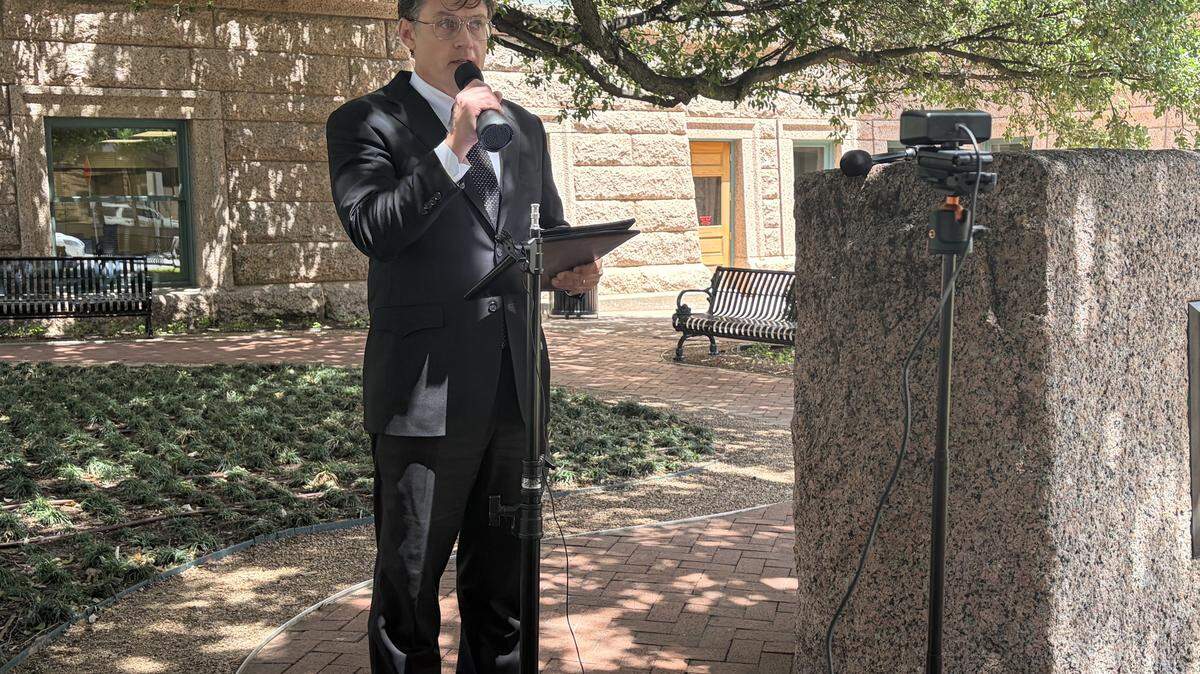
Faith leaders and community activists expressed their concerns on Thursday afternoon following a report that said Tarrant County unfairly targets racial and ethnic minorities in death penalty cases while also frequently threatening the death sentence to leverage plea bargains.
The report, “An Extreme Outlier: Race and the Death Penalty in Tarrant County, the Third Largest County in Texas,” was published by the Texas Defender Service, which describes itself as “dedicated to ending mass incarceration and excessive punishment in Texas through direct representation, policy reform, and public education.”
At a press conference at the Tarrant County Courthouse, the Rev. Ryon Price, the senior pastor of Broadway Baptist Church, said Tarrant County’s pursuit of the death penalty is “shocking in its frequency and absolutely abhorrent in its effect.”
Price says the death penalty is a cruel, unnecessarily vindictive form of punishment, and it disappoints him that Tarrant County leads the charge in the state.
“What is obvious from this report is that Tarrant County is consistently and abusively misusing capital case prosecution as a weapon of persecution against the Black and brown community, this must stop,” Price said. “I and other faith leaders here with me today call upon Tarrant County to end its extreme and unjust pursuit of the death penalty, and commit itself to seeking a more reasonable, ethical and equitable measure of justice.”
Pamela Young, executive director of United Fort Worth, compared the report to other Tarrant County issues, such as jail deaths, the Commissioners Court redistricting that likely flipped a Democrat’s seat, and voter suppression efforts, such as when commissioners tried to reduce the number of voting locations in 2024. Young called out registered Tarrant County voters, saying no one will come to save them except themselves, and that the best way to do it is by voting.
“Our consistent voting is the only thing that can turn Tarrant County into a government of intentional care instead of one of intentional racial violence,” Young said. “Every time the polls are open, we have to show up informed and ready to vote to literally save the lives of our neighbors.”
The report found Tarrant County has accounted for 23% of death penalty trials in Texas since 2020, even though it has 7% of the state’s population. The report says 92% of the death sentences sought by Tarrant County prosecutors since 2012 have been against racial and ethnic minorities, even though 40% of Tarrant County’s population is white.
Additionally, the report says that out of 431 capital murder trials in Tarrant County over a 20-year period, 35% resulted in something other than a homicide conviction; 67% of the people charged with capital murder who ended up receiving no jail time were Black; and all seven people acquitted of capital murder by a jury were Black. The Tarrant County District Attorney’s Office disproportionately presses capital murder charges against Black people, but lacks the evidence to win at trial or obtain a capital indictment, which shows that the office’s approach is both “broken and deeply racist,” according to the report.
The District Attorney’s Office also targets Black defendants for the death penalty in “upcharging” or charging harsh crimes beyond what the evidence supports in exchange for plea deals and using death-sentence eligible charges for aggravated burglary or robbery cases during an unplanned murder, the report says.
A death sentence is possible for someone charged with capital murder, but the District Attorney’s Office must choose to seek the death penalty. The county has failed to obtain capital murder convictions in most of its capital cases, and Black defendants were twice as likely as white defendants to receive no jail time or no conviction at all after being charged with capital murder, according to the report.
In a statement, District Attorney Phil Sorrells says, since he took office in January 2023, Tarrant County juries have heard six death penalty trials, and they have returned a death sentence in five.
Sorrells said every capital murder case a police agency files with his office is reviewed for a determination to waive or seek the death penalty.
Of the 109 cases presented by police, Sorrells said he filed an intent to seek the death penalty in eight of them. Two have pleaded guilty in exchange for a sentence of life without parole.
“In making the decision to seek death, I consider the facts of the case, the defendant’s criminal history, the defendant’s likelihood to commit future crime, any known mitigation, and input from the victim’s family,” Sorrells said in the statement. “In making this determination I do not know the race of the defendant. The death penalty laws of this State, the process used in my office, and the resulting trial is not an arbitrary process based on demographics. Every case must be evaluated on its own facts under the law in light of our high burden.”
When the press conference ended, the faith leaders and the Texas Defender Service delivered a signed letter to the District Attorney’s Office to address the issues in the report.
Cantor Sheri Allen, co-founder of the Makom Shelanu Congregation, an inclusive Jewish congregation in Fort Worth that advocates for social justice, says that for the death penalty in Tarrant County to be used exclusively on communities of color shows the practice of choosing who is charged with it is flawed and severely broken.
“Tarrant County needs to do better, society needs to do better, we need to do better,” Allen said.
This story was originally published May 7, 2026 at 4:46 PM.