How a local Bedford group uses its creativity to bring joy to Alzheimer’s patients
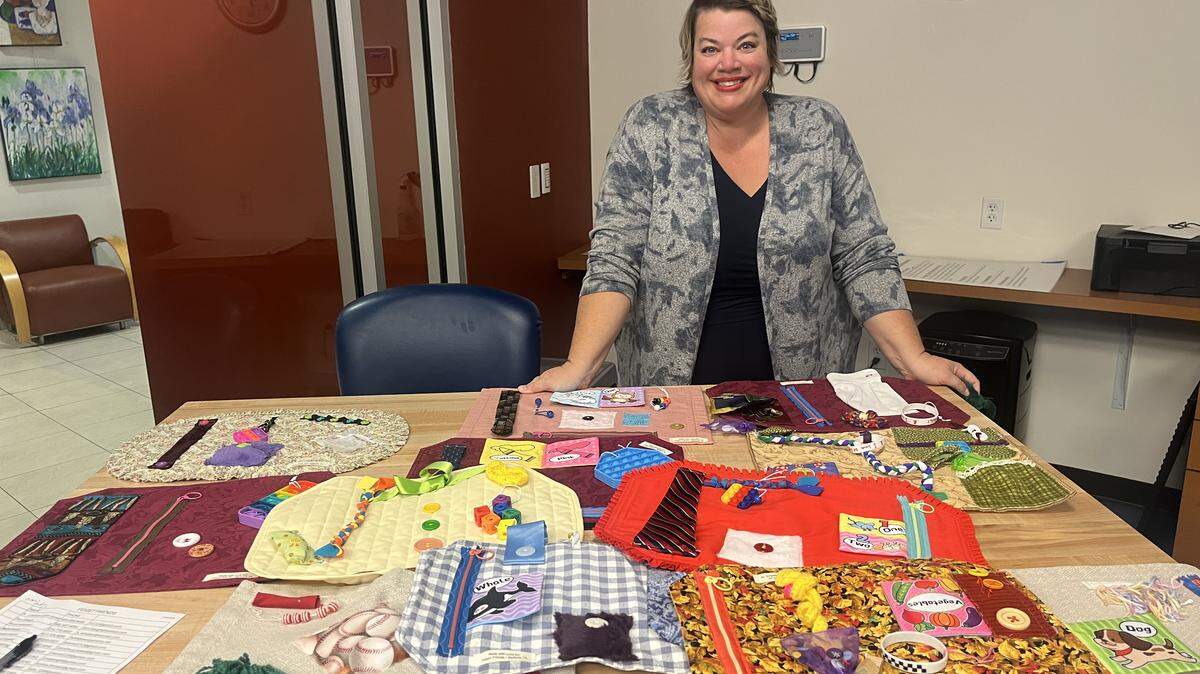
Katelyn Wilkening picked out a book with crinkly pages, a little bag of stones and a strip of fuzzy fabric, and arranged them just so on a rectangular piece of fabric. Later, she would sew the items to the fabric, creating a small playground for idle hands.
Wilkening was making a fidget mat, a fabric mat with different sensory items that can be used for patients with dementia or Alzheimer’s, the progressive disease that is the most common cause of dementia. Fidget mats give patients with Alzheimer’s something to occupy their hands and their attention.
“We’re trying to give them something to do with their hands,” said Cheryl Wilkening, Katelyn’s mom and an occupational therapist who works with dementia patients. “They get agitated. They get frustrated really easily with their lives.”
The Wilkenings are part of a group of volunteers that meets monthly at the Bedford Public Library to create the mats. The group has made and donated more than 100 mats for memory care centers, said the group’s founder, Lindsey Lyons Jones.
The group was inspired by Lyons Jones’ grandmother, Melba “Toni” Wade, who spent the last decade of her life battling Alzheimer’s. Lyons Jones was one of her primary caretakers, and experienced the challenges that so many caretakers for people with dementia face.
“We just couldn’t keep her safe,” Lyons Jones said. “She would open the front door and let the animals out, she would be up at all hours of the night, just confused and wanting to dig through any door or box she could find.”
Eventually, their family moved Wade into a memory care facility. But once there, Wade still experienced the agitation and boredom common to so many patients with Alzheimer’s, Lyons Jones said. On Facebook, Lyons Jones came across a group that made fidget mats, and decided to try some for her grandmother. She immediately found the mats to be a source of reprieve for both her grandmother and her caretakers.
“If I can do something as simple as this to bring even a second of joy, it’s worth it,” she said.
Wade died in 2020, but Lyons Jones was inspired to start making fidget mats earlier this year when she was looking for ways to connect with her community.
An estimated 7.2 million Americans age 65 and older have Alzheimer’s dementia, or about one in nine Americans in that age group according to the Alzheimer’s Association.
Alzheimer’s expert Dr. Gladys Maestre said fidgeting is a common symptom among those with Alzheimer’s.
“Most of the time it’s because of anxiety,” Maestre said. “And most of this anxiety might be related to loneliness or to being bored.”
Sometimes fidgeting might also be related to medications used for Alzheimer’s, Maestre said.
Maestre is the director of the Alzheimer’s Disease Resources Center for Minority Aging Research at the University of Texas Rio Grande Valley School of Medicine. Maestre said that although fidget mats themselves haven’t been studied as an intervention for Alzheimer’s disease, other similar non-pharmacological interventions have been shown to have a positive effect on those with the disease.
On a recent Sunday in Bedford, about a dozen volunteers gathered with Lyons Jones to make fidget mats. Those gathered brought different objects, like cookie cutters, buttons, zippers, ties, and more, to sew onto the mats. For this group, no scrap of fabric or old object is trash; everything can be turned into something for patients to fidget with.
How to get involved
Fidget Friends meets monthly at the Bedford Public Library. Its next meeting is at 2 p.m. Jan. 11.